 Add to Chrome
 Add to Firefox
 Add to Edge
LLMs Can Predict Failure Risk, But Struggle to Predict Which Collaboration Protocol Pays Off: Cost-Aware Protocol Routing Across Reasoning Tasks
Aug 14, 2026
Multi-agent large language model (LLM) systems can improve reasoning by spending more computation, but deployment requires deciding when extra collaboration is worth its cost. We isolate this decision by running every problem under four protocols while holding the solver fixed within each setting: direct solving (Baseline), iterative self-correction (Single), planner-executor-reviewer collaboration (PER), and multi-agent deliberation (Broadcast). The primary benchmark comprises 4,181 competition-level math problems; paired robustness checks cover four benchmarks spanning competition math, biology, and broader science with two solver families. Across fixed policies, trained routers, and frozen LLM routers, conservative policies under-escalate, whereas higher-solve frozen routers often over-escalate. A post-answer, pre-collaboration gpt-oss-120b probe ranks Baseline failures with 0.8847 AUROC (4,151 parseable cases; 95% CI [0.8732, 0.8955]). The same score remains informative for predicting whether any collaboration helps (0.7683 AUPRC), but is much weaker for identifying PER- or Broadcast-specific value (0.1674 and 0.1041 AUPRC). Separately, the pre-answer self-confidence gate reaches 78.0% solve at 45K tokens, compared with 73.8% at 71.3K for a frozen gpt-oss-120b router and 92.4% for a retrospective fixed-order oracle. Across 10 paired model-condition settings, the oracle adds 23.2-58.3 points of retrospective coverage over Baseline, but protocol profiles vary by task. In the six settings with held-out router evaluations, oracle gaps remain 18.5-28.9 points. Confidence can therefore support initial escalation, while protocol-specific cost-aware routing remains unresolved.

Wrong but Useful: Trajectory Value Beyond Answer Correctness in Multi-Agent Messages
Aug 14, 2026Multi-agent reasoning systems often use agreement, confidence, or automated scores to decide which messages should shape a final answer. Such filtering assumes that a message likely to be correct is also worth keeping. Yet a wrong answer can contain a useful decomposition, constraint, or scientific principle. We test this distinction with Diverse Hypothesis Deliberation (DHD), a controlled measurement protocol that caches five independently generated messages and replays the same downstream solver, called the integrator, with each message available or hidden. The replay comparison measures a message's trajectory value: whether making the message available helps or harms subsequent reasoning. Across five mathematics and science benchmarks and two openly available model families, gpt-oss-120b and gemma-4-31B-it, wrong-helpful messages appear in every benchmark-model combination. Among wrong-answer messages that change final correctness, more than four in ten changes are helpful in each model. Controlled repeats show that the number of repeatable message effects is unlikely to arise from replay variation alone (p=0.0002). A focused intervention on repeatable wrong-helpful messages finds that the complete message works best, while retaining its reasoning preserves more success than retaining only its answer; the source of the complete-message advantage remains open. Within the same problem, repeated trajectory-value evidence also identifies a better keep-or-remove choice than answer correctness alone. Answer correctness is therefore informative but does not determine trajectory value. DHD measures this missing property and produces reusable labels for learning when agents should listen.
Precise but Uncoupled: Reviewer Precision Does Not Guarantee Critique Uptake in Multi-Agent Math Reasoning
Jul 16, 2026Many math- and science-oriented agent systems use hierarchical designs with specialized reviewer roles, assuming that a dedicated review stage should help turn wrong candidates into correct ones. We test this assumption on 4,181 verifier-grounded Omni-MATH problems using matched gpt-oss-120b actors. Collaboration adds little on the easiest tiers, but from tier 4 onward the gains open sharply; in this harder regime, broadcast-style peer discussion reaches higher final accuracy than a planner-executor-reviewer pipeline (PER). We ask whether this gap is explained by reviewer quality or by whether critique changes the next answer the protocol carries forward. It is not explained by reviewer precision alone: PER's reviewer is more precise than broadcast's (0.861 vs. 0.644), yet evaluator-verified useful critique is much less likely to change the next candidate and produces lower reviewer-guided repair. These results show that reviewer detection quality and critique uptake are empirically separable. Within matched PER interventions, forcing explicit acknowledgment lowers final accuracy, while embedding reviewer guidance directly in the solver's working context partially improves follow-through without closing the gap. Overall, reviewer-centric evaluation can overstate system quality: a protocol may spot errors well yet still fail to solve more problems if it does not act on those critiques.
Who Gets the Reward, Who Gets the Blame? Evaluation-Aligned Training Signals for Multi-LLM Agents
Nov 17, 2025Large Language Models (LLMs) in multi-agent systems (MAS) have shown promise for complex tasks, yet current training methods lack principled ways to connect system-level evaluation with agent-level and message-level learning. We propose a theoretical framework that unifies cooperative game-theoretic attribution with process reward modeling to transform system evaluation into agent credit and then into response-level signals. Unlike prior approaches that rely only on attribution (e.g., Shapley) or step-level labels (e.g., PRM), our method produces local, signed, and credit-conserving signals. In success cases, Shapley-based credit assignment fairly allocates outcomes across agents and is refined into per-message rewards that promote cooperation while discouraging redundancy or sabotage. In failure cases, first-error localization yields repair-aware preferences that penalize harmful steps while rewarding corrective attempts. The resulting signals are bounded, cooperative, and directly compatible with reinforcement-based or preference-based post-training, providing a unified and auditable pathway from global evaluation to local supervision in LLM multi-agent training. Our contribution is conceptual: we present a theoretical foundation and training signals, leaving empirical validation for future work.
Employing Artificial Intelligence to Steer Exascale Workflows with Colmena
Aug 26, 2024
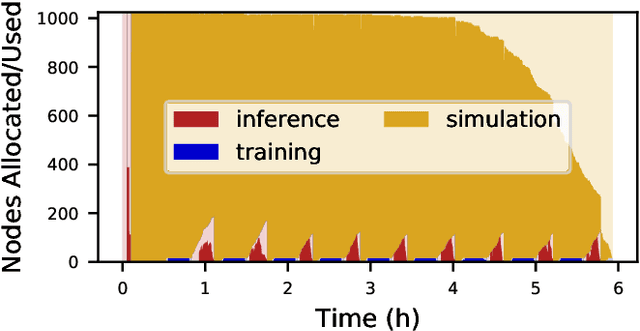


Computational workflows are a common class of application on supercomputers, yet the loosely coupled and heterogeneous nature of workflows often fails to take full advantage of their capabilities. We created Colmena to leverage the massive parallelism of a supercomputer by using Artificial Intelligence (AI) to learn from and adapt a workflow as it executes. Colmena allows scientists to define how their application should respond to events (e.g., task completion) as a series of cooperative agents. In this paper, we describe the design of Colmena, the challenges we overcame while deploying applications on exascale systems, and the science workflows we have enhanced through interweaving AI. The scaling challenges we discuss include developing steering strategies that maximize node utilization, introducing data fabrics that reduce communication overhead of data-intensive tasks, and implementing workflow tasks that cache costly operations between invocations. These innovations coupled with a variety of application patterns accessible through our agent-based steering model have enabled science advances in chemistry, biophysics, and materials science using different types of AI. Our vision is that Colmena will spur creative solutions that harness AI across many domains of scientific computing.
A Comprehensive Performance Study of Large Language Models on Novel AI Accelerators
Oct 06, 2023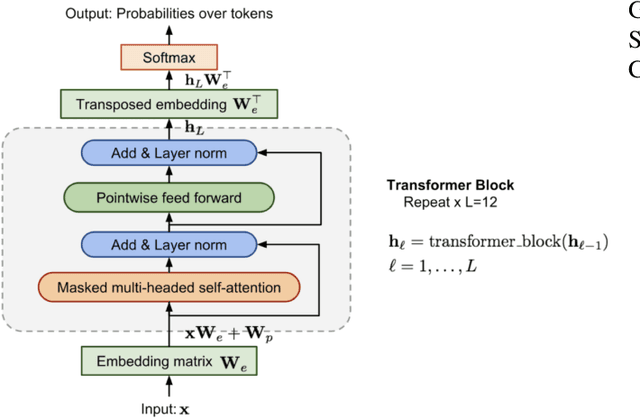
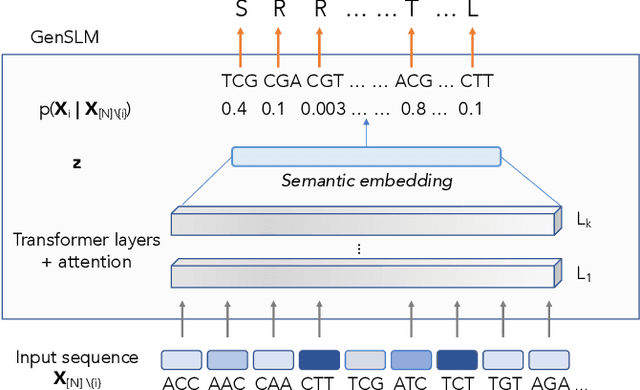


Artificial intelligence (AI) methods have become critical in scientific applications to help accelerate scientific discovery. Large language models (LLMs) are being considered as a promising approach to address some of the challenging problems because of their superior generalization capabilities across domains. The effectiveness of the models and the accuracy of the applications is contingent upon their efficient execution on the underlying hardware infrastructure. Specialized AI accelerator hardware systems have recently become available for accelerating AI applications. However, the comparative performance of these AI accelerators on large language models has not been previously studied. In this paper, we systematically study LLMs on multiple AI accelerators and GPUs and evaluate their performance characteristics for these models. We evaluate these systems with (i) a micro-benchmark using a core transformer block, (ii) a GPT- 2 model, and (iii) an LLM-driven science use case, GenSLM. We present our findings and analyses of the models' performance to better understand the intrinsic capabilities of AI accelerators. Furthermore, our analysis takes into account key factors such as sequence lengths, scaling behavior, sparsity, and sensitivity to gradient accumulation steps.
Cloud Services Enable Efficient AI-Guided Simulation Workflows across Heterogeneous Resources
Mar 15, 2023Applications that fuse machine learning and simulation can benefit from the use of multiple computing resources, with, for example, simulation codes running on highly parallel supercomputers and AI training and inference tasks on specialized accelerators. Here, we present our experiences deploying two AI-guided simulation workflows across such heterogeneous systems. A unique aspect of our approach is our use of cloud-hosted management services to manage challenging aspects of cross-resource authentication and authorization, function-as-a-service (FaaS) function invocation, and data transfer. We show that these methods can achieve performance parity with systems that rely on direct connection between resources. We achieve parity by integrating the FaaS system and data transfer capabilities with a system that passes data by reference among managers and workers, and a user-configurable steering algorithm to hide data transfer latencies. We anticipate that this ease of use can enable routine use of heterogeneous resources in computational science.
Colmena: Scalable Machine-Learning-Based Steering of Ensemble Simulations for High Performance Computing
Oct 06, 2021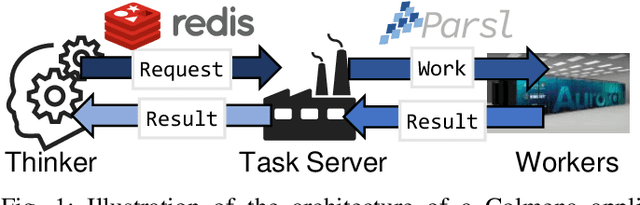
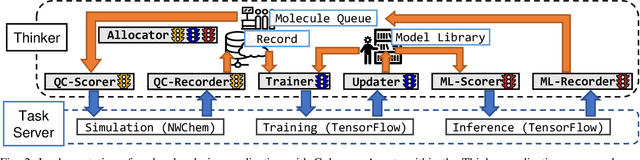
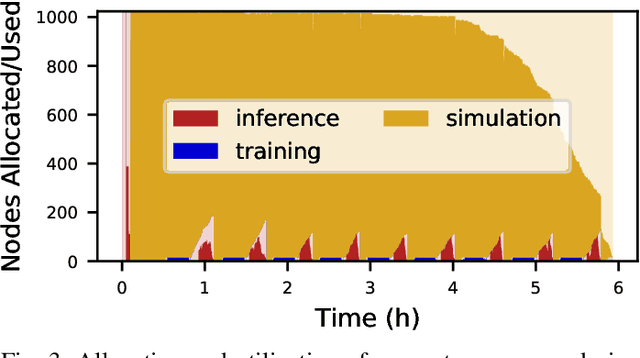
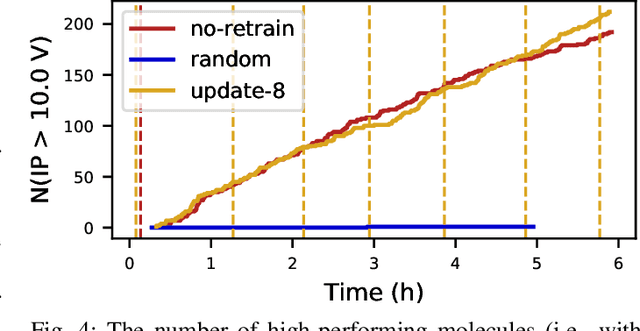
Scientific applications that involve simulation ensembles can be accelerated greatly by using experiment design methods to select the best simulations to perform. Methods that use machine learning (ML) to create proxy models of simulations show particular promise for guiding ensembles but are challenging to deploy because of the need to coordinate dynamic mixes of simulation and learning tasks. We present Colmena, an open-source Python framework that allows users to steer campaigns by providing just the implementations of individual tasks plus the logic used to choose which tasks to execute when. Colmena handles task dispatch, results collation, ML model invocation, and ML model (re)training, using Parsl to execute tasks on HPC systems. We describe the design of Colmena and illustrate its capabilities by applying it to electrolyte design, where it both scales to 65536 CPUs and accelerates the discovery rate for high-performance molecules by a factor of 100 over unguided searches.