 Add to Chrome
 Add to Firefox
 Add to Edge
LLMs Can Predict Failure Risk, But Struggle to Predict Which Collaboration Protocol Pays Off: Cost-Aware Protocol Routing Across Reasoning Tasks
Aug 14, 2026
Multi-agent large language model (LLM) systems can improve reasoning by spending more computation, but deployment requires deciding when extra collaboration is worth its cost. We isolate this decision by running every problem under four protocols while holding the solver fixed within each setting: direct solving (Baseline), iterative self-correction (Single), planner-executor-reviewer collaboration (PER), and multi-agent deliberation (Broadcast). The primary benchmark comprises 4,181 competition-level math problems; paired robustness checks cover four benchmarks spanning competition math, biology, and broader science with two solver families. Across fixed policies, trained routers, and frozen LLM routers, conservative policies under-escalate, whereas higher-solve frozen routers often over-escalate. A post-answer, pre-collaboration gpt-oss-120b probe ranks Baseline failures with 0.8847 AUROC (4,151 parseable cases; 95% CI [0.8732, 0.8955]). The same score remains informative for predicting whether any collaboration helps (0.7683 AUPRC), but is much weaker for identifying PER- or Broadcast-specific value (0.1674 and 0.1041 AUPRC). Separately, the pre-answer self-confidence gate reaches 78.0% solve at 45K tokens, compared with 73.8% at 71.3K for a frozen gpt-oss-120b router and 92.4% for a retrospective fixed-order oracle. Across 10 paired model-condition settings, the oracle adds 23.2-58.3 points of retrospective coverage over Baseline, but protocol profiles vary by task. In the six settings with held-out router evaluations, oracle gaps remain 18.5-28.9 points. Confidence can therefore support initial escalation, while protocol-specific cost-aware routing remains unresolved.

Wrong but Useful: Trajectory Value Beyond Answer Correctness in Multi-Agent Messages
Aug 14, 2026Multi-agent reasoning systems often use agreement, confidence, or automated scores to decide which messages should shape a final answer. Such filtering assumes that a message likely to be correct is also worth keeping. Yet a wrong answer can contain a useful decomposition, constraint, or scientific principle. We test this distinction with Diverse Hypothesis Deliberation (DHD), a controlled measurement protocol that caches five independently generated messages and replays the same downstream solver, called the integrator, with each message available or hidden. The replay comparison measures a message's trajectory value: whether making the message available helps or harms subsequent reasoning. Across five mathematics and science benchmarks and two openly available model families, gpt-oss-120b and gemma-4-31B-it, wrong-helpful messages appear in every benchmark-model combination. Among wrong-answer messages that change final correctness, more than four in ten changes are helpful in each model. Controlled repeats show that the number of repeatable message effects is unlikely to arise from replay variation alone (p=0.0002). A focused intervention on repeatable wrong-helpful messages finds that the complete message works best, while retaining its reasoning preserves more success than retaining only its answer; the source of the complete-message advantage remains open. Within the same problem, repeated trajectory-value evidence also identifies a better keep-or-remove choice than answer correctness alone. Answer correctness is therefore informative but does not determine trajectory value. DHD measures this missing property and produces reusable labels for learning when agents should listen.
Precise but Uncoupled: Reviewer Precision Does Not Guarantee Critique Uptake in Multi-Agent Math Reasoning
Jul 16, 2026Many math- and science-oriented agent systems use hierarchical designs with specialized reviewer roles, assuming that a dedicated review stage should help turn wrong candidates into correct ones. We test this assumption on 4,181 verifier-grounded Omni-MATH problems using matched gpt-oss-120b actors. Collaboration adds little on the easiest tiers, but from tier 4 onward the gains open sharply; in this harder regime, broadcast-style peer discussion reaches higher final accuracy than a planner-executor-reviewer pipeline (PER). We ask whether this gap is explained by reviewer quality or by whether critique changes the next answer the protocol carries forward. It is not explained by reviewer precision alone: PER's reviewer is more precise than broadcast's (0.861 vs. 0.644), yet evaluator-verified useful critique is much less likely to change the next candidate and produces lower reviewer-guided repair. These results show that reviewer detection quality and critique uptake are empirically separable. Within matched PER interventions, forcing explicit acknowledgment lowers final accuracy, while embedding reviewer guidance directly in the solver's working context partially improves follow-through without closing the gap. Overall, reviewer-centric evaluation can overstate system quality: a protocol may spot errors well yet still fail to solve more problems if it does not act on those critiques.
Who Gets the Reward, Who Gets the Blame? Evaluation-Aligned Training Signals for Multi-LLM Agents
Nov 17, 2025Large Language Models (LLMs) in multi-agent systems (MAS) have shown promise for complex tasks, yet current training methods lack principled ways to connect system-level evaluation with agent-level and message-level learning. We propose a theoretical framework that unifies cooperative game-theoretic attribution with process reward modeling to transform system evaluation into agent credit and then into response-level signals. Unlike prior approaches that rely only on attribution (e.g., Shapley) or step-level labels (e.g., PRM), our method produces local, signed, and credit-conserving signals. In success cases, Shapley-based credit assignment fairly allocates outcomes across agents and is refined into per-message rewards that promote cooperation while discouraging redundancy or sabotage. In failure cases, first-error localization yields repair-aware preferences that penalize harmful steps while rewarding corrective attempts. The resulting signals are bounded, cooperative, and directly compatible with reinforcement-based or preference-based post-training, providing a unified and auditable pathway from global evaluation to local supervision in LLM multi-agent training. Our contribution is conceptual: we present a theoretical foundation and training signals, leaving empirical validation for future work.
Arboretum: A Large Multimodal Dataset Enabling AI for Biodiversity
Jun 25, 2024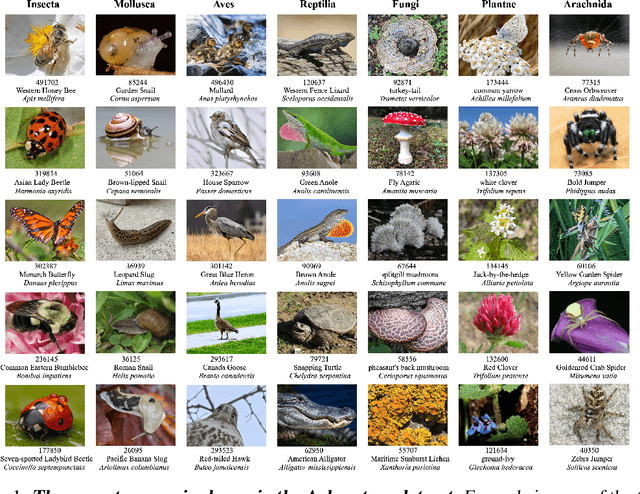

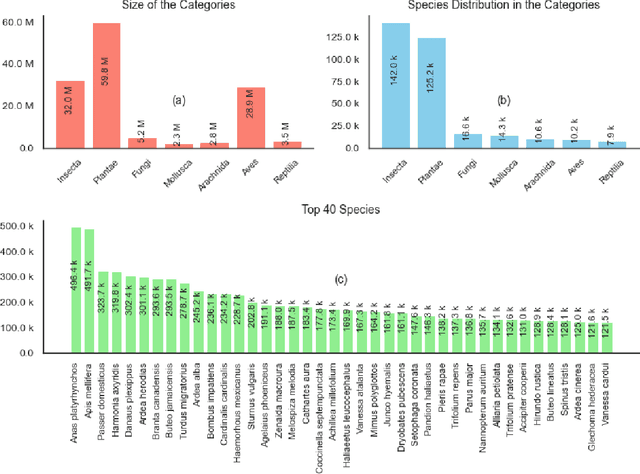

We introduce Arboretum, the largest publicly accessible dataset designed to advance AI for biodiversity applications. This dataset, curated from the iNaturalist community science platform and vetted by domain experts to ensure accuracy, includes 134.6 million images, surpassing existing datasets in scale by an order of magnitude. The dataset encompasses image-language paired data for a diverse set of species from birds (Aves), spiders/ticks/mites (Arachnida), insects (Insecta), plants (Plantae), fungus/mushrooms (Fungi), snails (Mollusca), and snakes/lizards (Reptilia), making it a valuable resource for multimodal vision-language AI models for biodiversity assessment and agriculture research. Each image is annotated with scientific names, taxonomic details, and common names, enhancing the robustness of AI model training. We showcase the value of Arboretum by releasing a suite of CLIP models trained using a subset of 40 million captioned images. We introduce several new benchmarks for rigorous assessment, report accuracy for zero-shot learning, and evaluations across life stages, rare species, confounding species, and various levels of the taxonomic hierarchy. We anticipate that Arboretum will spur the development of AI models that can enable a variety of digital tools ranging from pest control strategies, crop monitoring, and worldwide biodiversity assessment and environmental conservation. These advancements are critical for ensuring food security, preserving ecosystems, and mitigating the impacts of climate change. Arboretum is publicly available, easily accessible, and ready for immediate use. Please see the \href{https://baskargroup.github.io/Arboretum/}{project website} for links to our data, models, and code.
Neural PDE Solvers for Irregular Domains
Nov 07, 2022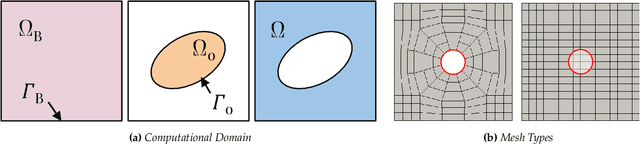
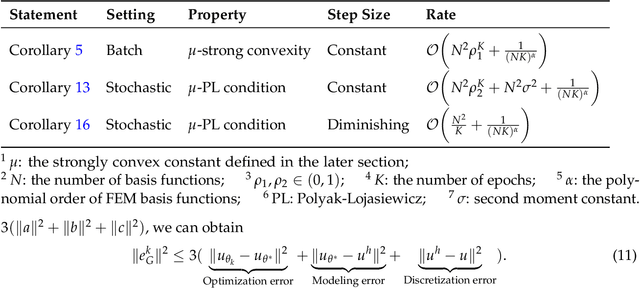
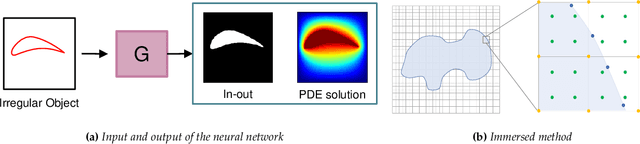
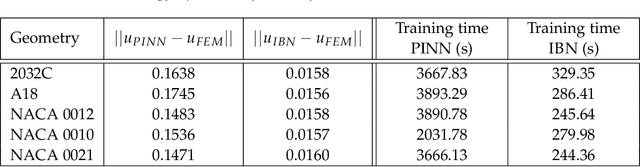
Neural network-based approaches for solving partial differential equations (PDEs) have recently received special attention. However, the large majority of neural PDE solvers only apply to rectilinear domains, and do not systematically address the imposition of Dirichlet/Neumann boundary conditions over irregular domain boundaries. In this paper, we present a framework to neurally solve partial differential equations over domains with irregularly shaped (non-rectilinear) geometric boundaries. Our network takes in the shape of the domain as an input (represented using an unstructured point cloud, or any other parametric representation such as Non-Uniform Rational B-Splines) and is able to generalize to novel (unseen) irregular domains; the key technical ingredient to realizing this model is a novel approach for identifying the interior and exterior of the computational grid in a differentiable manner. We also perform a careful error analysis which reveals theoretical insights into several sources of error incurred in the model-building process. Finally, we showcase a wide variety of applications, along with favorable comparisons with ground truth solutions.