 Add to Chrome
 Add to Firefox
 Add to Edge
Fine-Grained Action Segmentation for Renorrhaphy in Robot-Assisted Partial Nephrectomy
Apr 10, 2026
Fine-grained action segmentation during renorrhaphy in robot-assisted partial nephrectomy requires frame-level recognition of visually similar suturing gestures with variable duration and substantial class imbalance. The SIA-RAPN benchmark defines this problem on 50 clinical videos acquired with the da Vinci Xi system and annotated with 12 frame-level labels. The benchmark compares four temporal models built on I3D features: MS-TCN++, AsFormer, TUT, and DiffAct. Evaluation uses balanced accuracy, edit score, segmental F1 at overlap thresholds of 10, 25, and 50, frame-wise accuracy, and frame-wise mean average precision. In addition to the primary evaluation across five released split configurations on SIA-RAPN, the benchmark reports cross-domain results on a separate single-port RAPN dataset. Across the strongest reported values over those five runs on the primary dataset, DiffAct achieves the highest F1, frame-wise accuracy, edit score, and frame mAP, while MS-TCN++ attains the highest balanced accuracy.

Ada-Tracker: Soft Tissue Tracking via Inter-Frame and Adaptive-Template Matching
Mar 11, 2024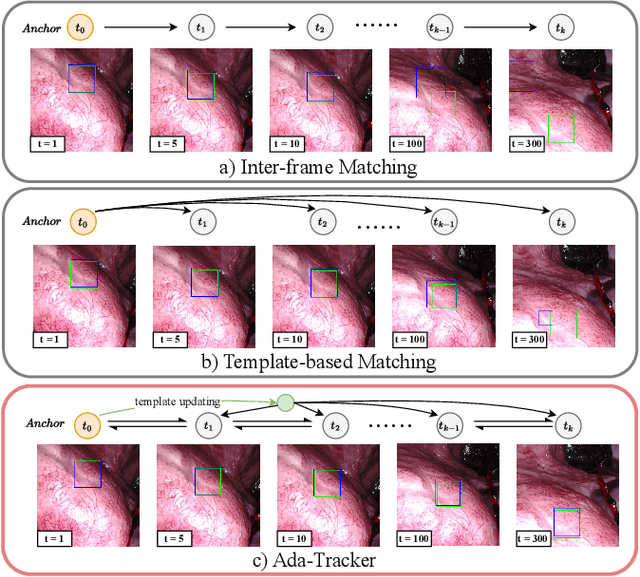
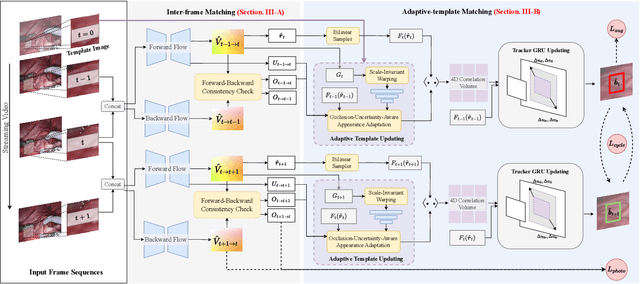
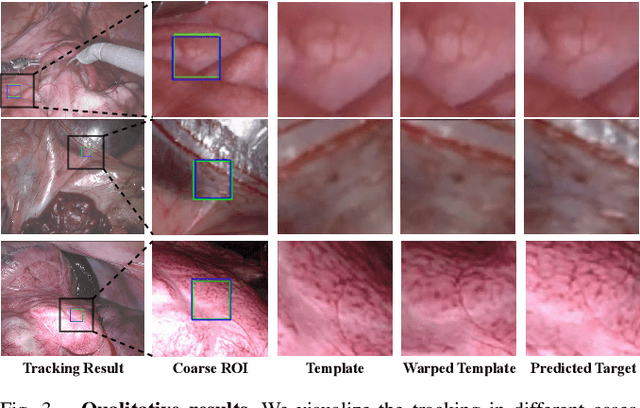
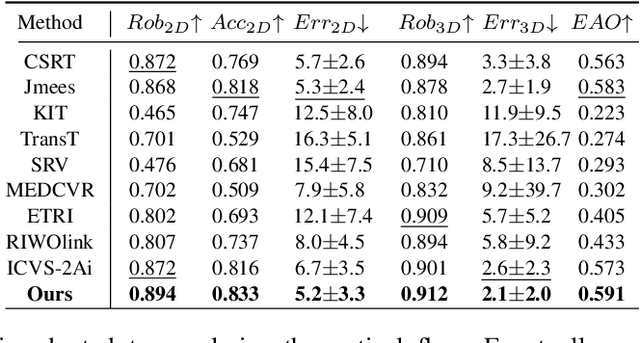
Soft tissue tracking is crucial for computer-assisted interventions. Existing approaches mainly rely on extracting discriminative features from the template and videos to recover corresponding matches. However, it is difficult to adopt these techniques in surgical scenes, where tissues are changing in shape and appearance throughout the surgery. To address this problem, we exploit optical flow to naturally capture the pixel-wise tissue deformations and adaptively correct the tracked template. Specifically, we first implement an inter-frame matching mechanism to extract a coarse region of interest based on optical flow from consecutive frames. To accommodate appearance change and alleviate drift, we then propose an adaptive-template matching method, which updates the tracked template based on the reliability of the estimates. Our approach, Ada-Tracker, enjoys both short-term dynamics modeling by capturing local deformations and long-term dynamics modeling by introducing global temporal compensation. We evaluate our approach on the public SurgT benchmark, which is generated from Hamlyn, SCARED, and Kidney boundary datasets. The experimental results show that Ada-Tracker achieves superior accuracy and performs more robustly against prior works. Code is available at https://github.com/wrld/Ada-Tracker.