 Add to Chrome
 Add to Firefox
 Add to Edge
PalmClaw: A Native On-Device Agent Framework for Mobile Phones
Jul 14, 2026
Large Language Model (LLM) agents have moved beyond generating responses to executing multi-step tasks by calling tools, observing the results, and iteratively deciding the next action. Most agent systems run on desktops or servers, which support tool use and task automation. Mobile devices are also important agent environments because they are widely accessible and contain users' data, sensors, and daily-use applications. Existing mobile agents mainly operate smartphones through graphical user interface (GUI) actions such as tapping, swiping, and typing, which often form long, interface-dependent sequences, cannot directly access device capabilities, and make execution boundaries difficult to define. We present \textbf{PalmClaw}, an open-source agent framework that runs natively on mobile phones and manages the sessions, memory, skills, tools, and agent loop directly on the device. PalmClaw exposes device capabilities as device tools with explicit arguments, structured results, and clearly defined execution boundaries. This design enables agents to use mobile capabilities directly while keeping each action explicit and controlled. Experiments show an 11.5\% relative improvement in task success and a 94.9\% reduction in completion time over the strongest baseline, with lower setup burden and traces illustrating how execution boundaries are applied. Code is available at https://github.com/ModalityDance/PalmClaw.

One Adapts to Any: Meta Reward Modeling for Personalized LLM Alignment
Jan 26, 2026Alignment of Large Language Models (LLMs) aims to align outputs with human preferences, and personalized alignment further adapts models to individual users. This relies on personalized reward models that capture user-specific preferences and automatically provide individualized feedback. However, developing these models faces two critical challenges: the scarcity of feedback from individual users and the need for efficient adaptation to unseen users. We argue that addressing these constraints requires a paradigm shift from fitting data to learn user preferences to learn the process of preference adaptation. To realize this, we propose Meta Reward Modeling (MRM), which reformulates personalized reward modeling as a meta-learning problem. Specifically, we represent each user's reward model as a weighted combination of base reward functions, and optimize the initialization of these weights using a Model-Agnostic Meta-Learning (MAML)-style framework to support fast adaptation under limited feedback. To ensure robustness, we introduce the Robust Personalization Objective (RPO), which places greater emphasis on hard-to-learn users during meta optimization. Extensive experiments on personalized preference datasets validate that MRM enhances few-shot personalization, improves user robustness, and consistently outperforms baselines.
Omni-R1: Towards the Unified Generative Paradigm for Multimodal Reasoning
Jan 14, 2026Multimodal Large Language Models (MLLMs) are making significant progress in multimodal reasoning. Early approaches focus on pure text-based reasoning. More recent studies have incorporated multimodal information into the reasoning steps; however, they often follow a single task-specific reasoning pattern, which limits their generalizability across various multimodal tasks. In fact, there are numerous multimodal tasks requiring diverse reasoning skills, such as zooming in on a specific region or marking an object within an image. To address this, we propose unified generative multimodal reasoning, which unifies diverse multimodal reasoning skills by generating intermediate images during the reasoning process. We instantiate this paradigm with Omni-R1, a two-stage SFT+RL framework featuring perception alignment loss and perception reward, thereby enabling functional image generation. Additionally, we introduce Omni-R1-Zero, which eliminates the need for multimodal annotations by bootstrapping step-wise visualizations from text-only reasoning data. Empirical results show that Omni-R1 achieves unified generative reasoning across a wide range of multimodal tasks, and Omni-R1-Zero can match or even surpass Omni-R1 on average, suggesting a promising direction for generative multimodal reasoning.
Agent-as-a-Judge
Jan 08, 2026LLM-as-a-Judge has revolutionized AI evaluation by leveraging large language models for scalable assessments. However, as evaluands become increasingly complex, specialized, and multi-step, the reliability of LLM-as-a-Judge has become constrained by inherent biases, shallow single-pass reasoning, and the inability to verify assessments against real-world observations. This has catalyzed the transition to Agent-as-a-Judge, where agentic judges employ planning, tool-augmented verification, multi-agent collaboration, and persistent memory to enable more robust, verifiable, and nuanced evaluations. Despite the rapid proliferation of agentic evaluation systems, the field lacks a unified framework to navigate this shifting landscape. To bridge this gap, we present the first comprehensive survey tracing this evolution. Specifically, we identify key dimensions that characterize this paradigm shift and establish a developmental taxonomy. We organize core methodologies and survey applications across general and professional domains. Furthermore, we analyze frontier challenges and identify promising research directions, ultimately providing a clear roadmap for the next generation of agentic evaluation.
Exploring Training and Inference Scaling Laws in Generative Retrieval
Mar 24, 2025Generative retrieval has emerged as a novel paradigm that leverages large language models (LLMs) to autoregressively generate document identifiers. Although promising, the mechanisms that underpin its performance and scalability remain largely unclear. We conduct a systematic investigation of training and inference scaling laws in generative retrieval, exploring how model size, training data scale, and inference-time compute jointly influence retrieval performance. To address the lack of suitable metrics, we propose a novel evaluation measure inspired by contrastive entropy and generation loss, providing a continuous performance signal that enables robust comparisons across diverse generative retrieval methods. Our experiments show that n-gram-based methods demonstrate strong alignment with both training and inference scaling laws, especially when paired with larger LLMs. Furthermore, increasing inference computation yields substantial performance gains, revealing that generative retrieval can significantly benefit from higher compute budgets at inference. Across these settings, LLaMA models consistently outperform T5 models, suggesting a particular advantage for larger decoder-only models in generative retrieval. Taken together, our findings underscore that model sizes, data availability, and inference computation interact to unlock the full potential of generative retrieval, offering new insights for designing and optimizing future systems.
Large Language Models Empowered Personalized Web Agents
Oct 22, 2024

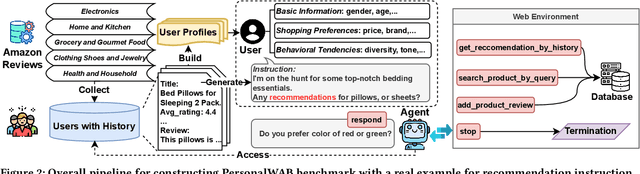

Web agents have emerged as a promising direction to automate Web task completion based on user instructions, significantly enhancing user experience. Recently, Web agents have evolved from traditional agents to Large Language Models (LLMs)-based Web agents. Despite their success, existing LLM-based Web agents overlook the importance of personalized data (e.g., user profiles and historical Web behaviors) in assisting the understanding of users' personalized instructions and executing customized actions. To overcome the limitation, we first formulate the task of LLM-empowered personalized Web agents, which integrate personalized data and user instructions to personalize instruction comprehension and action execution. To address the absence of a comprehensive evaluation benchmark, we construct a Personalized Web Agent Benchmark (PersonalWAB), featuring user instructions, personalized user data, Web functions, and two evaluation paradigms across three personalized Web tasks. Moreover, we propose a Personalized User Memory-enhanced Alignment (PUMA) framework to adapt LLMs to the personalized Web agent task. PUMA utilizes a memory bank with a task-specific retrieval strategy to filter relevant historical Web behaviors. Based on the behaviors, PUMA then aligns LLMs for personalized action execution through fine-tuning and direct preference optimization. Extensive experiments validate the superiority of PUMA over existing Web agents on PersonalWAB.
Revolutionizing Text-to-Image Retrieval as Autoregressive Token-to-Voken Generation
Jul 24, 2024
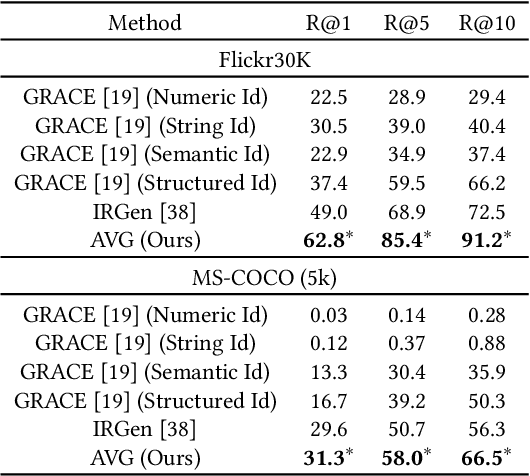
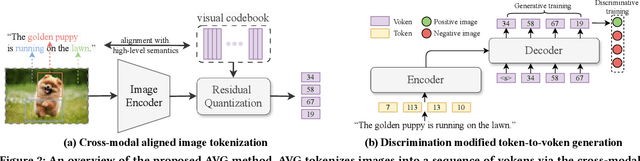
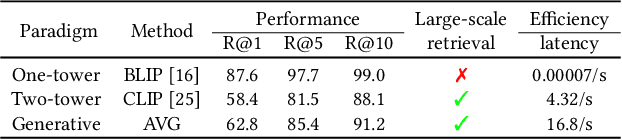
Text-to-image retrieval is a fundamental task in multimedia processing, aiming to retrieve semantically relevant cross-modal content. Traditional studies have typically approached this task as a discriminative problem, matching the text and image via the cross-attention mechanism (one-tower framework) or in a common embedding space (two-tower framework). Recently, generative cross-modal retrieval has emerged as a new research line, which assigns images with unique string identifiers and generates the target identifier as the retrieval target. Despite its great potential, existing generative approaches are limited due to the following issues: insufficient visual information in identifiers, misalignment with high-level semantics, and learning gap towards the retrieval target. To address the above issues, we propose an autoregressive voken generation method, named AVG. AVG tokenizes images into vokens, i.e., visual tokens, and innovatively formulates the text-to-image retrieval task as a token-to-voken generation problem. AVG discretizes an image into a sequence of vokens as the identifier of the image, while maintaining the alignment with both the visual information and high-level semantics of the image. Additionally, to bridge the learning gap between generative training and the retrieval target, we incorporate discriminative training to modify the learning direction during token-to-voken training. Extensive experiments demonstrate that AVG achieves superior results in both effectiveness and efficiency.