 Add to Chrome
 Add to Firefox
 Add to Edge
NDPP-Grasp: Non-Differentiable Physical Plausibility Constraint-Guided Task-Oriented Dexterous Grasp Generation
Jun 01, 2026
Task-oriented dexterous grasp generation aims to produce dexterous grasp poses that are both physically plausible and functionally suitable for specified manipulation tasks. Existing diffusion-based methods often address these two requirements in a decoupled manner: they first train a grasp diffusion model for task alignment and then rely on post-generation refinement to improve physical plausibility. However, this after-the-fact correction strategy applies physical plausibility guidance only once the grasp has already been generated, leaving the generation trajectory itself unguided by physical constraints and potentially leading to suboptimal grasps. To address this problem, we propose a novel framework that directly injects physical plausibility guidance into the denoising process of a task-aligned grasp diffusion model in a practical and effective manner, even when physical plausibility constraints are non-differentiable. This allows physical plausibility to shape grasp generation throughout denoising while preserving task alignment. Extensive experiments demonstrate the efficacy of our framework.

Is Monitoring Enough? Strategic Agent Selection For Stealthy Attack in Multi-Agent Discussions
Mar 22, 2026Multi-agent discussions have been widely adopted, motivating growing efforts to develop attacks that expose their vulnerabilities. In this work, we study a practical yet largely unexplored attack scenario, the discussion-monitored scenario, where anomaly detectors continuously monitor inter-agent communications and block detected adversarial messages. Although existing attacks are effective without discussion monitoring, we show that they exhibit detectable patterns and largely fail under such monitoring constraints. But does this imply that monitoring alone is sufficient to secure multi-agent discussions? To answer this question, we develop a novel attack method explicitly tailored to the discussion-monitored scenario. Extensive experiments demonstrate that effective attacks remain possible even under continuous monitoring, indicating that monitoring alone does not eliminate adversarial risks.
Learning to Generate Cross-Task Unexploitable Examples
Dec 15, 2025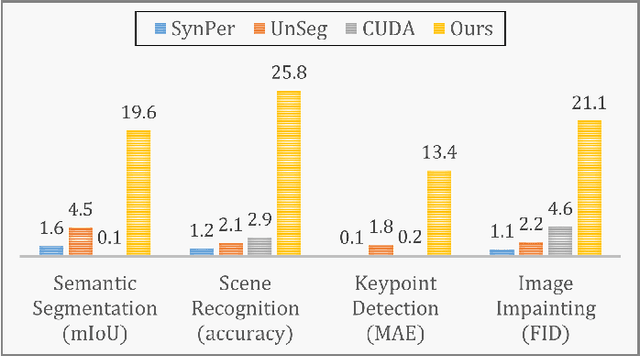
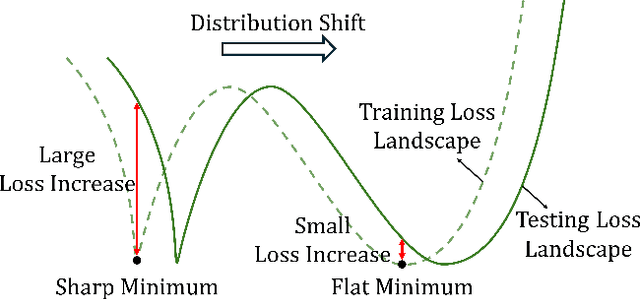
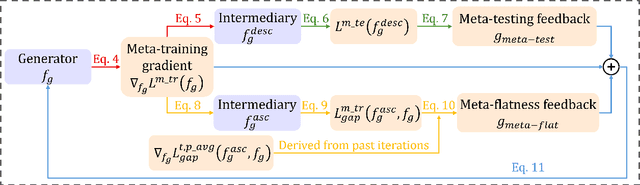
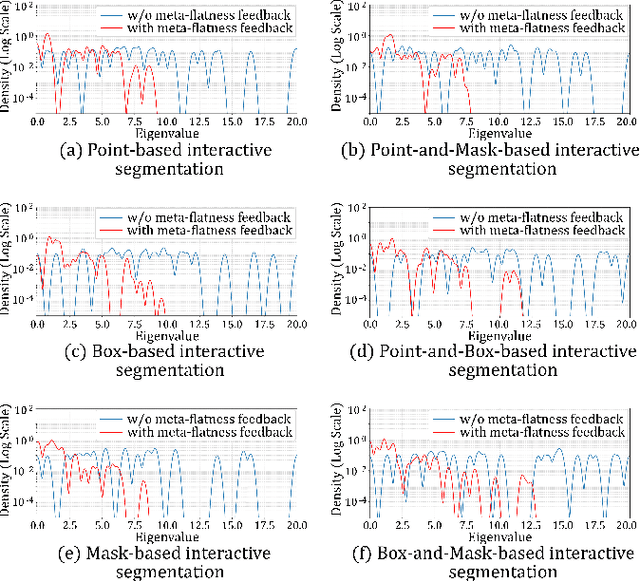
Unexploitable example generation aims to transform personal images into their unexploitable (unlearnable) versions before they are uploaded online, thereby preventing unauthorized exploitation of online personal images. Recently, this task has garnered significant research attention due to its critical relevance to personal data privacy. Yet, despite recent progress, existing methods for this task can still suffer from limited practical applicability, as they can fail to generate examples that are broadly unexploitable across different real-world computer vision tasks. To deal with this problem, in this work, we propose a novel Meta Cross-Task Unexploitable Example Generation (MCT-UEG) framework. At the core of our framework, to optimize the unexploitable example generator for effectively producing broadly unexploitable examples, we design a flat-minima-oriented meta training and testing scheme. Extensive experiments show the efficacy of our framework.
Incorporating GNSS Information with LIDAR-Inertial Odometry for Accurate Land-Vehicle Localization
Mar 29, 2025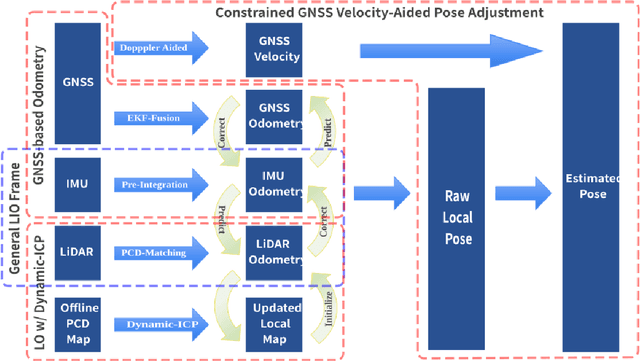
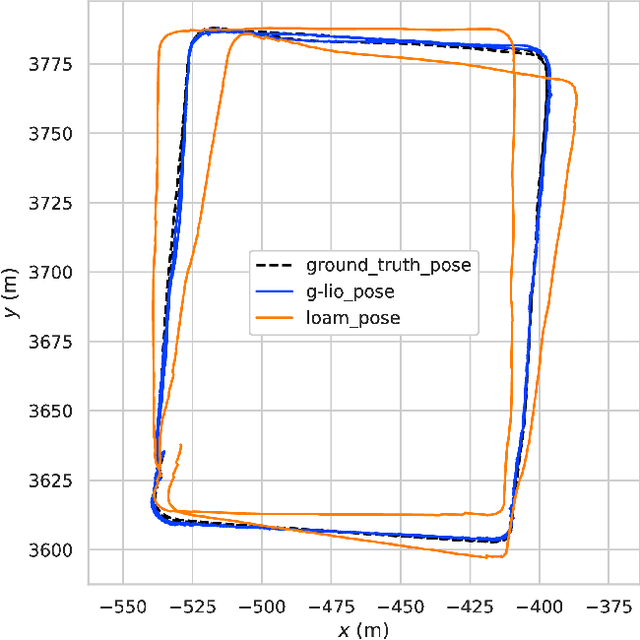
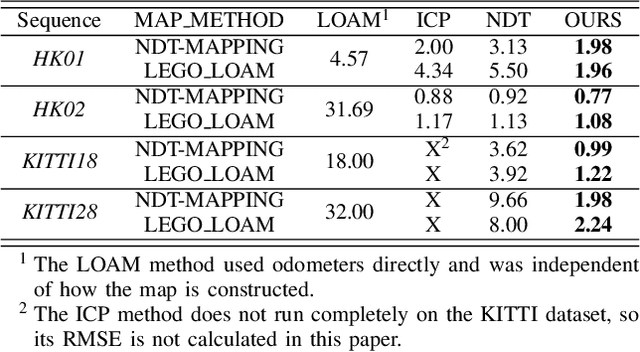
Currently, visual odometry and LIDAR odometry are performing well in pose estimation in some typical environments, but they still cannot recover the localization state at high speed or reduce accumulated drifts. In order to solve these problems, we propose a novel LIDAR-based localization framework, which achieves high accuracy and provides robust localization in 3D pointcloud maps with information of multi-sensors. The system integrates global information with LIDAR-based odometry to optimize the localization state. To improve robustness and enable fast resumption of localization, this paper uses offline pointcloud maps for prior knowledge and presents a novel registration method to speed up the convergence rate. The algorithm is tested on various maps of different data sets and has higher robustness and accuracy than other localization algorithms.
OverlapMamba: Novel Shift State Space Model for LiDAR-based Place Recognition
May 13, 2024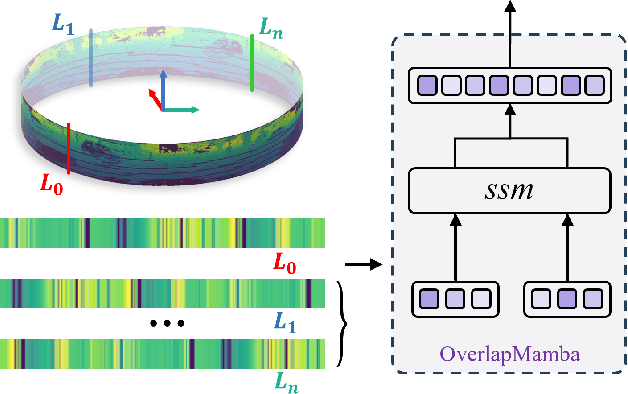
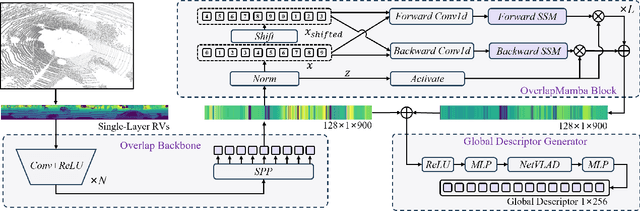

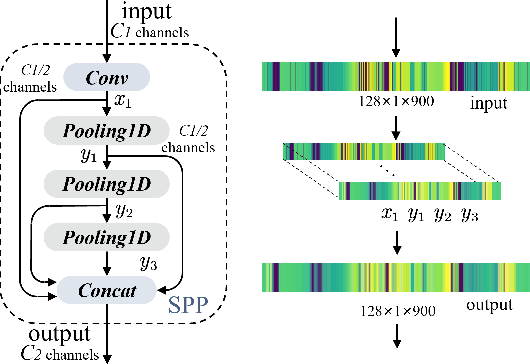
Place recognition is the foundation for enabling autonomous systems to achieve independent decision-making and safe operations. It is also crucial in tasks such as loop closure detection and global localization within SLAM. Previous methods utilize mundane point cloud representations as input and deep learning-based LiDAR-based Place Recognition (LPR) approaches employing different point cloud image inputs with convolutional neural networks (CNNs) or transformer architectures. However, the recently proposed Mamba deep learning model, combined with state space models (SSMs), holds great potential for long sequence modeling. Therefore, we developed OverlapMamba, a novel network for place recognition, which represents input range views (RVs) as sequences. In a novel way, we employ a stochastic reconstruction approach to build shift state space models, compressing the visual representation. Evaluated on three different public datasets, our method effectively detects loop closures, showing robustness even when traversing previously visited locations from different directions. Relying on raw range view inputs, it outperforms typical LiDAR and multi-view combination methods in time complexity and speed, indicating strong place recognition capabilities and real-time efficiency.