 Add to Chrome
 Add to Firefox
 Add to Edge
Training-free Controllable Human Motion Generation under Heterogeneous Constraints
Jul 02, 2026
Training-free controllable motion generation has attracted growing interest for enabling flexible constraint enforcement without constraint-specific training. However, existing training-free methods require constraints to be continuous objective-based with differentiable losses, while many real-world requirements are criterion-based and provide only discontinuous, sparse, or even black-box feedback. In this paper, we propose Motion-Inference-as-Control (MIC), the first training-free motion generation framework that handles both continuous objective-based and criterion-based motion constraints under a shared mechanism. The key idea is to cast diffusion-based motion generation as a stochastic control problem. This perspective not only provides principled and practically effective step-wise control laws that support criterion-based constraints without requiring differentiability and naturally accommodate objective-based constraints as a special case, but also motivates a control-oriented constraint coordination mechanism that adaptively balances and reconciles motion constraints during generation. Experiments across diverse constraint settings demonstrate the effectiveness of our framework.

Spatial-Temporal Expert Learning for Video-based Person Re-identification
Jul 01, 2026Video-based person re-identification (Re-ID) aims to retrieve the same identity in the query video clips from the gallery video clips. To solve this problem, exploiting fine-grained features is of great importance, especially when discriminating identities that are similar in appearance. In this paper, we propose to enhance the ability to explore fine-grained information with a novel input-aware extendable expert module. Instead of updating the network parameters with every sample in the dataset, we aim to train the experts within specific subsets that only contain similar samples and promote their ability to exploit fine-grained information within these similar samples. To achieve this goal, we incorporate two mechanisms in this module: input-aware expert selection mechanism and spatial-temporal selection mechanism. The first mechanism dynamically activates a set of experts on subsets of similar samples, pushing the experts to exploit subtle differences between these similar samples, while the second one further increases their sensitivity to the fine-grained differences in spatial and temporal aspects and allows the experts to dynamically utilize them for different input samples. In addition, to facilitate the expert module, we design an extendable scheme that allows the module to flexibly add new experts when necessary. As a result, our method achieves outstanding performance on two large-scale datasets.
MicroscopyMatching: Towards a Ready-to-use Framework for Microscopy Image Analysis in Diverse Conditions
May 14, 2026Analyzing microscopy images to extract biological object properties (e.g., their morphological organization, temporal dynamics, and population density) is fundamental to various biomedical research. Yet conducting this manually is costly and time-consuming. Though deep learning-based approaches have been explored to automate this process, the substantial diversity of microscopy analysis settings in practice (including variations of biological object types, sample processing protocols, imaging equipment, and analysis tasks, etc.) often renders them ineffective. As a result, these approaches typically require extensive adaptation for different settings, which, however, can impose burdens that are often practically unsustainable for laboratories, forcing biomedical researchers to still commonly rely on manual analysis, thereby severely bottlenecking the pace of biomedical research progress. This situation has created a pressing and long-standing need for a reliable and broadly applicable microscopy image analysis tool, yet such a tool is still missing. To address this gap, we present the first ready-to-use microscopy image analysis framework, MicroscopyMatching, that can reliably perform key analysis tasks (including segmentation, tracking, and counting) across diverse microscopy analysis settings. From a fundamentally different perspective, MicroscopyMatching reformulates diverse microscopy image analysis tasks as a unified matching problem, effectively handling this problem by exploiting the robust matching capability from pre-trained latent diffusion models.
When Visual Privacy Protection Meets Multimodal Large Language Models
Mar 14, 2026The emergence of Multimodal Large Language Models (MLLMs) and the widespread usage of MLLM cloud services such as GPT-4V raised great concerns about privacy leakage in visual data. As these models are typically deployed in cloud services, users are required to submit their images and videos, posing serious privacy risks. However, how to tackle such privacy concerns is an under-explored problem. Thus, in this paper, we aim to conduct a new investigation to protect visual privacy when enjoying the convenience brought by MLLM services. We address the practical case where the MLLM is a "black box", i.e., we only have access to its input and output without knowing its internal model information. To tackle such a challenging yet demanding problem, we propose a novel framework, in which we carefully design the learning objective with Pareto optimality to seek a better trade-off between visual privacy and MLLM's performance, and propose critical-history enhanced optimization to effectively optimize the framework with the black-box MLLM. Our experiments show that our method is effective on different benchmarks.
Left-right Discrepancy for Adversarial Attack on Stereo Networks
Jan 14, 2024Stereo matching neural networks often involve a Siamese structure to extract intermediate features from left and right images. The similarity between these intermediate left-right features significantly impacts the accuracy of disparity estimation. In this paper, we introduce a novel adversarial attack approach that generates perturbation noise specifically designed to maximize the discrepancy between left and right image features. Extensive experiments demonstrate the superior capability of our method to induce larger prediction errors in stereo neural networks, e.g. outperforming existing state-of-the-art attack methods by 219% MAE on the KITTI dataset and 85% MAE on the Scene Flow dataset. Additionally, we extend our approach to include a proxy network black-box attack method, eliminating the need for access to stereo neural network. This method leverages an arbitrary network from a different vision task as a proxy to generate adversarial noise, effectively causing the stereo network to produce erroneous predictions. Our findings highlight a notable sensitivity of stereo networks to discrepancies in shallow layer features, offering valuable insights that could guide future research in enhancing the robustness of stereo vision systems.
LMC: Large Model Collaboration with Cross-assessment for Training-Free Open-Set Object Recognition
Sep 22, 2023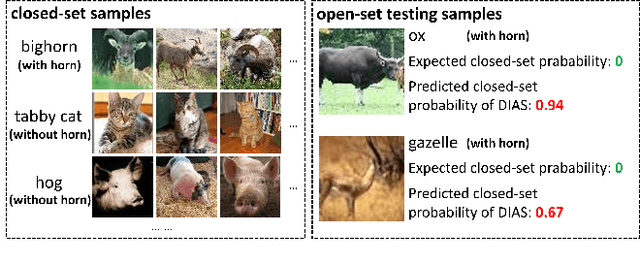
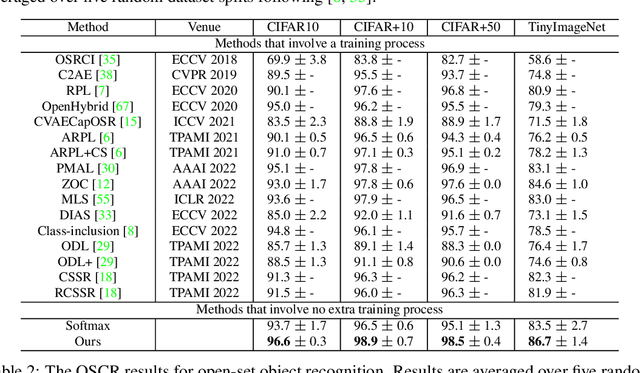
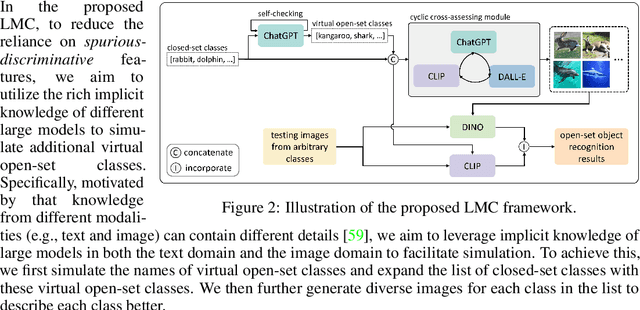

Open-set object recognition aims to identify if an object is from a class that has been encountered during training or not. To perform open-set object recognition accurately, a key challenge is how to reduce the reliance on spurious-discriminative features. In this paper, motivated by that different large models pre-trained through different paradigms can possess very rich while distinct implicit knowledge, we propose a novel framework named Large Model Collaboration (LMC) to tackle the above challenge via collaborating different off-the-shelf large models in a training-free manner. Moreover, we also incorporate the proposed framework with several novel designs to effectively extract implicit knowledge from large models. Extensive experiments demonstrate the efficacy of our proposed framework. Code is available \href{https://github.com/Harryqu123/LMC}{here}.