 Add to Chrome
 Add to Firefox
 Add to Edge
Liberating Seen Classes: Boosting Few-Shot and Zero-Shot Text Classification via Anchor Generation and Classification Reframing
May 06, 2024


Few-shot and zero-shot text classification aim to recognize samples from novel classes with limited labeled samples or no labeled samples at all. While prevailing methods have shown promising performance via transferring knowledge from seen classes to unseen classes, they are still limited by (1) Inherent dissimilarities among classes make the transformation of features learned from seen classes to unseen classes both difficult and inefficient. (2) Rare labeled novel samples usually cannot provide enough supervision signals to enable the model to adjust from the source distribution to the target distribution, especially for complicated scenarios. To alleviate the above issues, we propose a simple and effective strategy for few-shot and zero-shot text classification. We aim to liberate the model from the confines of seen classes, thereby enabling it to predict unseen categories without the necessity of training on seen classes. Specifically, for mining more related unseen category knowledge, we utilize a large pre-trained language model to generate pseudo novel samples, and select the most representative ones as category anchors. After that, we convert the multi-class classification task into a binary classification task and use the similarities of query-anchor pairs for prediction to fully leverage the limited supervision signals. Extensive experiments on six widely used public datasets show that our proposed method can outperform other strong baselines significantly in few-shot and zero-shot tasks, even without using any seen class samples.

MMGRec: Multimodal Generative Recommendation with Transformer Model
Apr 25, 2024Multimodal recommendation aims to recommend user-preferred candidates based on her/his historically interacted items and associated multimodal information. Previous studies commonly employ an embed-and-retrieve paradigm: learning user and item representations in the same embedding space, then retrieving similar candidate items for a user via embedding inner product. However, this paradigm suffers from inference cost, interaction modeling, and false-negative issues. Toward this end, we propose a new MMGRec model to introduce a generative paradigm into multimodal recommendation. Specifically, we first devise a hierarchical quantization method Graph RQ-VAE to assign Rec-ID for each item from its multimodal and CF information. Consisting of a tuple of semantically meaningful tokens, Rec-ID serves as the unique identifier of each item. Afterward, we train a Transformer-based recommender to generate the Rec-IDs of user-preferred items based on historical interaction sequences. The generative paradigm is qualified since this model systematically predicts the tuple of tokens identifying the recommended item in an autoregressive manner. Moreover, a relation-aware self-attention mechanism is devised for the Transformer to handle non-sequential interaction sequences, which explores the element pairwise relation to replace absolute positional encoding. Extensive experiments evaluate MMGRec's effectiveness compared with state-of-the-art methods.
PRISM: A Promptable and Robust Interactive Segmentation Model with Visual Prompts
Apr 23, 2024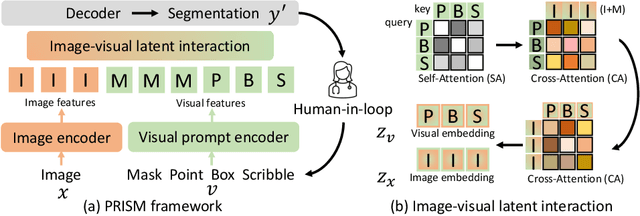
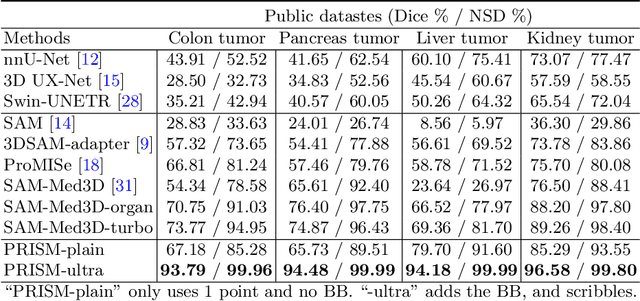
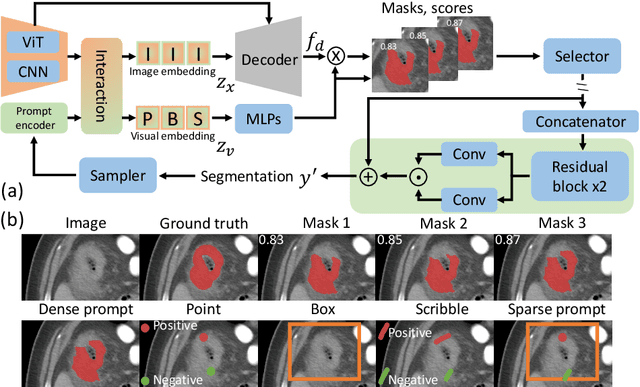

In this paper, we present PRISM, a Promptable and Robust Interactive Segmentation Model, aiming for precise segmentation of 3D medical images. PRISM accepts various visual inputs, including points, boxes, and scribbles as sparse prompts, as well as masks as dense prompts. Specifically, PRISM is designed with four principles to achieve robustness: (1) Iterative learning. The model produces segmentations by using visual prompts from previous iterations to achieve progressive improvement. (2) Confidence learning. PRISM employs multiple segmentation heads per input image, each generating a continuous map and a confidence score to optimize predictions. (3) Corrective learning. Following each segmentation iteration, PRISM employs a shallow corrective refinement network to reassign mislabeled voxels. (4) Hybrid design. PRISM integrates hybrid encoders to better capture both the local and global information. Comprehensive validation of PRISM is conducted using four public datasets for tumor segmentation in the colon, pancreas, liver, and kidney, highlighting challenges caused by anatomical variations and ambiguous boundaries in accurate tumor identification. Compared to state-of-the-art methods, both with and without prompt engineering, PRISM significantly improves performance, achieving results that are close to human levels. The code is publicly available at https://github.com/MedICL-VU/PRISM.
EIVEN: Efficient Implicit Attribute Value Extraction using Multimodal LLM
Apr 13, 2024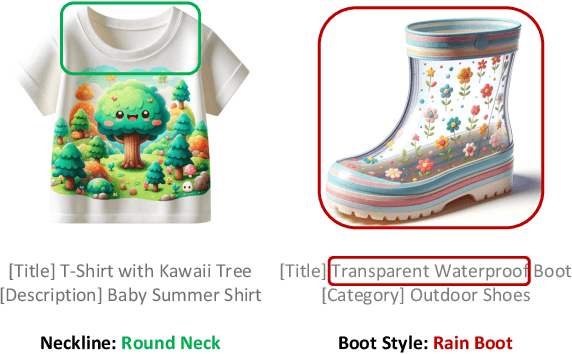
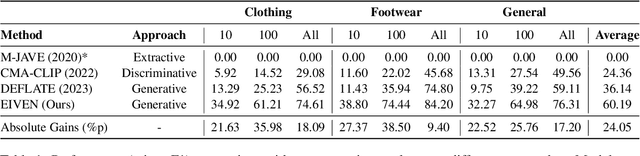
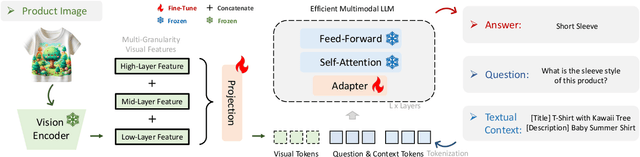
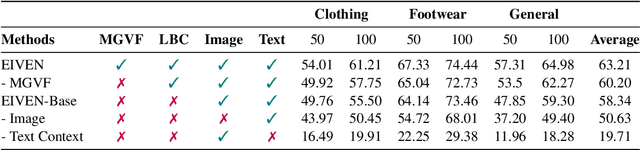
In e-commerce, accurately extracting product attribute values from multimodal data is crucial for improving user experience and operational efficiency of retailers. However, previous approaches to multimodal attribute value extraction often struggle with implicit attribute values embedded in images or text, rely heavily on extensive labeled data, and can easily confuse similar attribute values. To address these issues, we introduce EIVEN, a data- and parameter-efficient generative framework that pioneers the use of multimodal LLM for implicit attribute value extraction. EIVEN leverages the rich inherent knowledge of a pre-trained LLM and vision encoder to reduce reliance on labeled data. We also introduce a novel Learning-by-Comparison technique to reduce model confusion by enforcing attribute value comparison and difference identification. Additionally, we construct initial open-source datasets for multimodal implicit attribute value extraction. Our extensive experiments reveal that EIVEN significantly outperforms existing methods in extracting implicit attribute values while requiring less labeled data.
Nonparametric Modern Hopfield Models
Apr 05, 2024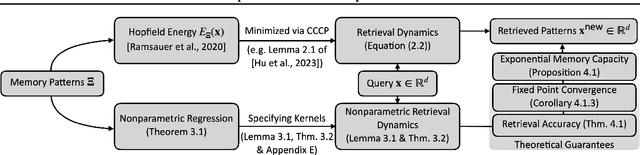
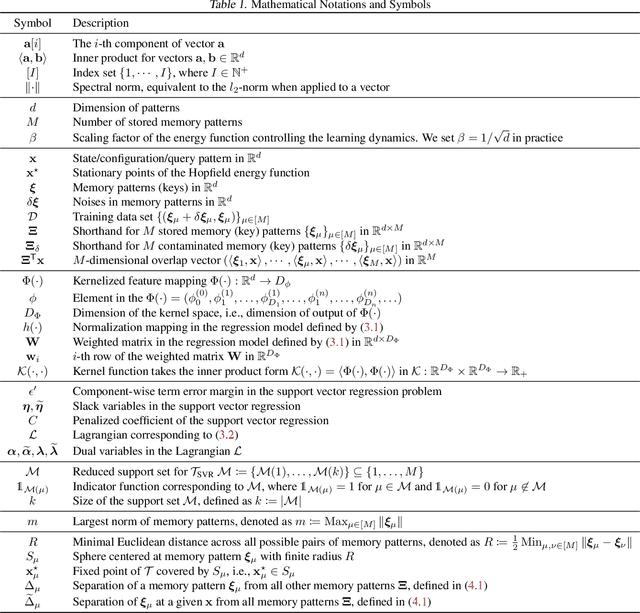
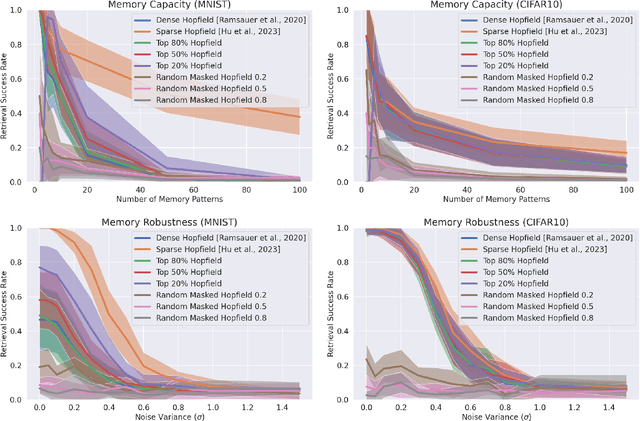
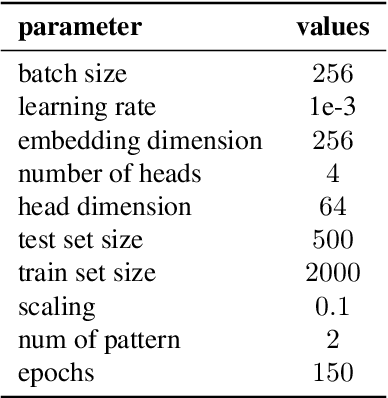
We present a nonparametric construction for deep learning compatible modern Hopfield models and utilize this framework to debut an efficient variant. Our key contribution stems from interpreting the memory storage and retrieval processes in modern Hopfield models as a nonparametric regression problem subject to a set of query-memory pairs. Crucially, our framework not only recovers the known results from the original dense modern Hopfield model but also fills the void in the literature regarding efficient modern Hopfield models, by introducing \textit{sparse-structured} modern Hopfield models with sub-quadratic complexity. We establish that this sparse model inherits the appealing theoretical properties of its dense analogue -- connection with transformer attention, fixed point convergence and exponential memory capacity -- even without knowing details of the Hopfield energy function. Additionally, we showcase the versatility of our framework by constructing a family of modern Hopfield models as extensions, including linear, random masked, top-$K$ and positive random feature modern Hopfield models. Empirically, we validate the efficacy of our framework in both synthetic and realistic settings.
Outlier-Efficient Hopfield Layers for Large Transformer-Based Models
Apr 04, 2024
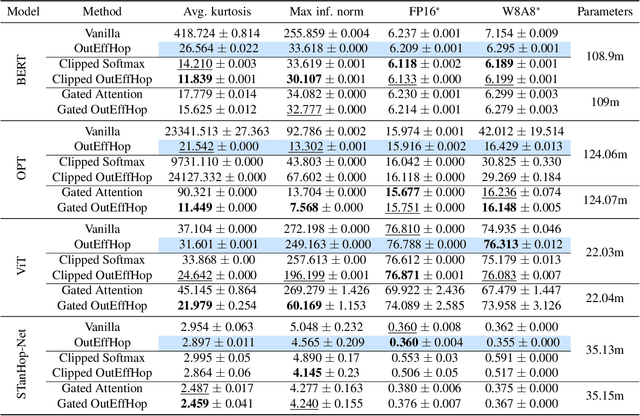

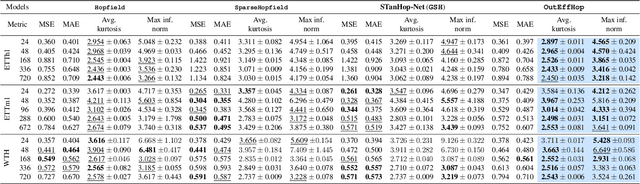
We introduce an Outlier-Efficient Modern Hopfield Model (termed $\mathtt{OutEffHop}$) and use it to address the outlier-induced challenge of quantizing gigantic transformer-based models. Our main contribution is a novel associative memory model facilitating \textit{outlier-efficient} associative memory retrievals. Interestingly, this memory model manifests a model-based interpretation of an outlier-efficient attention mechanism ($\text{Softmax}_1$): it is an approximation of the memory retrieval process of $\mathtt{OutEffHop}$. Methodologically, this allows us to debut novel outlier-efficient Hopfield layers a powerful attention alternative with superior post-quantization performance. Theoretically, the Outlier-Efficient Modern Hopfield Model retains and improves the desirable properties of the standard modern Hopfield models, including fixed point convergence and exponential storage capacity. Empirically, we demonstrate the proposed model's efficacy across large-scale transformer-based and Hopfield-based models (including BERT, OPT, ViT and STanHop-Net), benchmarking against state-of-the-art methods including $\mathtt{Clipped\_Softmax}$ and $\mathtt{Gated\_Attention}$. Notably, $\mathtt{OutEffHop}$ achieves on average $\sim$22+\% reductions in both average kurtosis and maximum infinity norm of model outputs accross 4 models.
BiSHop: Bi-Directional Cellular Learning for Tabular Data with Generalized Sparse Modern Hopfield Model
Apr 04, 2024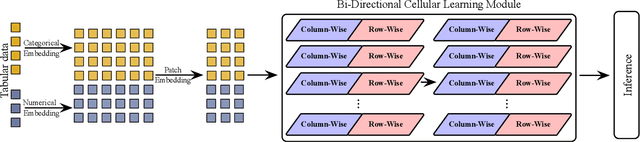

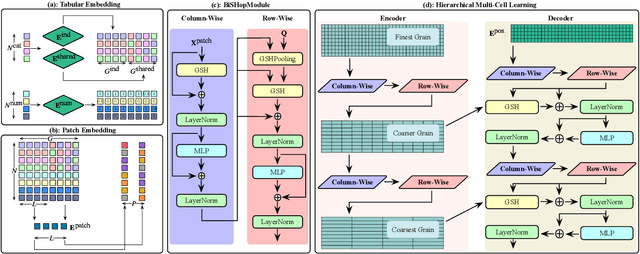
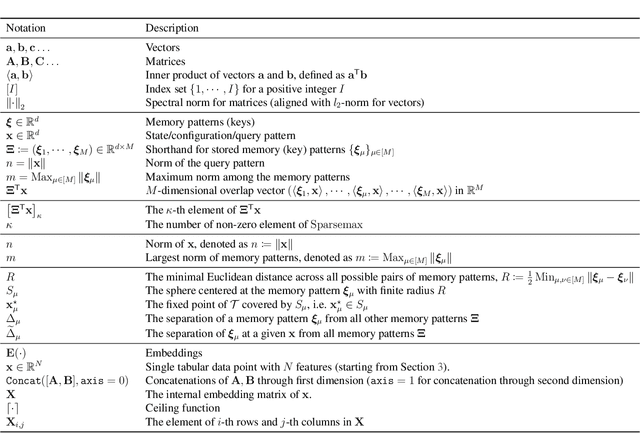
We introduce the \textbf{B}i-Directional \textbf{S}parse \textbf{Hop}field Network (\textbf{BiSHop}), a novel end-to-end framework for deep tabular learning. BiSHop handles the two major challenges of deep tabular learning: non-rotationally invariant data structure and feature sparsity in tabular data. Our key motivation comes from the recent established connection between associative memory and attention mechanisms. Consequently, BiSHop uses a dual-component approach, sequentially processing data both column-wise and row-wise through two interconnected directional learning modules. Computationally, these modules house layers of generalized sparse modern Hopfield layers, a sparse extension of the modern Hopfield model with adaptable sparsity. Methodologically, BiSHop facilitates multi-scale representation learning, capturing both intra-feature and inter-feature interactions, with adaptive sparsity at each scale. Empirically, through experiments on diverse real-world datasets, we demonstrate that BiSHop surpasses current SOTA methods with significantly less HPO runs, marking it a robust solution for deep tabular learning.
Uniform Memory Retrieval with Larger Capacity for Modern Hopfield Models
Apr 04, 2024We propose a two-stage memory retrieval dynamics for modern Hopfield models, termed $\mathtt{U\text{-}Hop}$, with enhanced memory capacity. Our key contribution is a learnable feature map $\Phi$ which transforms the Hopfield energy function into a kernel space. This transformation ensures convergence between the local minima of energy and the fixed points of retrieval dynamics within the kernel space. Consequently, the kernel norm induced by $\Phi$ serves as a novel similarity measure. It utilizes the stored memory patterns as learning data to enhance memory capacity across all modern Hopfield models. Specifically, we accomplish this by constructing a separation loss $\mathcal{L}_\Phi$ that separates the local minima of kernelized energy by separating stored memory patterns in kernel space. Methodologically, $\mathtt{U\text{-}Hop}$ memory retrieval process consists of: \textbf{(Stage~I.)} minimizing separation loss for a more uniformed memory (local minimum) distribution, followed by \textbf{(Stage~II.)} standard Hopfield energy minimization for memory retrieval. This results in a significant reduction of possible meta-stable states in the Hopfield energy function, thus enhancing memory capacity by preventing memory confusion. Empirically, with real-world datasets, we demonstrate that $\mathtt{U\text{-}Hop}$ outperforms all existing modern Hopfield models and SOTA similarity measures, achieving substantial improvements in both associative memory retrieval and deep learning tasks.
Chain-of-Action: Faithful and Multimodal Question Answering through Large Language Models
Mar 26, 2024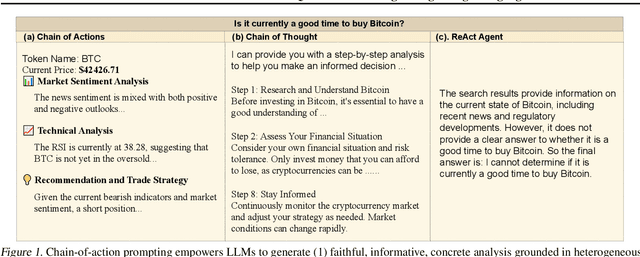

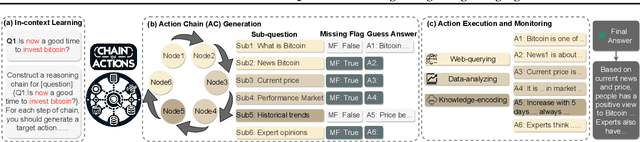
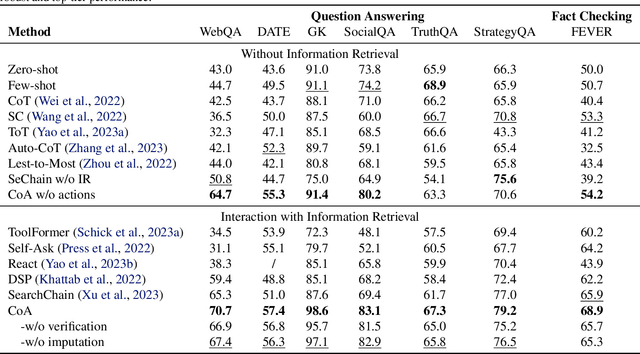
We present a Chain-of-Action (CoA) framework for multimodal and retrieval-augmented Question-Answering (QA). Compared to the literature, CoA overcomes two major challenges of current QA applications: (i) unfaithful hallucination that is inconsistent with real-time or domain facts and (ii) weak reasoning performance over compositional information. Our key contribution is a novel reasoning-retrieval mechanism that decomposes a complex question into a reasoning chain via systematic prompting and pre-designed actions. Methodologically, we propose three types of domain-adaptable `Plug-and-Play' actions for retrieving real-time information from heterogeneous sources. We also propose a multi-reference faith score (MRFS) to verify and resolve conflicts in the answers. Empirically, we exploit both public benchmarks and a Web3 case study to demonstrate the capability of CoA over other methods.
USE: Dynamic User Modeling with Stateful Sequence Models
Mar 20, 2024


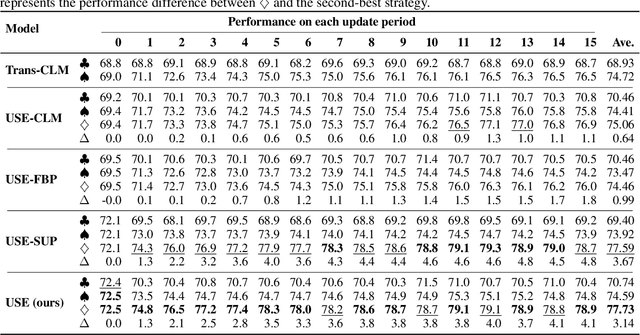
User embeddings play a crucial role in user engagement forecasting and personalized services. Recent advances in sequence modeling have sparked interest in learning user embeddings from behavioral data. Yet behavior-based user embedding learning faces the unique challenge of dynamic user modeling. As users continuously interact with the apps, user embeddings should be periodically updated to account for users' recent and long-term behavior patterns. Existing methods highly rely on stateless sequence models that lack memory of historical behavior. They have to either discard historical data and use only the most recent data or reprocess the old and new data jointly. Both cases incur substantial computational overhead. To address this limitation, we introduce User Stateful Embedding (USE). USE generates user embeddings and reflects users' evolving behaviors without the need for exhaustive reprocessing by storing previous model states and revisiting them in the future. Furthermore, we introduce a novel training objective named future W-behavior prediction to transcend the limitations of next-token prediction by forecasting a broader horizon of upcoming user behaviors. By combining it with the Same User Prediction, a contrastive learning-based objective that predicts whether different segments of behavior sequences belong to the same user, we further improve the embeddings' distinctiveness and representativeness. We conducted experiments on 8 downstream tasks using Snapchat users' behavioral logs in both static (i.e., fixed user behavior sequences) and dynamic (i.e., periodically updated user behavior sequences) settings. We demonstrate USE's superior performance over established baselines. The results underscore USE's effectiveness and efficiency in integrating historical and recent user behavior sequences into user embeddings in dynamic user modeling.