 Add to Chrome
 Add to Firefox
 Add to Edge
A Distributed Multi-UGV Exploration Framework With Loop-Aware Planning and Descriptor-Aided Localization in Resource-Limited Environments
Jun 09, 2026
Robust and efficient cooperative exploration with multiple unmanned ground vehicles (UGVs) in unknown, GPSdenied, and bandwidth-limited environments without prior maps remains challenging, as localization drift degrades map consistency and induces redundant coverage. This paper presents a fully distributed exploration framework that couples descriptoraided inter-UGV loop closure with loop-aware hierarchical planning while enabling autonomous localization and exploration. We develop a lightweight LiDAR global descriptor with range-image prealignment to enable robust cross-UGV place recognition under large yaw and lateral variations, and use verified loop closures to maintain globally consistent trajectories and a sparse topological representation. We further introduce an uncertainty-aware crossUGV loop-closure selection module that scores candidate loop closures under pose uncertainty and retains high-utility loop closures as planning anchors for global task allocation and local route refinement. Simulations and real-UGV experiments show that the loop-closure module achieves AR@1/AR@1% of 89.9%/95.5%, distributed optimization reduces absolute trajectory error, the system substantially reduces two-way communication volume, and the overall framework reduces exploration time and travel distance by 15% and 14%, respectively, compared with an mTSP baseline.

DiffPlace: Street View Generation via Place-Controllable Diffusion Model Enhancing Place Recognition
Feb 12, 2026Generative models have advanced significantly in realistic image synthesis, with diffusion models excelling in quality and stability. Recent multi-view diffusion models improve 3D-aware street view generation, but they struggle to produce place-aware and background-consistent urban scenes from text, BEV maps, and object bounding boxes. This limits their effectiveness in generating realistic samples for place recognition tasks. To address these challenges, we propose DiffPlace, a novel framework that introduces a place-ID controller to enable place-controllable multi-view image generation. The place-ID controller employs linear projection, perceiver transformer, and contrastive learning to map place-ID embeddings into a fixed CLIP space, allowing the model to synthesize images with consistent background buildings while flexibly modifying foreground objects and weather conditions. Extensive experiments, including quantitative comparisons and augmented training evaluations, demonstrate that DiffPlace outperforms existing methods in both generation quality and training support for visual place recognition. Our results highlight the potential of generative models in enhancing scene-level and place-aware synthesis, providing a valuable approach for improving place recognition in autonomous driving
Optimization-Guided Diffusion for Interactive Scene Generation
Dec 11, 2025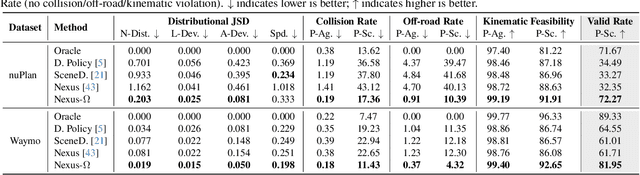
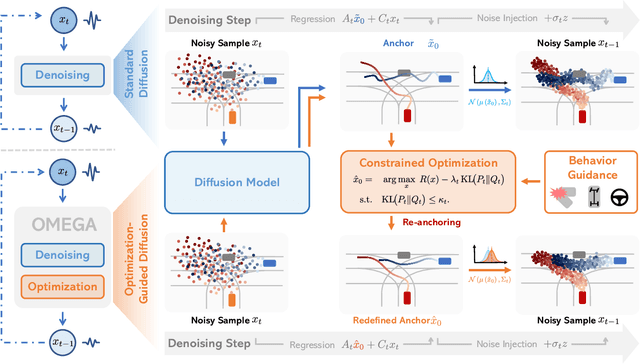
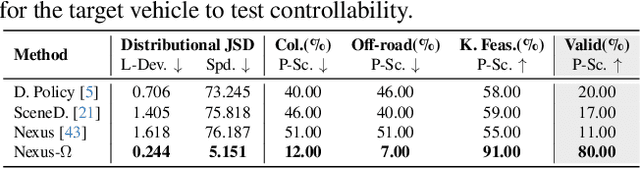
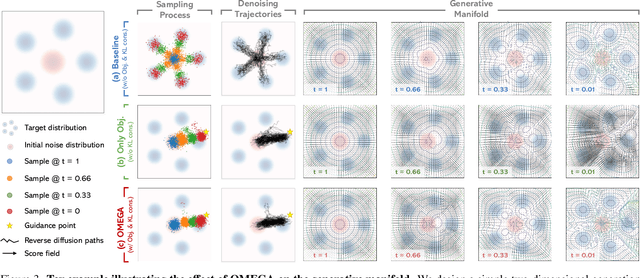
Realistic and diverse multi-agent driving scenes are crucial for evaluating autonomous vehicles, but safety-critical events which are essential for this task are rare and underrepresented in driving datasets. Data-driven scene generation offers a low-cost alternative by synthesizing complex traffic behaviors from existing driving logs. However, existing models often lack controllability or yield samples that violate physical or social constraints, limiting their usability. We present OMEGA, an optimization-guided, training-free framework that enforces structural consistency and interaction awareness during diffusion-based sampling from a scene generation model. OMEGA re-anchors each reverse diffusion step via constrained optimization, steering the generation towards physically plausible and behaviorally coherent trajectories. Building on this framework, we formulate ego-attacker interactions as a game-theoretic optimization in the distribution space, approximating Nash equilibria to generate realistic, safety-critical adversarial scenarios. Experiments on nuPlan and Waymo show that OMEGA improves generation realism, consistency, and controllability, increasing the ratio of physically and behaviorally valid scenes from 32.35% to 72.27% for free exploration capabilities, and from 11% to 80% for controllability-focused generation. Our approach can also generate $5\times$ more near-collision frames with a time-to-collision under three seconds while maintaining the overall scene realism.
A Hierarchical Multi-Vehicle Coordinated Motion Planning Method based on Interactive Spatio-Temporal Corridors
Apr 03, 2023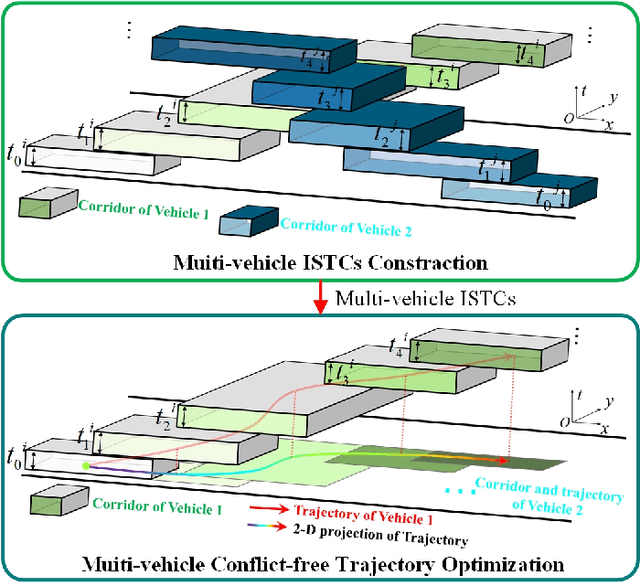
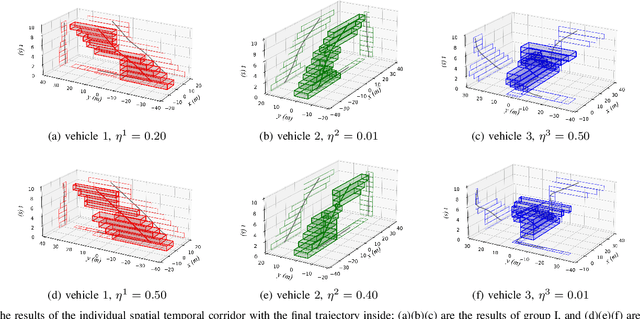
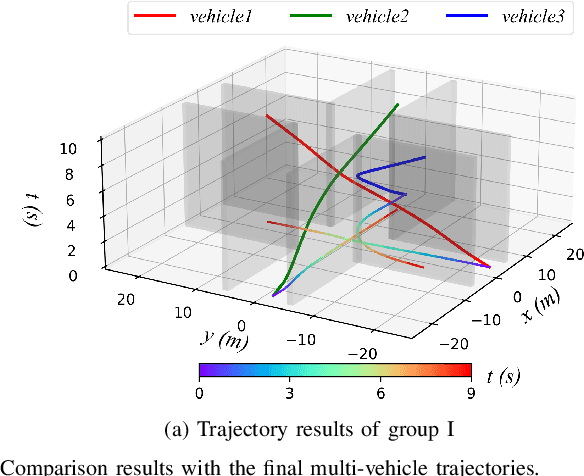
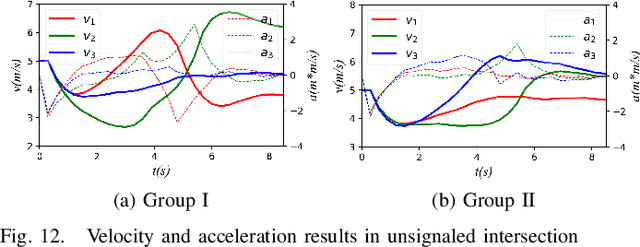
Multi-vehicle coordinated motion planning has always been challenged to safely and efficiently resolve conflicts under non-holonomic dynamic constraints. Constructing spatial-temporal corridors for multi-vehicle can decouple the high-dimensional conflicts and further reduce the difficulty of obtaining feasible trajectories. Therefore, this paper proposes a novel hierarchical method based on interactive spatio-temporal corridors (ISTCs). In the first layer, based on the initial guidance trajectories, Mixed Integer Quadratic Programming is designed to construct ISTCs capable of resolving conflicts in generic multi-vehicle scenarios. And then in the second layer, Non-Linear Programming is settled to generate in-corridor trajectories that satisfy the vehicle dynamics. By introducing ISTCs, the multi-vehicle coordinated motion planning problem is able to be decoupled into single-vehicle trajectory optimization problems, which greatly decentralizes the computational pressure and has great potential for real-world applications. Besides, the proposed method searches for feasible solutions in the 3-D $(x,y,t)$ configuration space, preserving more possibilities than the traditional velocity-path decoupling method. Simulated experiments in unsignalized intersection and challenging dense scenarios have been conduced to verify the feasibility and adaptability of the proposed framework.