 Add to Chrome
 Add to Firefox
 Add to Edge
World Engine: Towards the Era of Post-Training for Autonomous Driving
Jun 18, 2026
Autonomous vehicles must operate safely in the real world, where errors can have severe consequences. Although modern end-to-end driving policies excel in routine scenarios, their reliability is limited by the scarcity of safety-critical ``long-tail'' events in real driving datasets. These rare interactions define the practical safety boundary of the learned policy, yet they are difficult to collect at scale in the real world. Here we show that this fundamental limitation can be addressed by post-training pre-trained driving models on synthesized high-stakes interactions. We introduce World Engine, a generative framework that reconstructs high-fidelity interactive environments from real-world logs and systematically extrapolates them into realistic safety-critical variations. This paradigm enables reinforcement-based post-training to align policies with safety constraints, circumventing the physical risks inherent in real-world exploration. On a public benchmark built on nuPlan, World Engine substantially reduces failures in rare safety-critical scenarios and yields significantly larger gains than scaling pre-training data alone. Furthermore, when deployed on a production-scale autonomous driving system, the resulting policy reduces simulated collisions and demonstrates measurable improvements in on-road testing, showing that post-training on synthesized, safety-critical interactions offers a scalable and effective pathway to safer autonomous driving. The full codebase suite, including training, is released to the public.

Optimization-Guided Diffusion for Interactive Scene Generation
Dec 11, 2025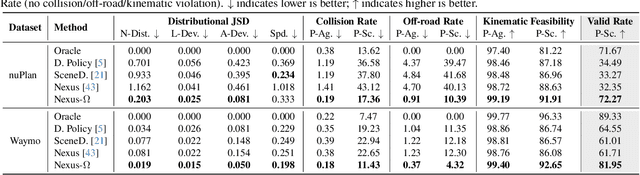
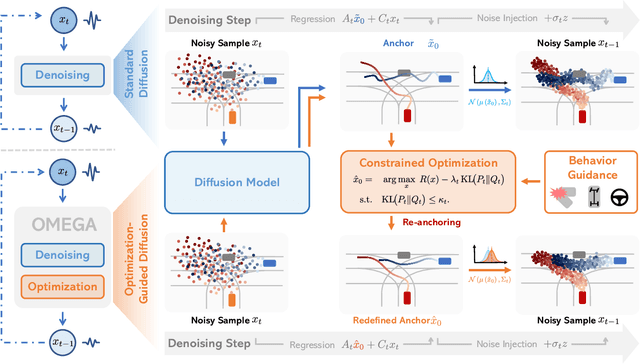
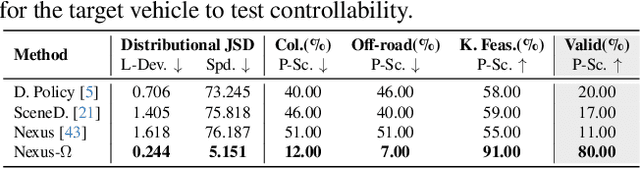
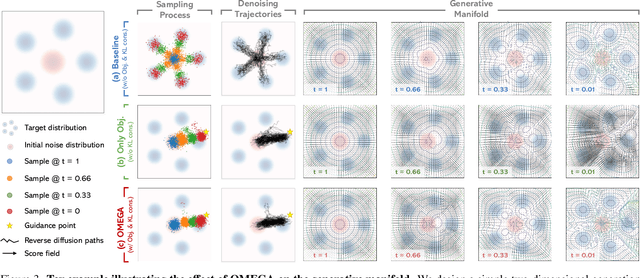
Realistic and diverse multi-agent driving scenes are crucial for evaluating autonomous vehicles, but safety-critical events which are essential for this task are rare and underrepresented in driving datasets. Data-driven scene generation offers a low-cost alternative by synthesizing complex traffic behaviors from existing driving logs. However, existing models often lack controllability or yield samples that violate physical or social constraints, limiting their usability. We present OMEGA, an optimization-guided, training-free framework that enforces structural consistency and interaction awareness during diffusion-based sampling from a scene generation model. OMEGA re-anchors each reverse diffusion step via constrained optimization, steering the generation towards physically plausible and behaviorally coherent trajectories. Building on this framework, we formulate ego-attacker interactions as a game-theoretic optimization in the distribution space, approximating Nash equilibria to generate realistic, safety-critical adversarial scenarios. Experiments on nuPlan and Waymo show that OMEGA improves generation realism, consistency, and controllability, increasing the ratio of physically and behaviorally valid scenes from 32.35% to 72.27% for free exploration capabilities, and from 11% to 80% for controllability-focused generation. Our approach can also generate $5\times$ more near-collision frames with a time-to-collision under three seconds while maintaining the overall scene realism.
Decoupled Diffusion Sparks Adaptive Scene Generation
Apr 14, 2025Controllable scene generation could reduce the cost of diverse data collection substantially for autonomous driving. Prior works formulate the traffic layout generation as predictive progress, either by denoising entire sequences at once or by iteratively predicting the next frame. However, full sequence denoising hinders online reaction, while the latter's short-sighted next-frame prediction lacks precise goal-state guidance. Further, the learned model struggles to generate complex or challenging scenarios due to a large number of safe and ordinal driving behaviors from open datasets. To overcome these, we introduce Nexus, a decoupled scene generation framework that improves reactivity and goal conditioning by simulating both ordinal and challenging scenarios from fine-grained tokens with independent noise states. At the core of the decoupled pipeline is the integration of a partial noise-masking training strategy and a noise-aware schedule that ensures timely environmental updates throughout the denoising process. To complement challenging scenario generation, we collect a dataset consisting of complex corner cases. It covers 540 hours of simulated data, including high-risk interactions such as cut-in, sudden braking, and collision. Nexus achieves superior generation realism while preserving reactivity and goal orientation, with a 40% reduction in displacement error. We further demonstrate that Nexus improves closed-loop planning by 20% through data augmentation and showcase its capability in safety-critical data generation.