 Add to Chrome
 Add to Firefox
 Add to Edge
UHR-DETR: Efficient End-to-End Small Object Detection for Ultra-High-Resolution Remote Sensing Imagery
Apr 23, 2026
Ultra-High-Resolution (UHR) imagery has become essential for modern remote sensing, offering unprecedented spatial coverage. However, detecting small objects in such vast scenes presents a critical dilemma: retaining the original resolution for small objects causes prohibitive memory bottlenecks. Conversely, conventional compromises like image downsampling or patch cropping either erase small objects or destroy context. To break this dilemma, we propose UHR-DETR, an efficient end-to-end transformer-based detector designed for UHR imagery. First, we introduce a Coverage-Maximizing Sparse Encoder that dynamically allocates finite computational resources to informative high-resolution regions, ensuring maximum object coverage with minimal spatial redundancy. Second, we design a Global-Local Decoupled Decoder. By integrating macroscopic scene awareness with microscopic object details, this module resolves semantic ambiguities and prevents scene fragmentation. Extensive experiments on the UHR imagery datasets (e.g., STAR and SODA-A) demonstrate the superiority of UHR-DETR under strict hardware constraints (e.g., a single 24GB RTX 3090). It achieves a 2.8\% mAP improvement while delivering a 10$\times$ inference speedup compared to standard sliding-window baselines on the STAR dataset. Our codes and models will be available at https://github.com/Li-JingFang/UHR-DETR.

Generalized Small Object Detection:A Point-Prompted Paradigm and Benchmark
Apr 03, 2026Small object detection (SOD) remains challenging due to extremely limited pixels and ambiguous object boundaries. These characteristics lead to challenging annotation, limited availability of large-scale high-quality datasets, and inherently weak semantic representations for small objects. In this work, we first address the data limitation by introducing TinySet-9M, the first large-scale, multi-domain dataset for small object detection. Beyond filling the gap in large-scale datasets, we establish a benchmark to evaluate the effectiveness of existing label-efficient detection methods for small objects. Our evaluation reveals that weak visual cues further exacerbate the performance degradation of label-efficient methods in small object detection, highlighting a critical challenge in label-efficient SOD. Secondly, to tackle the limitation of insufficient semantic representation, we move beyond training-time feature enhancement and propose a new paradigm termed Point-Prompt Small Object Detection (P2SOD). This paradigm introduces sparse point prompts at inference time as an efficient information bridge for category-level localization, enabling semantic augmentation. Building upon the P2SOD paradigm and the large-scale TinySet-9M dataset, we further develop DEAL (DEtect Any smalL object), a scalable and transferable point-prompted detection framework that learns robust, prompt-conditioned representations from large-scale data. With only a single click at inference time, DEAL achieves a 31.4% relative improvement over fully supervised baselines under strict localization metrics (e.g., AP75) on TinySet-9M, while generalizing effectively to unseen categories and unseen datasets. Our project is available at https://zhuhaoraneis.github.io/TinySet-9M/.
Unifying UAV Cross-View Geo-Localization via 3D Geometric Perception
Apr 02, 2026Cross-view geo-localization for Unmanned Aerial Vehicles (UAVs) operating in GNSS-denied environments remains challenging due to the severe geometric discrepancy between oblique UAV imagery and orthogonal satellite maps. Most existing methods address this problem through a decoupled pipeline of place retrieval and pose estimation, implicitly treating perspective distortion as appearance noise rather than an explicit geometric transformation. In this work, we propose a geometry-aware UAV geo-localization framework that explicitly models the 3D scene geometry to unify coarse place recognition and fine-grained pose estimation within a single inference pipeline. Our approach reconstructs a local 3D scene from multi-view UAV image sequences using a Visual Geometry Grounded Transformer (VGGT), and renders a virtual Bird's-Eye View (BEV) representation that orthorectifies the UAV perspective to align with satellite imagery. This BEV serves as a geometric intermediary that enables robust cross-view retrieval and provides spatial priors for accurate 3 Degrees of Freedom (3-DoF) pose regression. To efficiently handle multiple location hypotheses, we introduce a Satellite-wise Attention Block that isolates the interaction between each satellite candidate and the reconstructed UAV scene, preventing inter-candidate interference while maintaining linear computational complexity. In addition, we release a recalibrated version of the University-1652 dataset with precise coordinate annotations and spatial overlap analysis, enabling rigorous evaluation of end-to-end localization accuracy. Extensive experiments on the refined University-1652 benchmark and SUES-200 demonstrate that our method significantly outperforms state-of-the-art baselines, achieving robust meter-level localization accuracy and improved generalization in complex urban environments.
Tiny Object Detection with Single Point Supervision
Dec 08, 2024


Tiny objects, with their limited spatial resolution, often resemble point-like distributions. As a result, bounding box prediction using point-level supervision emerges as a natural and cost-effective alternative to traditional box-level supervision. However, the small scale and lack of distinctive features of tiny objects make point annotations prone to noise, posing significant hurdles for model robustness. To tackle these challenges, we propose Point Teacher--the first end-to-end point-supervised method for robust tiny object detection in aerial images. To handle label noise from scale ambiguity and location shifts in point annotations, Point Teacher employs the teacher-student architecture and decouples the learning into a two-phase denoising process. In this framework, the teacher network progressively denoises the pseudo boxes derived from noisy point annotations, guiding the student network's learning. Specifically, in the first phase, random masking of image regions facilitates regression learning, enabling the teacher to transform noisy point annotations into coarse pseudo boxes. In the second phase, these coarse pseudo boxes are refined using dynamic multiple instance learning, which adaptively selects the most reliable instance from dynamically constructed proposal bags around the coarse pseudo boxes. Extensive experiments on three tiny object datasets (i.e., AI-TOD-v2, SODA-A, and TinyPerson) validate the proposed method's effectiveness and robustness against point location shifts. Notably, relying solely on point supervision, our Point Teacher already shows comparable performance with box-supervised learning methods. Codes and models will be made publicly available.
Unsupervised Multi-view UAV Image Geo-localization via Iterative Rendering
Nov 22, 2024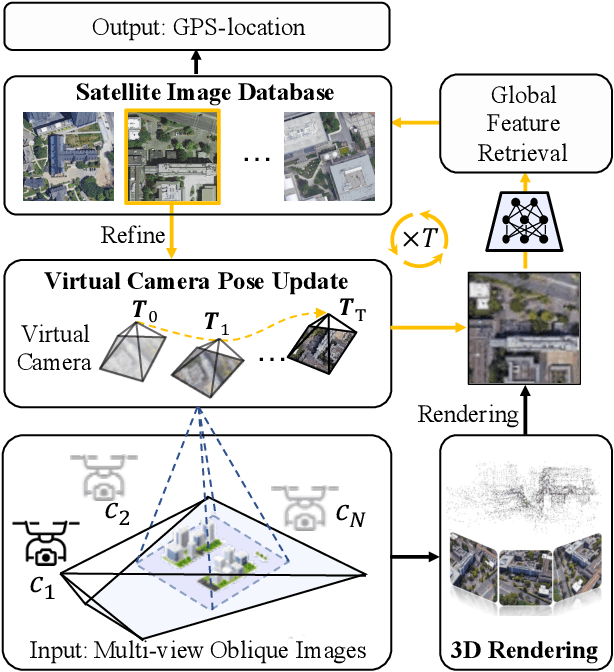
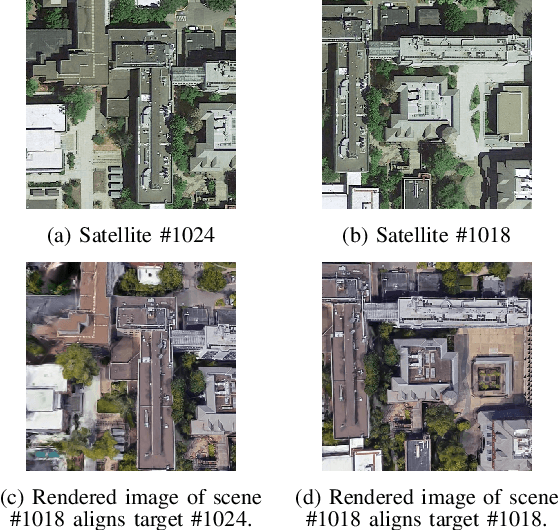
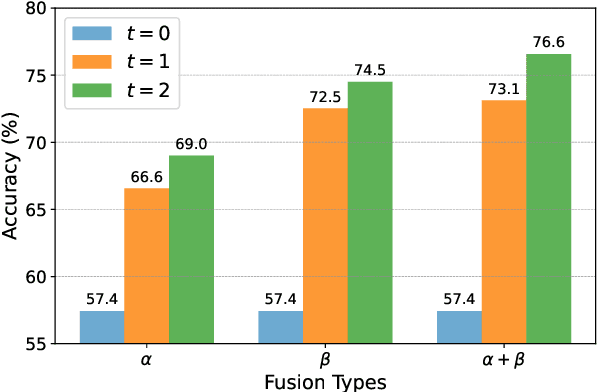
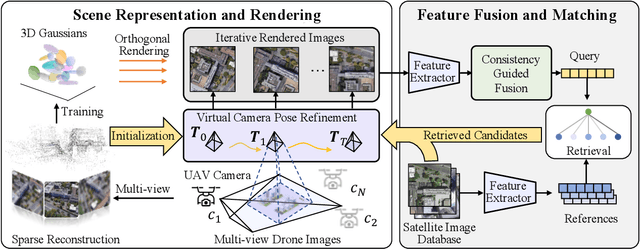
Unmanned Aerial Vehicle (UAV) Cross-View Geo-Localization (CVGL) presents significant challenges due to the view discrepancy between oblique UAV images and overhead satellite images. Existing methods heavily rely on the supervision of labeled datasets to extract viewpoint-invariant features for cross-view retrieval. However, these methods have expensive training costs and tend to overfit the region-specific cues, showing limited generalizability to new regions. To overcome this issue, we propose an unsupervised solution that lifts the scene representation to 3d space from UAV observations for satellite image generation, providing robust representation against view distortion. By generating orthogonal images that closely resemble satellite views, our method reduces view discrepancies in feature representation and mitigates shortcuts in region-specific image pairing. To further align the rendered image's perspective with the real one, we design an iterative camera pose updating mechanism that progressively modulates the rendered query image with potential satellite targets, eliminating spatial offsets relative to the reference images. Additionally, this iterative refinement strategy enhances cross-view feature invariance through view-consistent fusion across iterations. As such, our unsupervised paradigm naturally avoids the problem of region-specific overfitting, enabling generic CVGL for UAV images without feature fine-tuning or data-driven training. Experiments on the University-1652 and SUES-200 datasets demonstrate that our approach significantly improves geo-localization accuracy while maintaining robustness across diverse regions. Notably, without model fine-tuning or paired training, our method achieves competitive performance with recent supervised methods.
Video Frame Interpolation with Stereo Event and Intensity Camera
Jul 17, 2023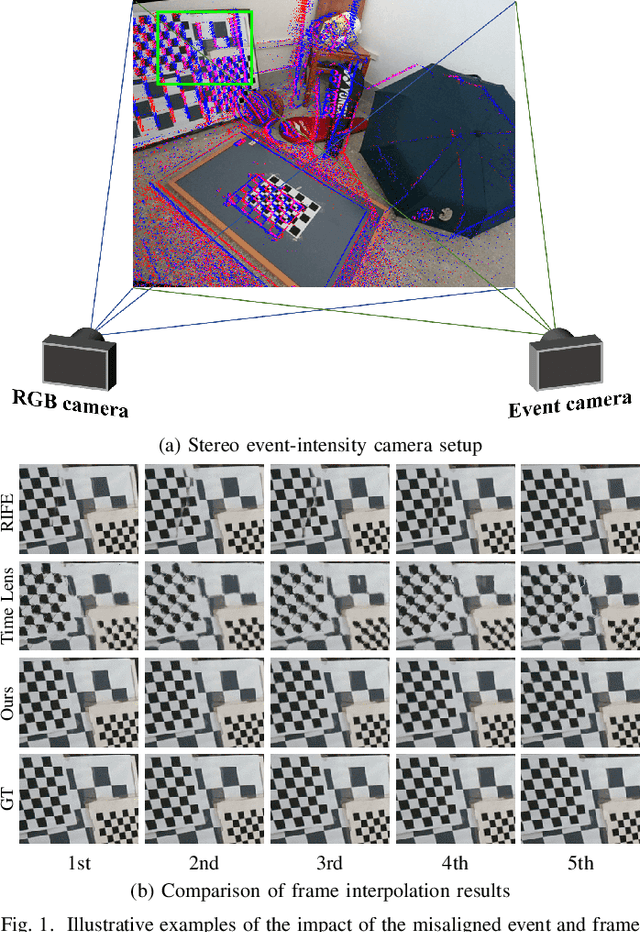
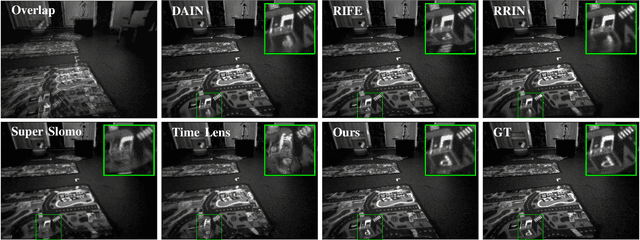
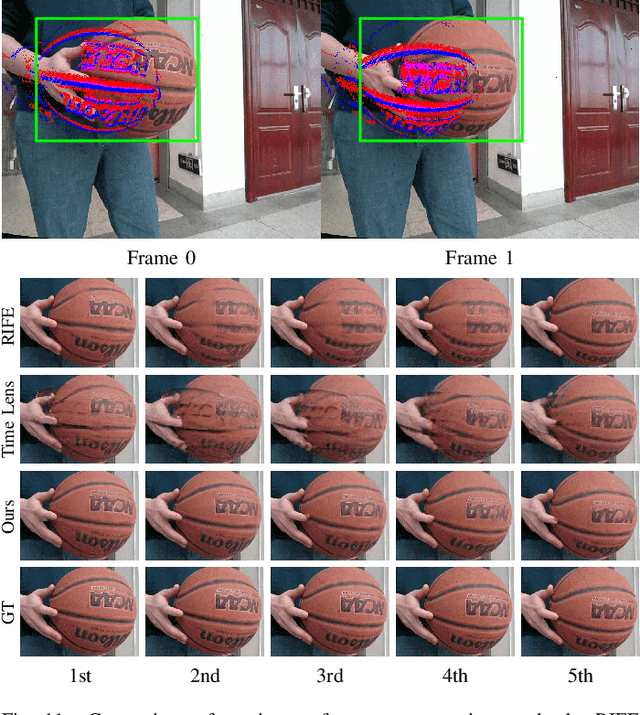
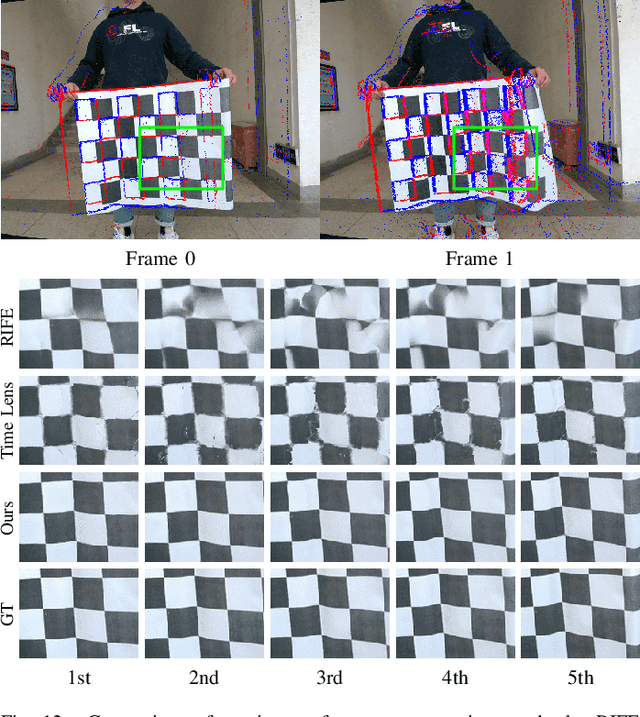
The stereo event-intensity camera setup is widely applied to leverage the advantages of both event cameras with low latency and intensity cameras that capture accurate brightness and texture information. However, such a setup commonly encounters cross-modality parallax that is difficult to be eliminated solely with stereo rectification especially for real-world scenes with complex motions and varying depths, posing artifacts and distortion for existing Event-based Video Frame Interpolation (E-VFI) approaches. To tackle this problem, we propose a novel Stereo Event-based VFI (SE-VFI) network (SEVFI-Net) to generate high-quality intermediate frames and corresponding disparities from misaligned inputs consisting of two consecutive keyframes and event streams emitted between them. Specifically, we propose a Feature Aggregation Module (FAM) to alleviate the parallax and achieve spatial alignment in the feature domain. We then exploit the fused features accomplishing accurate optical flow and disparity estimation, and achieving better interpolated results through flow-based and synthesis-based ways. We also build a stereo visual acquisition system composed of an event camera and an RGB-D camera to collect a new Stereo Event-Intensity Dataset (SEID) containing diverse scenes with complex motions and varying depths. Experiments on public real-world stereo datasets, i.e., DSEC and MVSEC, and our SEID dataset demonstrate that our proposed SEVFI-Net outperforms state-of-the-art methods by a large margin.
"Seeing'' Electric Network Frequency from Events
May 04, 2023Most of the artificial lights fluctuate in response to the grid's alternating current and exhibit subtle variations in terms of both intensity and spectrum, providing the potential to estimate the Electric Network Frequency (ENF) from conventional frame-based videos. Nevertheless, the performance of Video-based ENF (V-ENF) estimation largely relies on the imaging quality and thus may suffer from significant interference caused by non-ideal sampling, motion, and extreme lighting conditions. In this paper, we show that the ENF can be extracted without the above limitations from a new modality provided by the so-called event camera, a neuromorphic sensor that encodes the light intensity variations and asynchronously emits events with extremely high temporal resolution and high dynamic range. Specifically, we first formulate and validate the physical mechanism for the ENF captured in events, and then propose a simple yet robust Event-based ENF (E-ENF) estimation method through mode filtering and harmonic enhancement. Furthermore, we build an Event-Video ENF Dataset (EV-ENFD) that records both events and videos in diverse scenes. Extensive experiments on EV-ENFD demonstrate that our proposed E-ENF method can extract more accurate ENF traces, outperforming the conventional V-ENF by a large margin, especially in challenging environments with object motions and extreme lighting conditions. The code and dataset are available at https://xlx-creater.github.io/E-ENF.
Learning to Super-Resolve Blurry Images with Events
Feb 27, 2023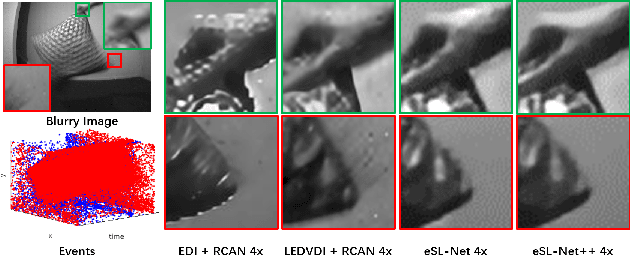
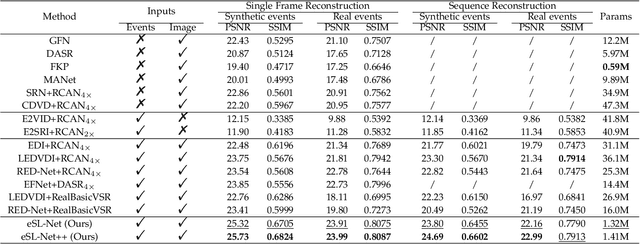
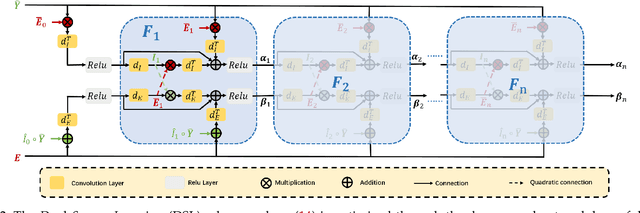
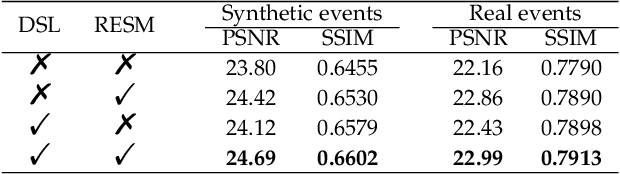
Super-Resolution from a single motion Blurred image (SRB) is a severely ill-posed problem due to the joint degradation of motion blurs and low spatial resolution. In this paper, we employ events to alleviate the burden of SRB and propose an Event-enhanced SRB (E-SRB) algorithm, which can generate a sequence of sharp and clear images with High Resolution (HR) from a single blurry image with Low Resolution (LR). To achieve this end, we formulate an event-enhanced degeneration model to consider the low spatial resolution, motion blurs, and event noises simultaneously. We then build an event-enhanced Sparse Learning Network (eSL-Net++) upon a dual sparse learning scheme where both events and intensity frames are modeled with sparse representations. Furthermore, we propose an event shuffle-and-merge scheme to extend the single-frame SRB to the sequence-frame SRB without any additional training process. Experimental results on synthetic and real-world datasets show that the proposed eSL-Net++ outperforms state-of-the-art methods by a large margin. Datasets, codes, and more results are available at https://github.com/ShinyWang33/eSL-Net-Plusplus.
Towards End-to-End Synthetic Speech Detection
Jun 11, 2021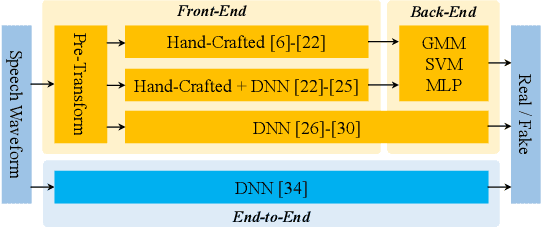
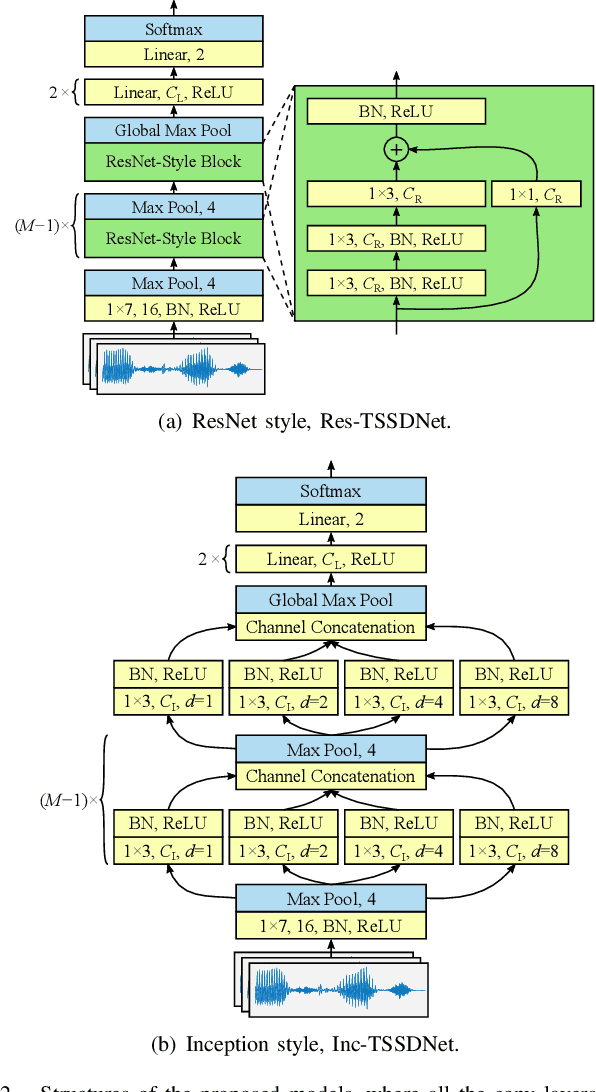
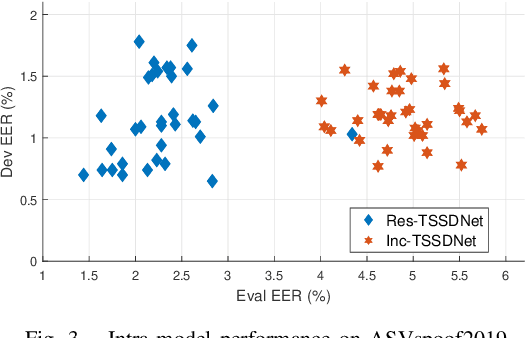
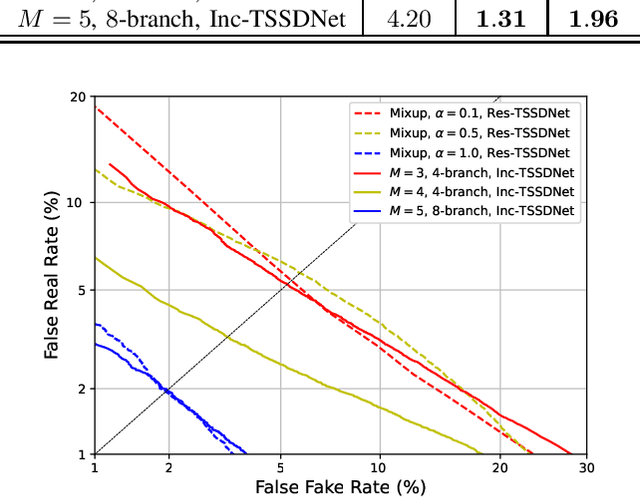
The constant Q transform (CQT) has been shown to be one of the most effective speech signal pre-transforms to facilitate synthetic speech detection, followed by either hand-crafted (subband) constant Q cepstral coefficient (CQCC) feature extraction and a back-end binary classifier, or a deep neural network (DNN) directly for further feature extraction and classification. Despite the rich literature on such a pipeline, we show in this paper that the pre-transform and hand-crafted features could simply be replaced by end-to-end DNNs. Specifically, we experimentally verify that by only using standard components, a light-weight neural network could outperform the state-of-the-art methods for the ASVspoof2019 challenge. The proposed model is termed Time-domain Synthetic Speech Detection Net (TSSDNet), having ResNet- or Inception-style structures. We further demonstrate that the proposed models also have attractive generalization capability. Trained on ASVspoof2019, they could achieve promising detection performance when tested on disjoint ASVspoof2015, significantly better than the existing cross-dataset results. This paper reveals the great potential of end-to-end DNNs for synthetic speech detection, without hand-crafted features.
Learning Cluster Structured Sparsity by Reweighting
Oct 11, 2019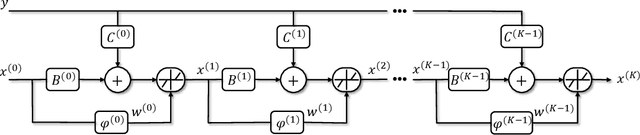
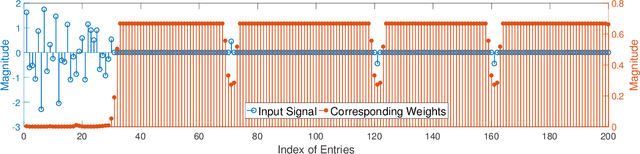
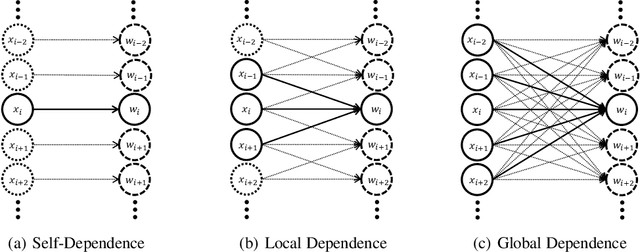
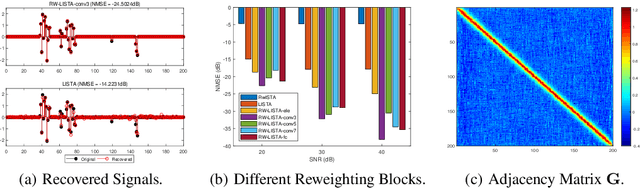
Recently, the paradigm of unfolding iterative algorithms into finite-length feed-forward neural networks has achieved a great success in the area of sparse recovery. Benefit from available training data, the learned networks have achieved state-of-the-art performance in respect of both speed and accuracy. However, the structure behind sparsity, imposing constraint on the support of sparse signals, is often an essential prior knowledge but seldom considered in the existing networks. In this paper, we aim at bridging this gap. Specifically, exploiting the iterative reweighted $\ell_1$ minimization (IRL1) algorithm, we propose to learn the cluster structured sparsity (CSS) by rewegihting adaptively. In particular, we first unfold the Reweighted Iterative Shrinkage Algorithm (RwISTA) into an end-to-end trainable deep architecture termed as RW-LISTA. Then instead of the element-wise reweighting, the global and local reweighting manner are proposed for the cluster structured sparse learning. Numerical experiments further show the superiority of our algorithm against both classical algorithms and learning-based networks on different tasks.