 Add to Chrome
 Add to Firefox
 Add to Edge
When Rules Learn: A Self-Evolving Agent for Legal Case Retrieval
Jun 15, 2026
Legal case retrieval remains challenging due to the complexity of legal language and the need for precise lexical alignment between queries and relevant cases. Although dense retrieval models have achieved notable progress, empirical studies show that BM25 continues to serve as a strong baseline in this domain. It motivates us to propose a self-evolving framework for rule-driven query rewriting that enhances BM25 without any parameter training. The framework equips an LLM-based agent with an automatic evaluation environment, enabling it to iteratively create rewriting rules, plan validation experiments over rule combinations, and eliminate ineffective rules based on historical feedbacks. We evaluate our method on the Chinese legal case retrieval benchmark LeCaRD-v2. Experimental results demonstrate that the proposed framework outperforms non-evolutionary baselines, including human-designed rules and greedy rule selection, particularly when powered by a highcapacity core LLM. We also conduct detailed analyses to investigate the mechanisms underlying self-evolution. Our findings reveal that LLM's capabilities to leverage previous experimental results and its intrinsic knowledge of rule elimination play critical roles in refining the rule set via self-evolution.

IS-CoT: Breaking the Long-form Generation Collapse via Interleaved Structural Thinking
Jun 08, 2026Generating coherent and controllable long-form content remains a persistent challenge for Large Language Models (LLMs). While reasoning-enhanced models have demonstrated success in logic-intensive domains, our evaluation reveals that they suffer from a severe length collapse in open-ended writing, where performance degrades sharply as target lengths exceed 2,000 words. We attribute this failure to the limitation of static hierarchical planning, which struggles to provide dynamic guidance over extended contexts. To bridge this gap, we introduce the Interleaved Structural Chain-of-Thought (IS-CoT) framework. Unlike external agentic workflows, IS-CoT embeds a dynamic Plan-Write-Reflect cycle into the generation process, enabling continuous strategy adaptation and global alignment without additional assistance. Based on this framework, we construct a high-quality dataset of interleaved reasoning traces via a multi-teacher pipeline and train IS-Writer-8B. Experiments demonstrate that IS-Writer-8B achieves state-of-the-art performance on challenging long-form benchmarks (e.g., +3.08 vs. DeepSeek-V3.2 on LongBench-Write), exhibiting robust length compliance and coherence competitive with significantly larger proprietary models.
DeFine: A Decomposed and Fine-Grained Annotated Dataset for Long-form Article Generation
Mar 10, 2025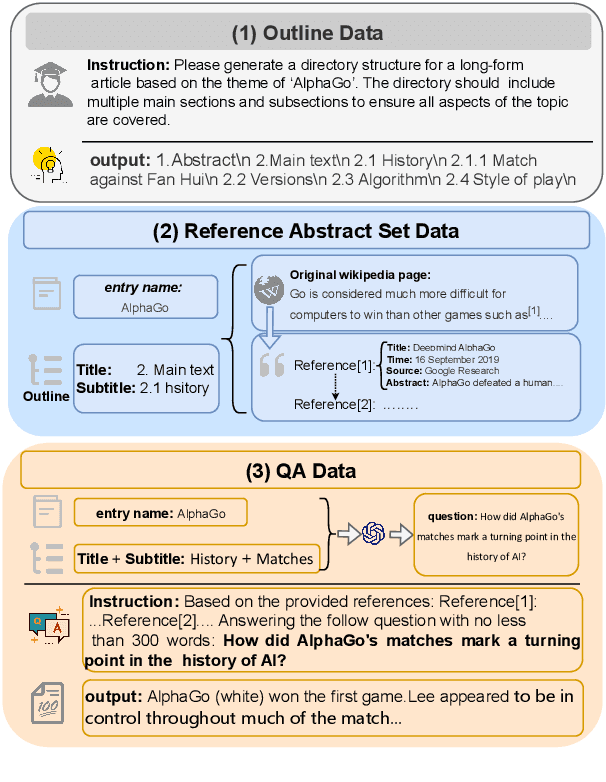
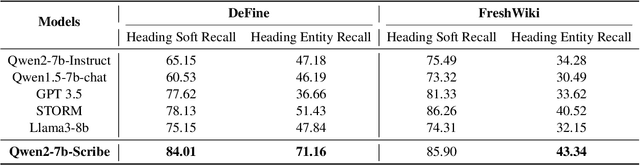
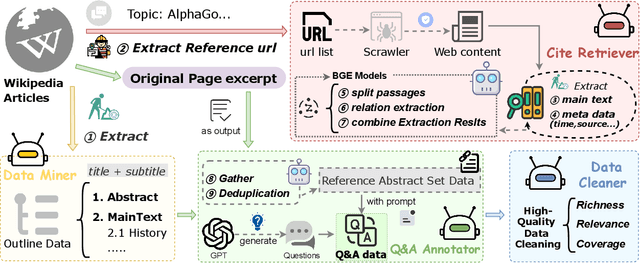
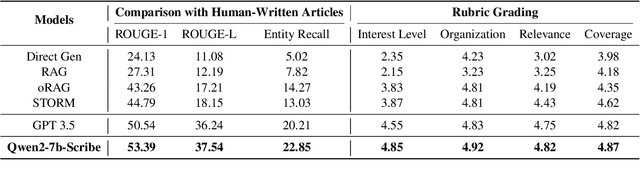
Long-form article generation (LFAG) presents challenges such as maintaining logical consistency, comprehensive topic coverage, and narrative coherence across extended articles. Existing datasets often lack both the hierarchical structure and fine-grained annotation needed to effectively decompose tasks, resulting in shallow, disorganized article generation. To address these limitations, we introduce DeFine, a Decomposed and Fine-grained annotated dataset for long-form article generation. DeFine is characterized by its hierarchical decomposition strategy and the integration of domain-specific knowledge with multi-level annotations, ensuring granular control and enhanced depth in article generation. To construct the dataset, a multi-agent collaborative pipeline is proposed, which systematically segments the generation process into four parts: Data Miner, Cite Retreiver, Q&A Annotator and Data Cleaner. To validate the effectiveness of DeFine, we designed and tested three LFAG baselines: the web retrieval, the local retrieval, and the grounded reference. We fine-tuned the Qwen2-7b-Instruct model using the DeFine training dataset. The experimental results showed significant improvements in text quality, specifically in topic coverage, depth of information, and content fidelity. Our dataset publicly available to facilitate future research.