 Add to Chrome
 Add to Firefox
 Add to Edge
Seeing Touch from Motion: A Unified Modality-Aware Visuo-Tactile Policy with Tactile Motion Correlation
Jun 29, 2026
Visuo-Tactile policies leveraging optical tactile sensors have shown great promise in contact-rich manipulation. These sensors achieve high spatial resolution and multi-dimensional force sensing by utilizing an internal camera to monitor the deformation of their elastic gel surface, thereby indirectly inferring tactile cues. Despite their advantages, extracting fine-grained contact states necessary for contact-rich manipulation remains an open challenge. Existing methods typically use either raw images or cumulative motion fields to represent tactile cues. However, both are prone to perception ambiguity. Raw tactile images mainly capture appearance changes, while cumulative motion fields only reflect the aggregate gel deformation. Consequently, distinct fine-grained contact states can exhibit highly similar patterns, making it difficult to explicitly distinguish subtle contact variations. To address this issue, we explore the dynamic priors of tactile motion and discover that the correlation between transient and cumulative motion can explicitly distinguish fine-grained contact states. Based on this insight, we propose a motion-aware tactile representation to facilitate contact-rich manipulation. Beyond tactile representation, effective fusion of tactile and visual modalities is also critical. Most existing fusion methods either directly concatenate features from each modality or train modality-specific networks separately and fuse their outputs. However, these strategies struggle to simultaneously model cross-modal interactions and preserve modality-specific characteristics. In this work, we take advantage of the Mixture-of-Transformers architecture and propose a unified modality-aware visuo-tactile policy that captures cross-modal complementarity while maintaining modality-specific properties.

ThinkingVLA: Interleaved Vision and Language Reasoning for Robotic Manipulation
Jun 16, 2026Most Vision-Language-Action (VLA) models map observations directly to actions without explicit reasoning, limiting their capacity for reasoning-intensive long-horizon tasks. To address this, existing approaches adopt Chain-of-Thought (CoT) reasoning to enable subgoal decomposition and spatial anticipation. However, those methods lack a unified architecture for effective cross-modal reasoning and fail to explicitly include inverse reasoning ability based on the target state. We argue that manipulation planning naturally decomposes into prediction, anticipating the next visual state, and inverse dynamics, inferring the actions to reach it. Bridging both requires a unified autoregressive architecture that interleaves textual and visual reasoning in a single generation process. We propose \textbf{ThinkingVLA}, a generative model that realizes this decomposition within a unified Mixture-of-Transformers architecture. ThinkingVLA consists of a forward CoT that identifies the immediate subgoal and guides the visual forecasting; the predicted image then serves as the target state, grounding an inverse CoT that reasons about spatial relationships and action intent based on the predicted image; and the final action is generated conditioned on this full reasoning context. Extensive experiments on simulation and real-world benchmarks demonstrate that ThinkingVLA consistently outperforms state-of-the-art baselines, with particularly large gains on long-horizon manipulation tasks.
Long-range Turbulence Mitigation: A Large-scale Dataset and A Coarse-to-fine Framework
Jul 11, 2024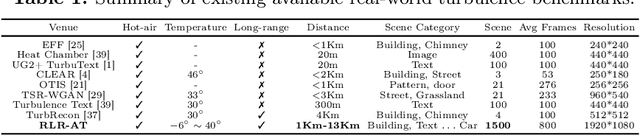
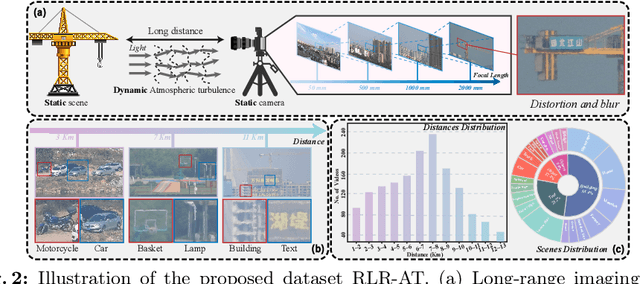
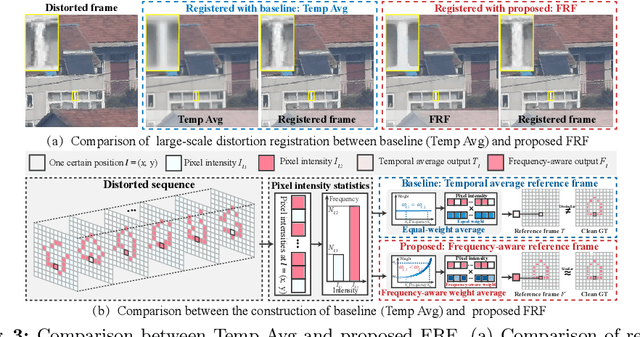
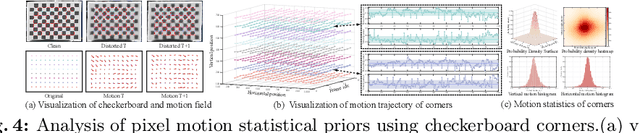
Long-range imaging inevitably suffers from atmospheric turbulence with severe geometric distortions due to random refraction of light. The further the distance, the more severe the disturbance. Despite existing research has achieved great progress in tackling short-range turbulence, there is less attention paid to long-range turbulence with significant distortions. To address this dilemma and advance the field, we construct a large-scale real long-range atmospheric turbulence dataset (RLR-AT), including 1500 turbulence sequences spanning distances from 1 Km to 13 Km. The advantages of RLR-AT compared to existing ones: turbulence with longer-distances and higher-diversity, scenes with greater-variety and larger-scale. Moreover, most existing work adopts either registration-based or decomposition-based methods to address distortions through one-step mitigation. However, they fail to effectively handle long-range turbulence due to its significant pixel displacements. In this work, we propose a coarse-to-fine framework to handle severe distortions, which cooperates dynamic turbulence and static background priors (CDSP). On the one hand, we discover the pixel motion statistical prior of turbulence, and propose a frequency-aware reference frame for better large-scale distortion registration, greatly reducing the burden of refinement. On the other hand, we take advantage of the static prior of background, and propose a subspace-based low-rank tensor refinement model to eliminate the misalignments inevitably left by registration while well preserving details. The dynamic and static priors complement to each other, facilitating us to progressively mitigate long-range turbulence with severe distortions. Extensive experiments demonstrate that the proposed method outperforms SOTA methods on different datasets.
1st Solution Places for CVPR 2023 UG$^2$+ Challenge Track 2.2-Coded Target Restoration through Atmospheric Turbulence
Jun 15, 2023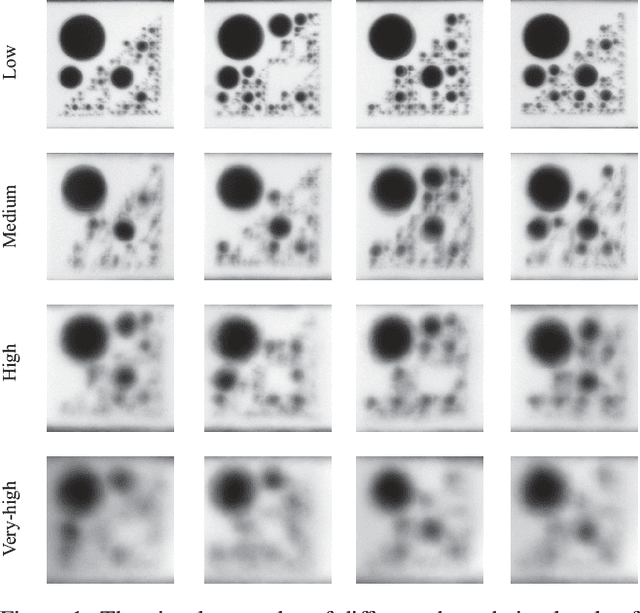

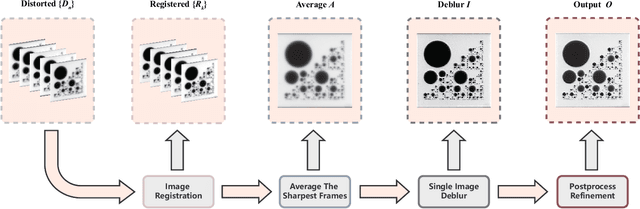
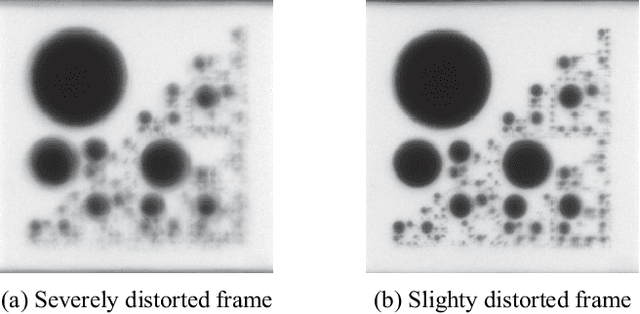
In this technical report, we briefly introduce the solution of our team VIELab-HUST for coded target restoration through atmospheric turbulence in CVPR 2023 UG$^2$+ Track 2.2. In this task, we propose an efficient multi-stage framework to restore a high quality image from distorted frames. Specifically, each distorted frame is initially aligned using image registration to suppress geometric distortion. We subsequently select the sharpest set of registered frames by employing a frame selection approach based on image sharpness, and average them to produce an image that is largely free of geometric distortion, albeit with blurriness. A learning-based deblurring method is then applied to remove the residual blur in the averaged image. Finally, post-processing techniques are utilized to further enhance the quality of the output image. Our framework is capable of handling different kinds of coded target dataset provided in the final testing phase, and ranked 1st on the final leaderboard. Our code will be available at https://github.com/xsqhust/Turbulence_Removal.
1st Solution Places for CVPR 2023 UG$^{\textbf{2}}$+ Challenge Track 2.1-Text Recognition through Atmospheric Turbulence
Jun 15, 2023In this technical report, we present the solution developed by our team VIELab-HUST for text recognition through atmospheric turbulence in Track 2.1 of the CVPR 2023 UG$^{2}$+ challenge. Our solution involves an efficient multi-stage framework that restores a high-quality image from distorted frames. Specifically, a frame selection algorithm based on sharpness is first utilized to select the sharpest set of distorted frames. Next, each frame in the selected frames is aligned to suppress geometric distortion through optical-flow-based image registration. Then, a region-based image fusion method with DT-CWT is utilized to mitigate the blur caused by the turbulence. Finally, a learning-based deartifacts method is applied to remove the artifacts in the fused image, generating a high-quality outuput. Our framework can handle both hot-air text dataset and turbulence text dataset provided in the final testing phase and achieved 1st place in text recognition accuracy. Our code will be available at https://github.com/xsqhust/Turbulence_Removal.