 Add to Chrome
 Add to Firefox
 Add to Edge
Seeing Touch from Motion: A Unified Modality-Aware Visuo-Tactile Policy with Tactile Motion Correlation
Jun 29, 2026
Visuo-Tactile policies leveraging optical tactile sensors have shown great promise in contact-rich manipulation. These sensors achieve high spatial resolution and multi-dimensional force sensing by utilizing an internal camera to monitor the deformation of their elastic gel surface, thereby indirectly inferring tactile cues. Despite their advantages, extracting fine-grained contact states necessary for contact-rich manipulation remains an open challenge. Existing methods typically use either raw images or cumulative motion fields to represent tactile cues. However, both are prone to perception ambiguity. Raw tactile images mainly capture appearance changes, while cumulative motion fields only reflect the aggregate gel deformation. Consequently, distinct fine-grained contact states can exhibit highly similar patterns, making it difficult to explicitly distinguish subtle contact variations. To address this issue, we explore the dynamic priors of tactile motion and discover that the correlation between transient and cumulative motion can explicitly distinguish fine-grained contact states. Based on this insight, we propose a motion-aware tactile representation to facilitate contact-rich manipulation. Beyond tactile representation, effective fusion of tactile and visual modalities is also critical. Most existing fusion methods either directly concatenate features from each modality or train modality-specific networks separately and fuse their outputs. However, these strategies struggle to simultaneously model cross-modal interactions and preserve modality-specific characteristics. In this work, we take advantage of the Mixture-of-Transformers architecture and propose a unified modality-aware visuo-tactile policy that captures cross-modal complementarity while maintaining modality-specific properties.

Spectral-based Graph Neural Networks for Complementary Item Recommendation
Jan 11, 2024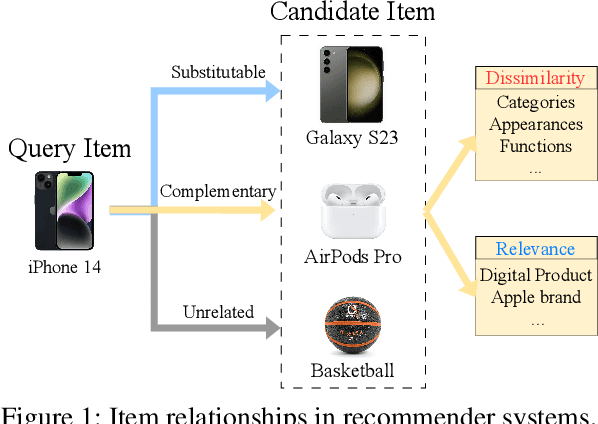
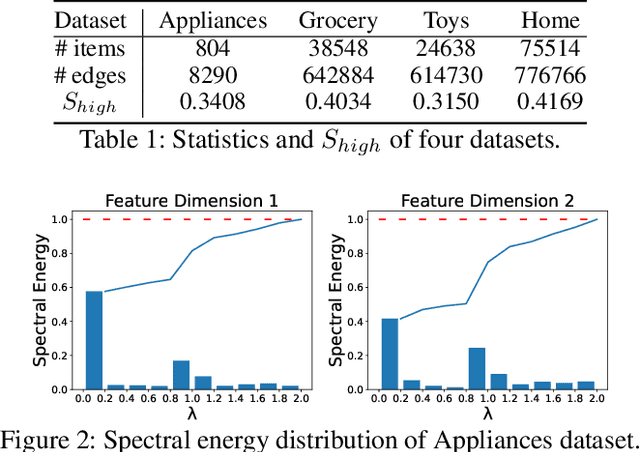
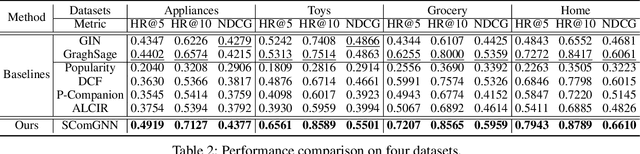
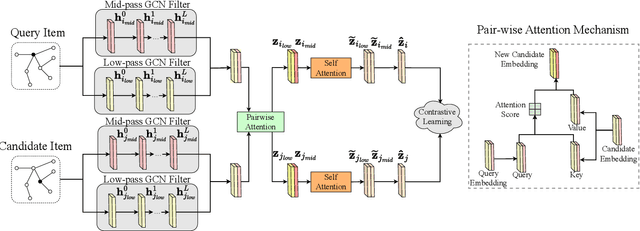
Modeling complementary relationships greatly helps recommender systems to accurately and promptly recommend the subsequent items when one item is purchased. Unlike traditional similar relationships, items with complementary relationships may be purchased successively (such as iPhone and Airpods Pro), and they not only share relevance but also exhibit dissimilarity. Since the two attributes are opposites, modeling complementary relationships is challenging. Previous attempts to exploit these relationships have either ignored or oversimplified the dissimilarity attribute, resulting in ineffective modeling and an inability to balance the two attributes. Since Graph Neural Networks (GNNs) can capture the relevance and dissimilarity between nodes in the spectral domain, we can leverage spectral-based GNNs to effectively understand and model complementary relationships. In this study, we present a novel approach called Spectral-based Complementary Graph Neural Networks (SComGNN) that utilizes the spectral properties of complementary item graphs. We make the first observation that complementary relationships consist of low-frequency and mid-frequency components, corresponding to the relevance and dissimilarity attributes, respectively. Based on this spectral observation, we design spectral graph convolutional networks with low-pass and mid-pass filters to capture the low-frequency and mid-frequency components. Additionally, we propose a two-stage attention mechanism to adaptively integrate and balance the two attributes. Experimental results on four e-commerce datasets demonstrate the effectiveness of our model, with SComGNN significantly outperforming existing baseline models.