 Add to Chrome
 Add to Firefox
 Add to Edge
Seeing Touch from Motion: A Unified Modality-Aware Visuo-Tactile Policy with Tactile Motion Correlation
Jun 29, 2026
Visuo-Tactile policies leveraging optical tactile sensors have shown great promise in contact-rich manipulation. These sensors achieve high spatial resolution and multi-dimensional force sensing by utilizing an internal camera to monitor the deformation of their elastic gel surface, thereby indirectly inferring tactile cues. Despite their advantages, extracting fine-grained contact states necessary for contact-rich manipulation remains an open challenge. Existing methods typically use either raw images or cumulative motion fields to represent tactile cues. However, both are prone to perception ambiguity. Raw tactile images mainly capture appearance changes, while cumulative motion fields only reflect the aggregate gel deformation. Consequently, distinct fine-grained contact states can exhibit highly similar patterns, making it difficult to explicitly distinguish subtle contact variations. To address this issue, we explore the dynamic priors of tactile motion and discover that the correlation between transient and cumulative motion can explicitly distinguish fine-grained contact states. Based on this insight, we propose a motion-aware tactile representation to facilitate contact-rich manipulation. Beyond tactile representation, effective fusion of tactile and visual modalities is also critical. Most existing fusion methods either directly concatenate features from each modality or train modality-specific networks separately and fuse their outputs. However, these strategies struggle to simultaneously model cross-modal interactions and preserve modality-specific characteristics. In this work, we take advantage of the Mixture-of-Transformers architecture and propose a unified modality-aware visuo-tactile policy that captures cross-modal complementarity while maintaining modality-specific properties.

OCRA: Object-Centric Learning with 3D and Tactile Priors for Human-to-Robot Action Transfer
Mar 15, 2026We present OCRA, an Object-Centric framework for video-based human-to-Robot Action transfer that learns directly from human demonstration videos to enable robust manipulation. Object-centric learning emphasizes task-relevant objects and their interactions while filtering out irrelevant background, providing a natural and scalable way to teach robots. OCRA leverages multi-view RGB videos, the state-of-the-art 3D foundation model VGGT, and advanced detection and segmentation models to reconstruct object-centric 3D point clouds, capturing rich interactions between objects. To handle properties not easily perceived by vision alone, we incorporate tactile priors via a large-scale dataset of over one million tactile images. These 3D and tactile priors are fused through a multimodal module (ResFiLM) and fed into a Diffusion Policy to generate robust manipulation actions. Extensive experiments on both vision-only and visuo-tactile tasks show that OCRA significantly outperforms existing baselines and ablations, demonstrating its effectiveness for learning from human demonstration videos.
A multi-branch convolutional neural network for detecting double JPEG compression
Oct 16, 2017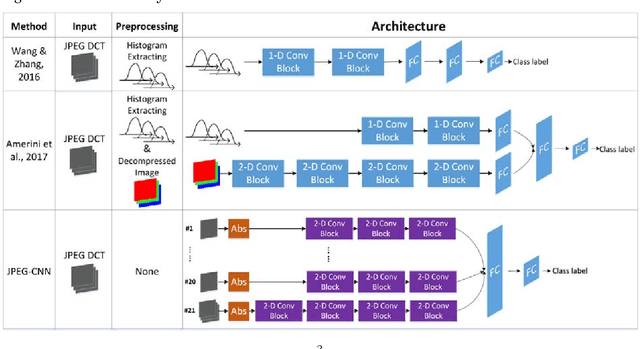
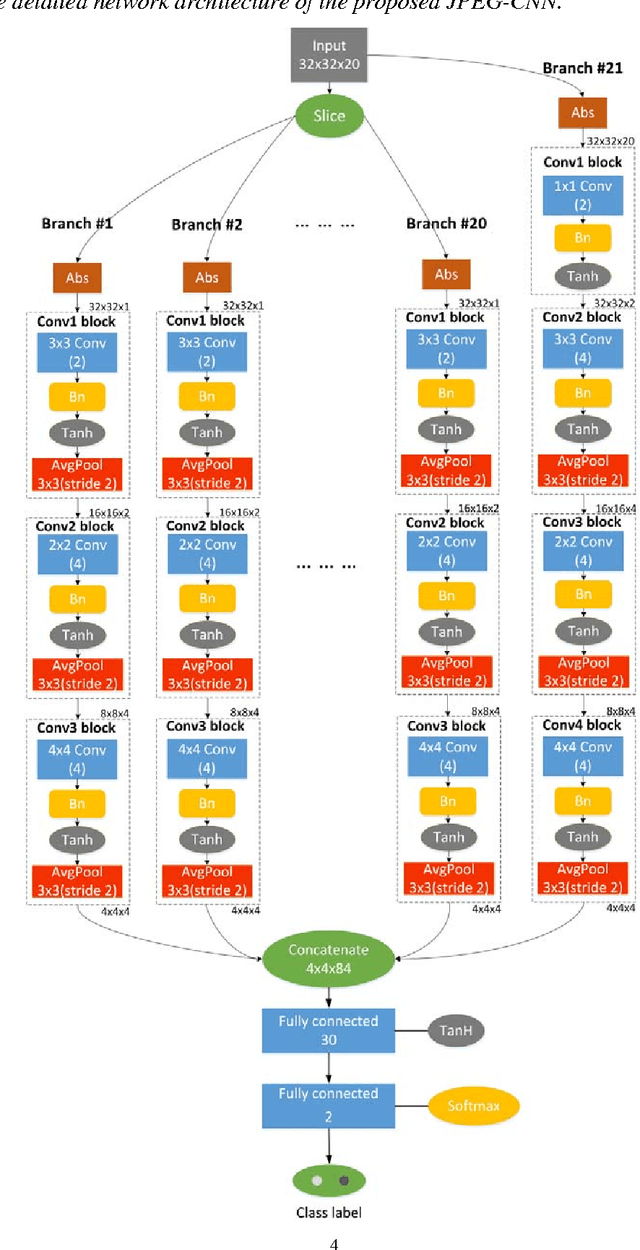
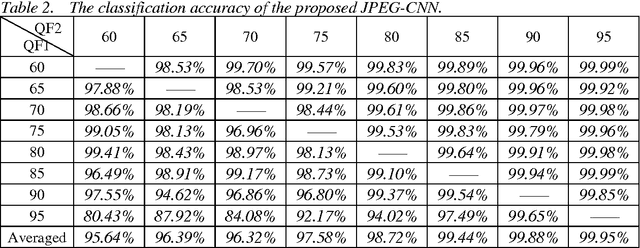
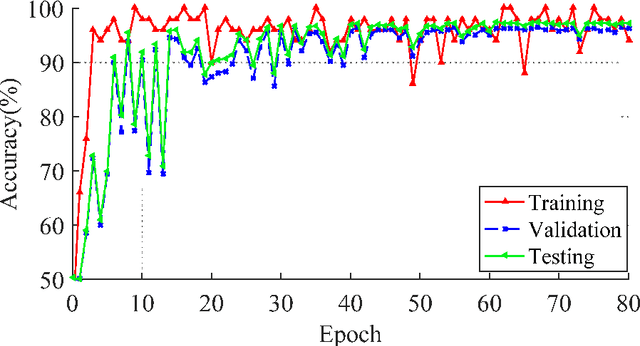
Detection of double JPEG compression is important to forensics analysis. A few methods were proposed based on convolutional neural networks (CNNs). These methods only accept inputs from pre-processed data, such as histogram features and/or decompressed images. In this paper, we present a CNN solution by using raw DCT (discrete cosine transformation) coefficients from JPEG images as input. Considering the DCT sub-band nature in JPEG, a multiple-branch CNN structure has been designed to reveal whether a JPEG format image has been doubly compressed. Comparing with previous methods, the proposed method provides end-to-end detection capability. Extensive experiments have been carried out to demonstrate the effectiveness of the proposed network.