 Add to Chrome
 Add to Firefox
 Add to Edge
Statistical Inference for Temporal Difference Learning with Linear Function Approximation
Oct 21, 2024
Statistical inference with finite-sample validity for the value function of a given policy in Markov decision processes (MDPs) is crucial for ensuring the reliability of reinforcement learning. Temporal Difference (TD) learning, arguably the most widely used algorithm for policy evaluation, serves as a natural framework for this purpose.In this paper, we study the consistency properties of TD learning with Polyak-Ruppert averaging and linear function approximation, and obtain three significant improvements over existing results. First, we derive a novel sharp high-dimensional probability convergence guarantee that depends explicitly on the asymptotic variance and holds under weak conditions. We further establish refined high-dimensional Berry-Esseen bounds over the class of convex sets that guarantee faster rates than those in the literature. Finally, we propose a plug-in estimator for the asymptotic covariance matrix, designed for efficient online computation. These results enable the construction of confidence regions and simultaneous confidence intervals for the linear parameters of the value function, with guaranteed finite-sample coverage. We demonstrate the applicability of our theoretical findings through numerical experiments.

Improved Convergence Rate for Diffusion Probabilistic Models
Oct 17, 2024Score-based diffusion models have achieved remarkable empirical performance in the field of machine learning and artificial intelligence for their ability to generate high-quality new data instances from complex distributions. Improving our understanding of diffusion models, including mainly convergence analysis for such models, has attracted a lot of interests. Despite a lot of theoretical attempts, there still exists significant gap between theory and practice. Towards to close this gap, we establish an iteration complexity at the order of $d^{1/3}\varepsilon^{-2/3}$, which is better than $d^{5/12}\varepsilon^{-1}$, the best known complexity achieved before our work. This convergence analysis is based on a randomized midpoint method, which is first proposed for log-concave sampling (Shen and Lee, 2019), and then extended to diffusion models by Gupta et al. (2024). Our theory accommodates $\varepsilon$-accurate score estimates, and does not require log-concavity on the target distribution. Moreover, the algorithm can also be parallelized to run in only $O(\log^2(d/\varepsilon))$ parallel rounds in a similar way to prior works.
DART: A Diffusion-Based Autoregressive Motion Model for Real-Time Text-Driven Motion Control
Oct 07, 2024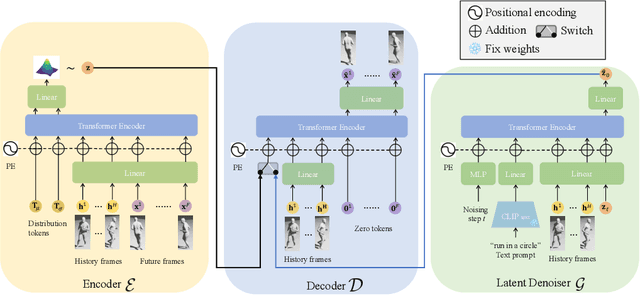

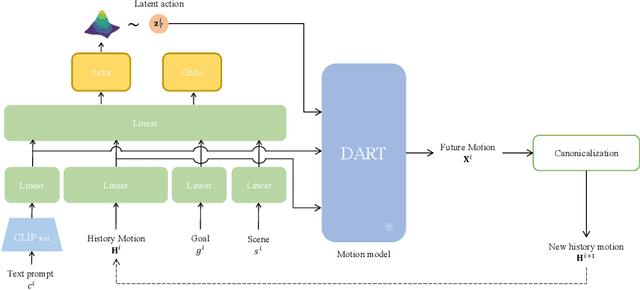

Text-conditioned human motion generation, which allows for user interaction through natural language, has become increasingly popular. Existing methods typically generate short, isolated motions based on a single input sentence. However, human motions are continuous and can extend over long periods, carrying rich semantics. Creating long, complex motions that precisely respond to streams of text descriptions, particularly in an online and real-time setting, remains a significant challenge. Furthermore, incorporating spatial constraints into text-conditioned motion generation presents additional challenges, as it requires aligning the motion semantics specified by text descriptions with geometric information, such as goal locations and 3D scene geometry. To address these limitations, we propose DART, a Diffusion-based Autoregressive motion primitive model for Real-time Text-driven motion control. Our model, DART, effectively learns a compact motion primitive space jointly conditioned on motion history and text inputs using latent diffusion models. By autoregressively generating motion primitives based on the preceding history and current text input, DART enables real-time, sequential motion generation driven by natural language descriptions. Additionally, the learned motion primitive space allows for precise spatial motion control, which we formulate either as a latent noise optimization problem or as a Markov decision process addressed through reinforcement learning. We present effective algorithms for both approaches, demonstrating our model's versatility and superior performance in various motion synthesis tasks. Experiments show our method outperforms existing baselines in motion realism, efficiency, and controllability. Video results are available on the project page: https://zkf1997.github.io/DART/.
SpecSAR-Former: A Lightweight Transformer-based Network for Global LULC Mapping Using Integrated Sentinel-1 and Sentinel-2
Oct 04, 2024


Recent approaches in remote sensing have increasingly focused on multimodal data, driven by the growing availability of diverse earth observation datasets. Integrating complementary information from different modalities has shown substantial potential in enhancing semantic understanding. However, existing global multimodal datasets often lack the inclusion of Synthetic Aperture Radar (SAR) data, which excels at capturing texture and structural details. SAR, as a complementary perspective to other modalities, facilitates the utilization of spatial information for global land use and land cover (LULC). To address this gap, we introduce the Dynamic World+ dataset, expanding the current authoritative multispectral dataset, Dynamic World, with aligned SAR data. Additionally, to facilitate the combination of multispectral and SAR data, we propose a lightweight transformer architecture termed SpecSAR-Former. It incorporates two innovative modules, Dual Modal Enhancement Module (DMEM) and Mutual Modal Aggregation Module (MMAM), designed to exploit cross-information between the two modalities in a split-fusion manner. These modules enhance the model's ability to integrate spectral and spatial information, thereby improving the overall performance of global LULC semantic segmentation. Furthermore, we adopt an imbalanced parameter allocation strategy that assigns parameters to different modalities based on their importance and information density. Extensive experiments demonstrate that our network outperforms existing transformer and CNN-based models, achieving a mean Intersection over Union (mIoU) of 59.58%, an Overall Accuracy (OA) of 79.48%, and an F1 Score of 71.68% with only 26.70M parameters. The code will be available at https://github.com/Reagan1311/LULC_segmentation.
$O(d/T)$ Convergence Theory for Diffusion Probabilistic Models under Minimal Assumptions
Sep 27, 2024

Score-based diffusion models, which generate new data by learning to reverse a diffusion process that perturbs data from the target distribution into noise, have achieved remarkable success across various generative tasks. Despite their superior empirical performance, existing theoretical guarantees are often constrained by stringent assumptions or suboptimal convergence rates. In this paper, we establish a fast convergence theory for a popular SDE-based sampler under minimal assumptions. Our analysis shows that, provided $\ell_{2}$-accurate estimates of the score functions, the total variation distance between the target and generated distributions is upper bounded by $O(d/T)$ (ignoring logarithmic factors), where $d$ is the data dimensionality and $T$ is the number of steps. This result holds for any target distribution with finite first-order moment. To our knowledge, this improves upon existing convergence theory for both the SDE-based sampler and another ODE-based sampler, while imposing minimal assumptions on the target data distribution and score estimates. This is achieved through a novel set of analytical tools that provides a fine-grained characterization of how the error propagates at each step of the reverse process.
AEANet: Affinity Enhanced Attentional Networks for Arbitrary Style Transfer
Sep 24, 2024

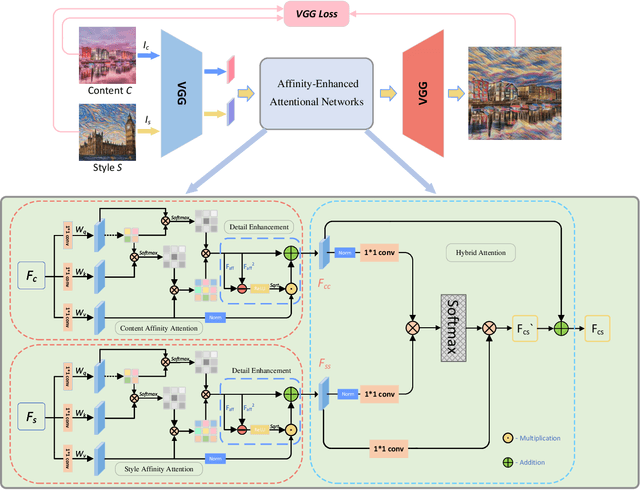
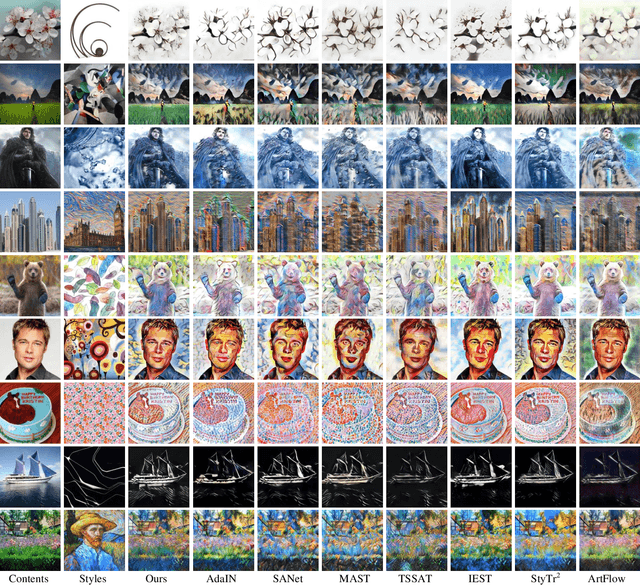
Arbitrary artistic style transfer is a research area that combines rational academic study with emotive artistic creation. It aims to create a new image from a content image according to a target artistic style, maintaining the content's textural structural information while incorporating the artistic characteristics of the style image. However, existing style transfer methods often significantly damage the texture lines of the content image during the style transformation. To address these issues, we propose affinity-enhanced attentional network, which include the content affinity-enhanced attention (CAEA) module, the style affinity-enhanced attention (SAEA) module, and the hybrid attention (HA) module. The CAEA and SAEA modules first use attention to enhance content and style representations, followed by a detail enhanced (DE) module to reinforce detail features. The hybrid attention module adjusts the style feature distribution based on the content feature distribution. We also introduce the local dissimilarity loss based on affinity attention, which better preserves the affinity with content and style images. Experiments demonstrate that our work achieves better results in arbitrary style transfer than other state-of-the-art methods.
F3T: A soft tactile unit with 3D force and temperature mathematical decoupling ability for robots
Sep 05, 2024


The human skin exhibits remarkable capability to perceive contact forces and environmental temperatures, providing intricate information essential for nuanced manipulation. Despite recent advancements in soft tactile sensors, a significant challenge remains in accurately decoupling signals - specifically, separating force from directional orientation and temperature - resulting in fail to meet the advanced application requirements of robots. This research proposes a multi-layered soft sensor unit (F3T) designed to achieve isolated measurements and mathematical decoupling of normal pressure, omnidirectional tangential forces, and temperature. We developed a circular coaxial magnetic film featuring a floating-mountain multi-layer capacitor, facilitating the physical decoupling of normal and tangential forces in all directions. Additionally, we incorporated an ion gel-based temperature sensing film atop the tactile sensor. This sensor is resilient to external pressure and deformation, enabling it to measure temperature and, crucially, eliminate capacitor errors induced by environmental temperature changes. This innovative design allows for the decoupled measurement of multiple signals, paving the way for advancements in higher-level robot motion control, autonomous decision-making, and task planning.
A Score-Based Density Formula, with Applications in Diffusion Generative Models
Aug 29, 2024Score-based generative models (SGMs) have revolutionized the field of generative modeling, achieving unprecedented success in generating realistic and diverse content. Despite empirical advances, the theoretical basis for why optimizing the evidence lower bound (ELBO) on the log-likelihood is effective for training diffusion generative models, such as DDPMs, remains largely unexplored. In this paper, we address this question by establishing a density formula for a continuous-time diffusion process, which can be viewed as the continuous-time limit of the forward process in an SGM. This formula reveals the connection between the target density and the score function associated with each step of the forward process. Building on this, we demonstrate that the minimizer of the optimization objective for training DDPMs nearly coincides with that of the true objective, providing a theoretical foundation for optimizing DDPMs using the ELBO. Furthermore, we offer new insights into the role of score-matching regularization in training GANs, the use of ELBO in diffusion classifiers, and the recently proposed diffusion loss.
Learning Precise Affordances from Egocentric Videos for Robotic Manipulation
Aug 19, 2024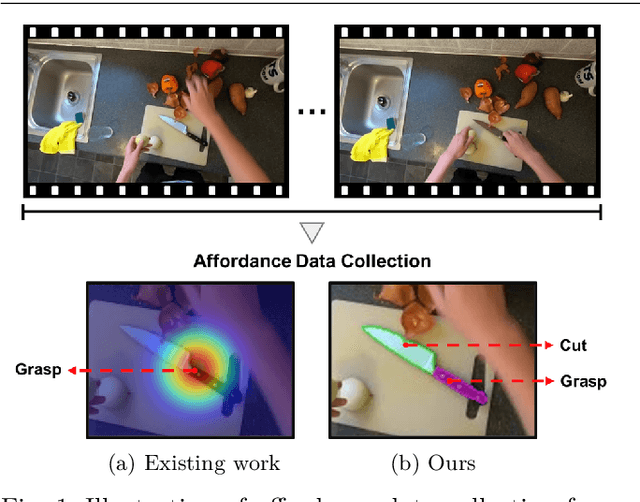

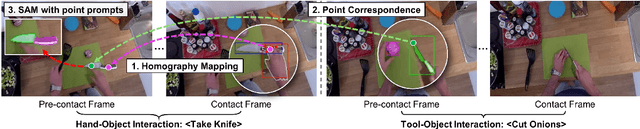

Affordance, defined as the potential actions that an object offers, is crucial for robotic manipulation tasks. A deep understanding of affordance can lead to more intelligent AI systems. For example, such knowledge directs an agent to grasp a knife by the handle for cutting and by the blade when passing it to someone. In this paper, we present a streamlined affordance learning system that encompasses data collection, effective model training, and robot deployment. First, we collect training data from egocentric videos in an automatic manner. Different from previous methods that focus only on the object graspable affordance and represent it as coarse heatmaps, we cover both graspable (e.g., object handles) and functional affordances (e.g., knife blades, hammer heads) and extract data with precise segmentation masks. We then propose an effective model, termed Geometry-guided Affordance Transformer (GKT), to train on the collected data. GKT integrates an innovative Depth Feature Injector (DFI) to incorporate 3D shape and geometric priors, enhancing the model's understanding of affordances. To enable affordance-oriented manipulation, we further introduce Aff-Grasp, a framework that combines GKT with a grasp generation model. For comprehensive evaluation, we create an affordance evaluation dataset with pixel-wise annotations, and design real-world tasks for robot experiments. The results show that GKT surpasses the state-of-the-art by 15.9% in mIoU, and Aff-Grasp achieves high success rates of 95.5% in affordance prediction and 77.1% in successful grasping among 179 trials, including evaluations with seen, unseen objects, and cluttered scenes.
A Sharp Convergence Theory for The Probability Flow ODEs of Diffusion Models
Aug 05, 2024Diffusion models, which convert noise into new data instances by learning to reverse a diffusion process, have become a cornerstone in contemporary generative modeling. In this work, we develop non-asymptotic convergence theory for a popular diffusion-based sampler (i.e., the probability flow ODE sampler) in discrete time, assuming access to $\ell_2$-accurate estimates of the (Stein) score functions. For distributions in $\mathbb{R}^d$, we prove that $d/\varepsilon$ iterations -- modulo some logarithmic and lower-order terms -- are sufficient to approximate the target distribution to within $\varepsilon$ total-variation distance. This is the first result establishing nearly linear dimension-dependency (in $d$) for the probability flow ODE sampler. Imposing only minimal assumptions on the target data distribution (e.g., no smoothness assumption is imposed), our results also characterize how $\ell_2$ score estimation errors affect the quality of the data generation processes. In contrast to prior works, our theory is developed based on an elementary yet versatile non-asymptotic approach without the need of resorting to SDE and ODE toolboxes.