 Add to Chrome
 Add to Firefox
 Add to Edge
Generative AI impacts on intra-urban inequality and skill premium in Beijing
May 25, 2026
Generative artificial intelligence (GenAI) is the first automation wave to reach high-cognitive tasks at scale, yet its effects on intra-urban inequality remain largely unknown. Using 5 million job postings from Beijing (2018--2024), we construct a neighborhood-level GenAI Exposure Index by aggregating task-level assessments from five leading large language models. We examine the spatial, structural and causal mechanisms of this shock. We find that GenAI exposure is highly concentrated in the city's core districts, deepening the intra-urban AI divide. Since 2023, high-exposure neighborhoods have experienced wage stagnation even as they continue to attract high-skilled workers -- a "high-skill trap." This wage penalty is driven by task de-skilling and intensified labor-market crowding. A difference-in-differences design centered on ChatGPT's release supports a causal interpretation. These findings challenge the prevailing theory of skill-biased technological change and provide a basis for inclusive AI governance in global technology hubs.

Repulsor: Accelerating Generative Modeling with a Contrastive Memory Bank
Dec 13, 2025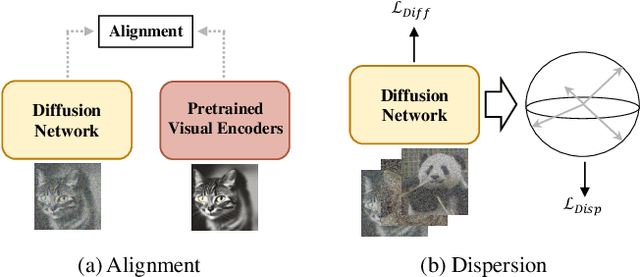
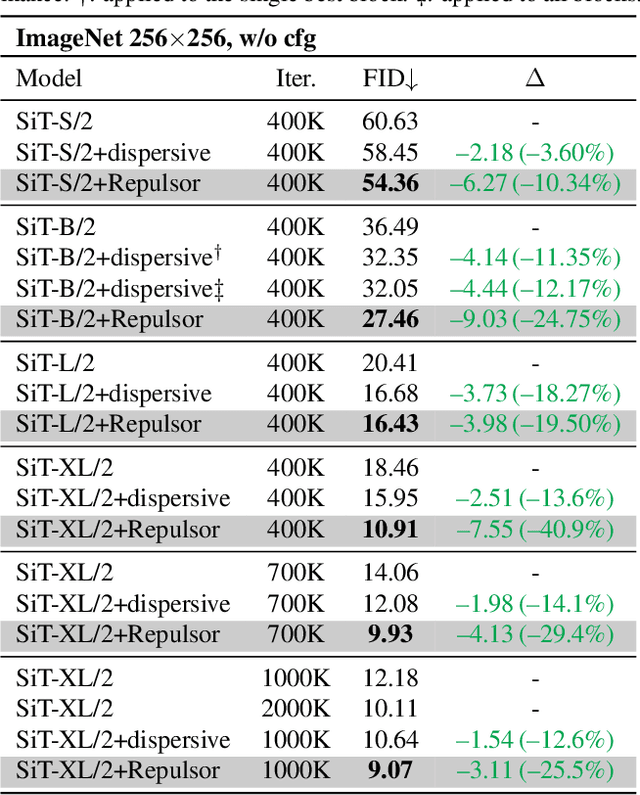
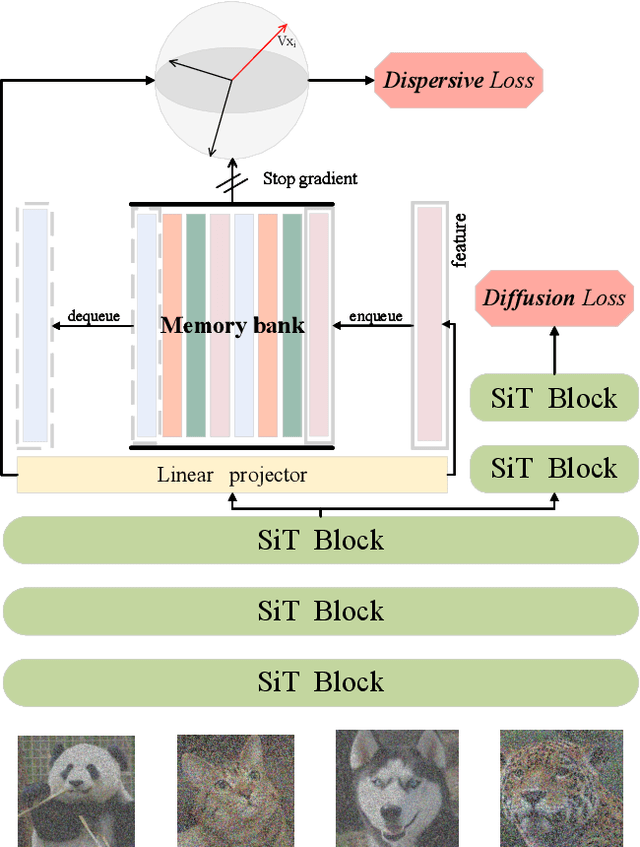
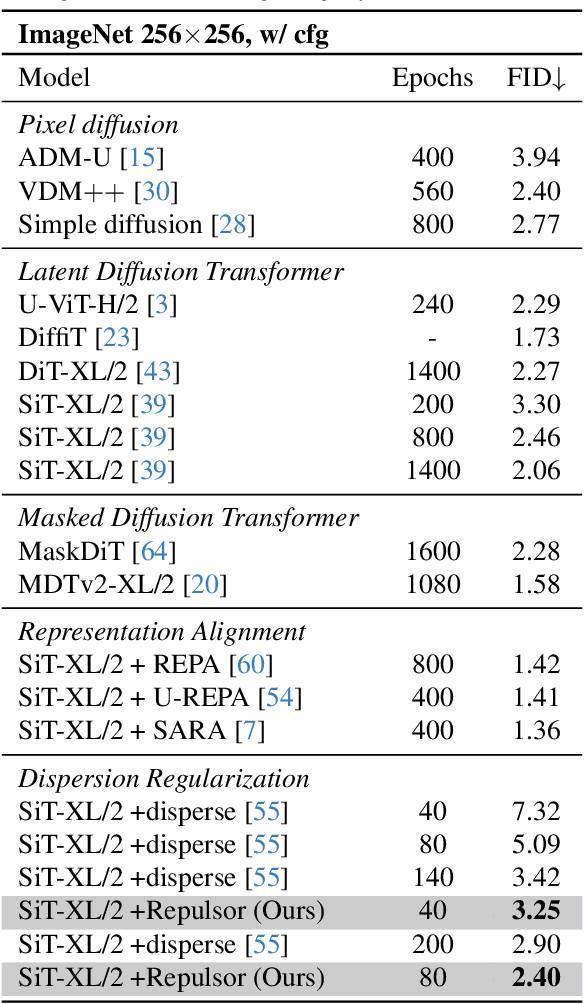
The dominance of denoising generative models (e.g., diffusion, flow-matching) in visual synthesis is tempered by their substantial training costs and inefficiencies in representation learning. While injecting discriminative representations via auxiliary alignment has proven effective, this approach still faces key limitations: the reliance on external, pre-trained encoders introduces overhead and domain shift. A dispersed-based strategy that encourages strong separation among in-batch latent representations alleviates this specific dependency. To assess the effect of the number of negative samples in generative modeling, we propose {\mname}, a plug-and-play training framework that requires no external encoders. Our method integrates a memory bank mechanism that maintains a large, dynamically updated queue of negative samples across training iterations. This decouples the number of negatives from the mini-batch size, providing abundant and high-quality negatives for a contrastive objective without a multiplicative increase in computational cost. A low-dimensional projection head is used to further minimize memory and bandwidth overhead. {\mname} offers three principal advantages: (1) it is self-contained, eliminating dependency on pretrained vision foundation models and their associated forward-pass overhead; (2) it introduces no additional parameters or computational cost during inference; and (3) it enables substantially faster convergence, achieving superior generative quality more efficiently. On ImageNet-256, {\mname} achieves a state-of-the-art FID of \textbf{2.40} within 400k steps, significantly outperforming comparable methods.
F3T: A soft tactile unit with 3D force and temperature mathematical decoupling ability for robots
Sep 05, 2024


The human skin exhibits remarkable capability to perceive contact forces and environmental temperatures, providing intricate information essential for nuanced manipulation. Despite recent advancements in soft tactile sensors, a significant challenge remains in accurately decoupling signals - specifically, separating force from directional orientation and temperature - resulting in fail to meet the advanced application requirements of robots. This research proposes a multi-layered soft sensor unit (F3T) designed to achieve isolated measurements and mathematical decoupling of normal pressure, omnidirectional tangential forces, and temperature. We developed a circular coaxial magnetic film featuring a floating-mountain multi-layer capacitor, facilitating the physical decoupling of normal and tangential forces in all directions. Additionally, we incorporated an ion gel-based temperature sensing film atop the tactile sensor. This sensor is resilient to external pressure and deformation, enabling it to measure temperature and, crucially, eliminate capacitor errors induced by environmental temperature changes. This innovative design allows for the decoupled measurement of multiple signals, paving the way for advancements in higher-level robot motion control, autonomous decision-making, and task planning.