 Add to Chrome
 Add to Firefox
 Add to Edge
AI4GCC -- Track 3: Consumption and the Challenges of Multi-Agent RL
Aug 09, 2023
The AI4GCC competition presents a bold step forward in the direction of integrating machine learning with traditional economic policy analysis. Below, we highlight two potential areas for improvement that could enhance the competition's ability to identify and evaluate proposed negotiation protocols. Firstly, we suggest the inclusion of an additional index that accounts for consumption/utility as part of the evaluation criteria. Secondly, we recommend further investigation into the learning dynamics of agents in the simulator and the game theoretic properties of outcomes from proposed negotiation protocols. We hope that these suggestions can be of use for future iterations of the competition/simulation.

Omega: Optimistic EMA Gradients
Jun 13, 2023Stochastic min-max optimization has gained interest in the machine learning community with the advancements in GANs and adversarial training. Although game optimization is fairly well understood in the deterministic setting, some issues persist in the stochastic regime. Recent work has shown that stochastic gradient descent-ascent methods such as the optimistic gradient are highly sensitive to noise or can fail to converge. Although alternative strategies exist, they can be prohibitively expensive. We introduce Omega, a method with optimistic-like updates that mitigates the impact of noise by incorporating an EMA of historic gradients in its update rule. We also explore a variation of this algorithm that incorporates momentum. Although we do not provide convergence guarantees, our experiments on stochastic games show that Omega outperforms the optimistic gradient method when applied to linear players.
Synaptic Weight Distributions Depend on the Geometry of Plasticity
May 30, 2023
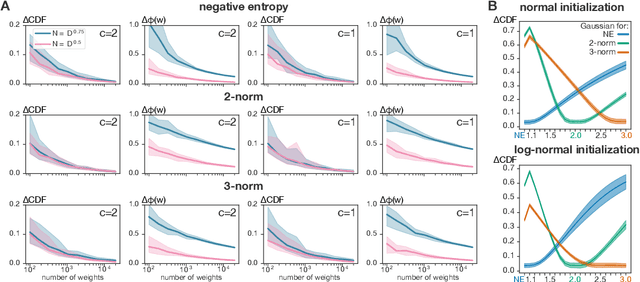

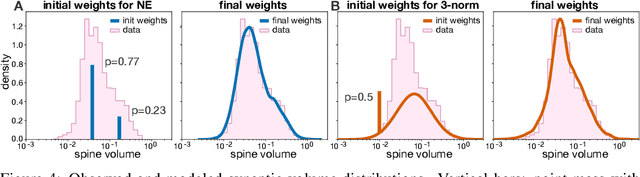
Most learning algorithms in machine learning rely on gradient descent to adjust model parameters, and a growing literature in computational neuroscience leverages these ideas to study synaptic plasticity in the brain. However, the vast majority of this work ignores a critical underlying assumption: the choice of distance for synaptic changes (i.e. the geometry of synaptic plasticity). Gradient descent assumes that the distance is Euclidean, but many other distances are possible, and there is no reason that biology necessarily uses Euclidean geometry. Here, using the theoretical tools provided by mirror descent, we show that, regardless of the loss being minimized, the distribution of synaptic weights will depend on the geometry of synaptic plasticity. We use these results to show that experimentally-observed log-normal weight distributions found in several brain areas are not consistent with standard gradient descent (i.e. a Euclidean geometry), but rather with non-Euclidean distances. Finally, we show that it should be possible to experimentally test for different synaptic geometries by comparing synaptic weight distributions before and after learning. Overall, this work shows that the current paradigm in theoretical work on synaptic plasticity that assumes Euclidean synaptic geometry may be misguided and that it should be possible to experimentally determine the true geometry of synaptic plasticity in the brain.
Raising the Bar for Certified Adversarial Robustness with Diffusion Models
May 17, 2023Certified defenses against adversarial attacks offer formal guarantees on the robustness of a model, making them more reliable than empirical methods such as adversarial training, whose effectiveness is often later reduced by unseen attacks. Still, the limited certified robustness that is currently achievable has been a bottleneck for their practical adoption. Gowal et al. and Wang et al. have shown that generating additional training data using state-of-the-art diffusion models can considerably improve the robustness of adversarial training. In this work, we demonstrate that a similar approach can substantially improve deterministic certified defenses. In addition, we provide a list of recommendations to scale the robustness of certified training approaches. One of our main insights is that the generalization gap, i.e., the difference between the training and test accuracy of the original model, is a good predictor of the magnitude of the robustness improvement when using additional generated data. Our approach achieves state-of-the-art deterministic robustness certificates on CIFAR-10 for the $\ell_2$ ($\epsilon = 36/255$) and $\ell_\infty$ ($\epsilon = 8/255$) threat models, outperforming the previous best results by $+3.95\%$ and $+1.39\%$, respectively. Furthermore, we report similar improvements for CIFAR-100.
Sarah Frank-Wolfe: Methods for Constrained Optimization with Best Rates and Practical Features
Apr 23, 2023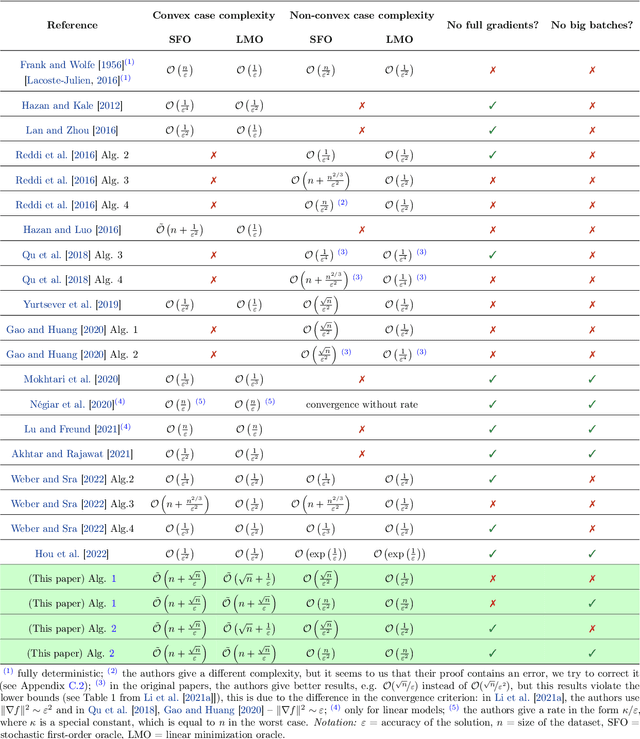

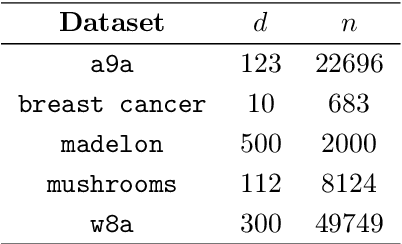

The Frank-Wolfe (FW) method is a popular approach for solving optimization problems with structured constraints that arise in machine learning applications. In recent years, stochastic versions of FW have gained popularity, motivated by large datasets for which the computation of the full gradient is prohibitively expensive. In this paper, we present two new variants of the FW algorithms for stochastic finite-sum minimization. Our algorithms have the best convergence guarantees of existing stochastic FW approaches for both convex and non-convex objective functions. Our methods do not have the issue of permanently collecting large batches, which is common to many stochastic projection-free approaches. Moreover, our second approach does not require either large batches or full deterministic gradients, which is a typical weakness of many techniques for finite-sum problems. The faster theoretical rates of our approaches are confirmed experimentally.
Performative Prediction with Neural Networks
Apr 14, 2023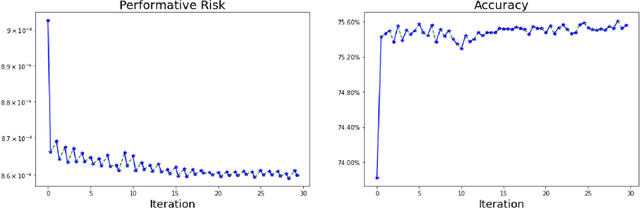
Performative prediction is a framework for learning models that influence the data they intend to predict. We focus on finding classifiers that are performatively stable, i.e. optimal for the data distribution they induce. Standard convergence results for finding a performatively stable classifier with the method of repeated risk minimization assume that the data distribution is Lipschitz continuous to the model's parameters. Under this assumption, the loss must be strongly convex and smooth in these parameters; otherwise, the method will diverge for some problems. In this work, we instead assume that the data distribution is Lipschitz continuous with respect to the model's predictions, a more natural assumption for performative systems. As a result, we are able to significantly relax the assumptions on the loss function. In particular, we do not need to assume convexity with respect to the model's parameters. As an illustration, we introduce a resampling procedure that models realistic distribution shifts and show that it satisfies our assumptions. We support our theory by showing that one can learn performatively stable classifiers with neural networks making predictions about real data that shift according to our proposed procedure.
Feature Likelihood Score: Evaluating Generalization of Generative Models Using Samples
Feb 09, 2023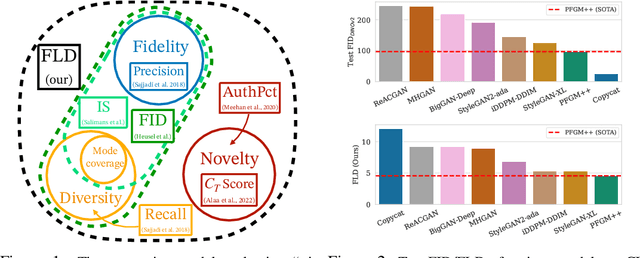
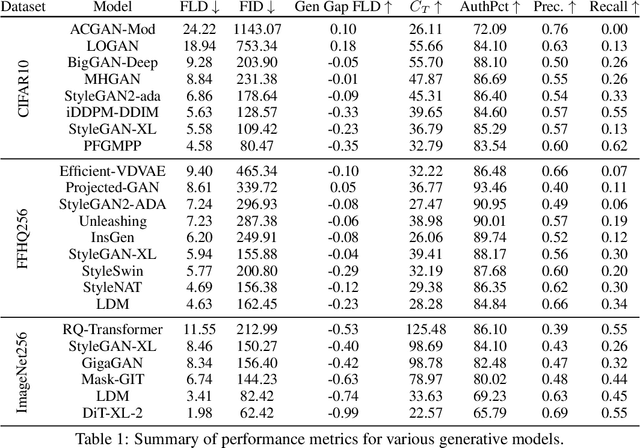
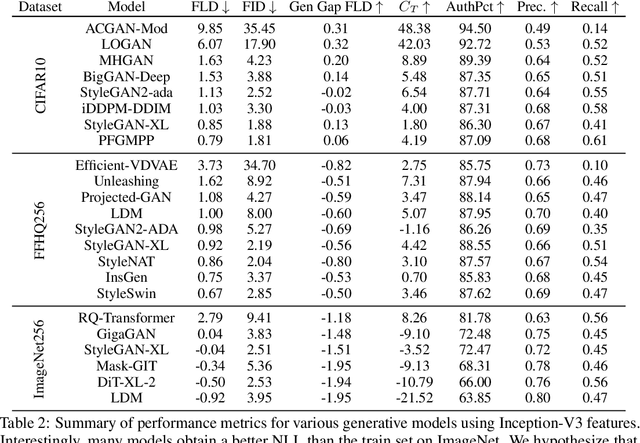
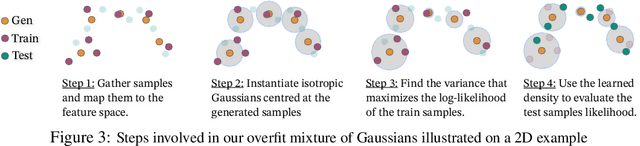
Deep generative models have demonstrated the ability to generate complex, high-dimensional, and photo-realistic data. However, a unified framework for evaluating different generative modeling families remains a challenge. Indeed, likelihood-based metrics do not apply in many cases while pure sample-based metrics such as FID fail to capture known failure modes such as overfitting on training data. In this work, we introduce the Feature Likelihood Score (FLS), a parametric sample-based score that uses density estimation to quantitatively measure the quality/diversity of generated samples while taking into account overfitting. We empirically demonstrate the ability of FLS to identify specific overfitting problem cases, even when previously proposed metrics fail. We further perform an extensive experimental evaluation on various image datasets and model classes. Our results indicate that FLS matches intuitions of previous metrics, such as FID, while providing a more holistic evaluation of generative models that highlights models whose generalization abilities are under or overappreciated. Code for computing FLS is provided at https://github.com/marcojira/fls
High-Probability Bounds for Stochastic Optimization and Variational Inequalities: the Case of Unbounded Variance
Feb 02, 2023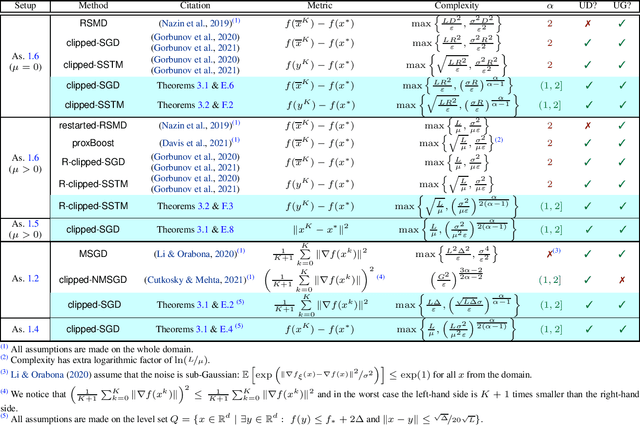
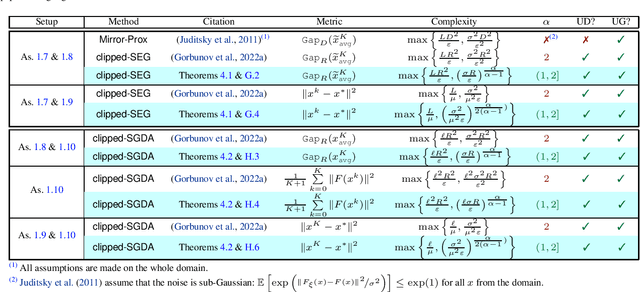
During recent years the interest of optimization and machine learning communities in high-probability convergence of stochastic optimization methods has been growing. One of the main reasons for this is that high-probability complexity bounds are more accurate and less studied than in-expectation ones. However, SOTA high-probability non-asymptotic convergence results are derived under strong assumptions such as the boundedness of the gradient noise variance or of the objective's gradient itself. In this paper, we propose several algorithms with high-probability convergence results under less restrictive assumptions. In particular, we derive new high-probability convergence results under the assumption that the gradient/operator noise has bounded central $\alpha$-th moment for $\alpha \in (1,2]$ in the following setups: (i) smooth non-convex / Polyak-Lojasiewicz / convex / strongly convex / quasi-strongly convex minimization problems, (ii) Lipschitz / star-cocoercive and monotone / quasi-strongly monotone variational inequalities. These results justify the usage of the considered methods for solving problems that do not fit standard functional classes studied in stochastic optimization.
Extragradient with Positive Momentum is Optimal for Games with Cross-Shaped Jacobian Spectrum
Nov 09, 2022The extragradient method has recently gained increasing attention, due to its convergence behavior on smooth games. In $n$-player differentiable games, the eigenvalues of the Jacobian of the vector field are distributed on the complex plane, exhibiting more convoluted dynamics compared to classical (i.e., single player) minimization. In this work, we take a polynomial-based analysis of the extragradient with momentum for optimizing games with \emph{cross-shaped} Jacobian spectrum on the complex plane. We show two results. First, based on the hyperparameter setup, the extragradient with momentum exhibits three different modes of convergence: when the eigenvalues are distributed $i)$ on the real line, $ii)$ both on the real line along with complex conjugates, and $iii)$ only as complex conjugates. Then, we focus on the case $ii)$, i.e., when the eigenvalues of the Jacobian have \emph{cross-shaped} structure, as observed in training generative adversarial networks. For this problem class, we derive the optimal hyperparameters of the momentum extragradient method, and show that it achieves an accelerated convergence rate.
Nesterov Meets Optimism: Rate-Optimal Optimistic-Gradient-Based Method for Stochastic Bilinearly-Coupled Minimax Optimization
Oct 31, 2022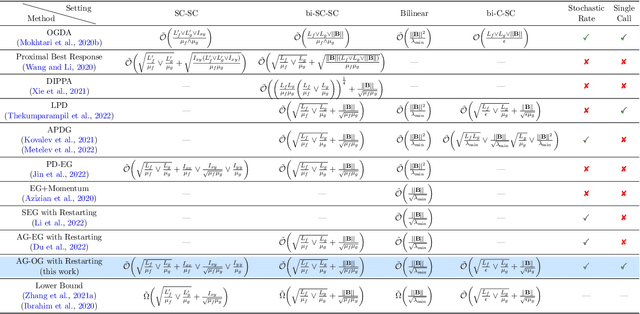
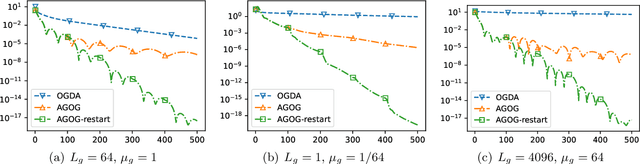
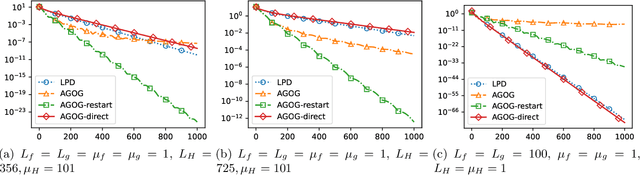
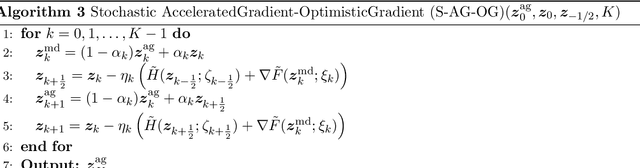
We provide a novel first-order optimization algorithm for bilinearly-coupled strongly-convex-concave minimax optimization called the AcceleratedGradient OptimisticGradient (AG-OG). The main idea of our algorithm is to leverage the structure of the considered minimax problem and operates Nesterov's acceleration on the individual part and optimistic gradient on the coupling part of the objective. We motivate our method by showing that its continuous-time dynamics corresponds to an organic combination of the dynamics of optimistic gradient and of Nesterov's acceleration. By discretizing the dynamics we conclude polynomial convergence behavior in discrete time. Further enhancement of AG-OG with proper restarting allows us to achieve rate-optimal (up to a constant) convergence rates with respect to the conditioning of the coupling and individual parts, which results in the first single-call algorithm achieving improved convergence in the deterministic setting and rate-optimality in the stochastic setting under bilinearly coupled minimax problem sets.