 Add to Chrome
 Add to Firefox
 Add to Edge
One-Step Gradient Delay is Not a Barrier for Large-Scale Asynchronous Pipeline Parallel LLM Pretraining
Jun 29, 2026
Modern large-scale LLM pretraining benefits from utilizing Pipeline Parallelism; however, synchronous implementations leave GPUs idle during pipeline bubbles, wasting computational resources. Asynchronous Pipeline Parallelism eliminates these bubbles, maximizing throughput at the cost of gradient staleness. Among asynchronous schedules, PipeDream-2BW is particularly appealing: unlike the original PipeDream schedule, it ensures a constant one-step gradient delay regardless of pipeline depth. However, its adoption remains limited due to the common belief that optimizing under staleness is fundamentally unstable. In this work, we challenge this assumption, demonstrating that degradation under one-step delay depends strongly on optimizer choice rather than being an intrinsic limitation. We provide the first comprehensive empirical analysis showing that while AdamW, the predominant optimizer at the time when PipeDream-2BW was introduced, indeed suffers from severe degradation, recent methods like Muon exhibit strong robustness under a one-step delay. We introduce an optimizer-agnostic Error Feedback-inspired correction to further mitigate delay effects. We provide supporting theoretical analysis demonstrating convergence for Muon with and without this correction. Extensive evaluation on models up to 10B parameters confirms that our strategies bridge the performance gap with synchronous training, highlighting the practical potential of asynchronous pipeline parallelism at scale.

CacheMuon: Using Temporal Preconditioning To Approximate Polar Factor
Jun 15, 2026Muon is an optimizer that computes updates using the polar factor of the momentum matrix and has shown strong empirical performance across a range of training settings. A key component of Muon is the Newton-Schulz iteration used to compute this polar factor. Although this avoids the cost of an exact singular value decomposition, it remains expensive in practice because it is applied at every optimization step. At the same time, the momentum matrix changes smoothly over training, suggesting strong temporal correlation in the corresponding polar factors. In this paper, we exploit this structure and propose CacheMuon, a temporal preconditioning method that reuses information from previous optimization steps to approximate the polar factor at the current step. This reduces redundant orthogonalization computation across iterations. We analyze CacheMuon as an inexact Muon update, with error controlled by fresh-solver error and cache staleness. Empirically, CacheMuon provides a controllable quality-efficiency frontier: conservative thresholds closely match fresh Muon on language-model and vision training while reducing orthogonalization FLOPs, whereas more aggressive thresholds yield larger arithmetic savings at the cost of modest validation-quality degradation.
LionMuon: Alternating Spectral and Sign Descent for Efficient Training
May 19, 2026In large-scale optimization, the cheapness and effectiveness of update steps are the most crucial factors for a successful optimizer. Sign-based optimizers like Lion or Signum produce cheap per-step updates, whereas Muon's spectral matrix-sign update gives a much stronger direction at a substantially higher per-step cost. In this work, we propose LionMuon, which retains the effectiveness of Muon steps while considerably cutting the averaged iteration cost, similar to sign-based methods. It alternates between Lion's and Muon's updates on a fixed period P, sharing a single dual-EMA momentum buffer between them. The optimizer state memory therefore matches Lion and is exactly half of AdamW's. A simpler single-EMA variant, SignMuon, by itself already outperforms pure Muon. At P = 2, LionMuon Pareto-dominates Muon, Lion, Signum, and AdamW on every dataset and architecture we tested at 124M model size, reaching lower validation loss at lower compute, and the same advantage persists at 355M and 720M scale. On the theory side, we prove sharp complexity bounds under heavy-tailed noise which are governed by period-averaged smoothness and noise that interpolate between Muon's and Lion's constants. These bounds predict the compute-optimal period and the conditions under which LionMuon outruns Muon and Lion. Code: https://github.com/brain-lab-research/lion-muon
Byzantine-Robust Optimization under $(L_0, L_1)$-Smoothness
Mar 12, 2026We consider distributed optimization under Byzantine attacks in the presence of $(L_0,L_1)$-smoothness, a generalization of standard $L$-smoothness that captures functions with state-dependent gradient Lipschitz constants. We propose Byz-NSGDM, a normalized stochastic gradient descent method with momentum that achieves robustness against Byzantine workers while maintaining convergence guarantees. Our algorithm combines momentum normalization with Byzantine-robust aggregation enhanced by Nearest Neighbor Mixing (NNM) to handle both the challenges posed by $(L_0,L_1)$-smoothness and Byzantine adversaries. We prove that Byz-NSGDM achieves a convergence rate of $O(K^{-1/4})$ up to a Byzantine bias floor proportional to the robustness coefficient and gradient heterogeneity. Experimental validation on heterogeneous MNIST classification, synthetic $(L_0,L_1)$-smooth optimization, and character-level language modeling with a small GPT model demonstrates the effectiveness of our approach against various Byzantine attack strategies. An ablation study further shows that Byz-NSGDM is robust across a wide range of momentum and learning rate choices.
Learning in the Null Space: Small Singular Values for Continual Learning
Feb 25, 2026Alleviating catastrophic forgetting while enabling further learning is a primary challenge in continual learning (CL). Orthogonal-based training methods have gained attention for their efficiency and strong theoretical properties, and many existing approaches enforce orthogonality through gradient projection. In this paper, we revisit orthogonality and exploit the fact that small singular values correspond to directions that are nearly orthogonal to the input space of previous tasks. Building on this principle, we introduce NESS (Null-space Estimated from Small Singular values), a CL method that applies orthogonality directly in the weight space rather than through gradient manipulation. Specifically, NESS constructs an approximate null space using the smallest singular values of each layer's input representation and parameterizes task-specific updates via a compact low-rank adaptation (LoRA-style) formulation constrained to this subspace. The subspace basis is fixed to preserve the null-space constraint, and only a single trainable matrix is learned for each task. This design ensures that the resulting updates remain approximately in the null space of previous inputs while enabling adaptation to new tasks. Our theoretical analysis and experiments on three benchmark datasets demonstrate competitive performance, low forgetting, and stable accuracy across tasks, highlighting the role of small singular values in continual learning. The code is available at https://github.com/pacman-ctm/NESS.
Beyond SGD, Without SVD: Proximal Subspace Iteration LoRA with Diagonal Fractional K-FAC
Feb 18, 2026Low-Rank Adaptation (LoRA) fine-tunes large models by learning low-rank updates on top of frozen weights, dramatically reducing trainable parameters and memory. In this work, we address the gap between training with full steps with low-rank projections (SVDLoRA) and LoRA fine-tuning. We propose LoRSum, a memory-efficient subroutine that closes this gap for gradient descent by casting LoRA optimization as a proximal sub-problem and solving it efficiently with alternating least squares updates, which we prove to be an implicit block power method. We recover several recently proposed preconditioning methods for LoRA as special cases, and show that LoRSum can also be used for updating a low-rank momentum. In order to address full steps with preconditioned gradient descent, we propose a scaled variant of LoRSum that uses structured metrics such as K-FAC and Shampoo, and we show that storing the diagonal of these metrics still allows them to perform well while remaining memory-efficient. Experiments on a synthetic task, CIFAR-100, and language-model fine-tuning on GLUE, SQuAD v2, and WikiText-103, show that our method can match or improve LoRA baselines given modest compute overhead, while avoiding full-matrix SVD projections and retaining LoRA-style parameter efficiency.
FlexRank: Nested Low-Rank Knowledge Decomposition for Adaptive Model Deployment
Feb 02, 2026The growing scale of deep neural networks, encompassing large language models (LLMs) and vision transformers (ViTs), has made training from scratch prohibitively expensive and deployment increasingly costly. These models are often used as computational monoliths with fixed cost, a rigidity that does not leverage overparametrized architectures and largely hinders adaptive deployment across different cost budgets. We argue that importance-ordered nested components can be extracted from pretrained models, and selectively activated on the available computational budget. To this end, our proposed FlexRank method leverages low-rank weight decomposition with nested, importance-based consolidation to extract submodels of increasing capabilities. Our approach enables a "train-once, deploy-everywhere" paradigm that offers a graceful trade-off between cost and performance without training from scratch for each budget - advancing practical deployment of large models.
Who to Trust? Aggregating Client Knowledge in Logit-Based Federated Learning
Sep 18, 2025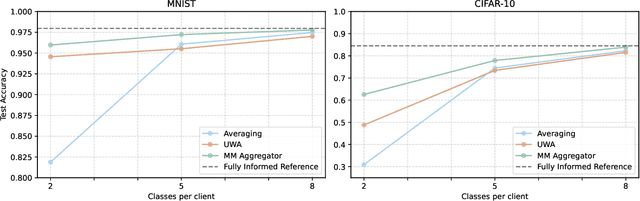
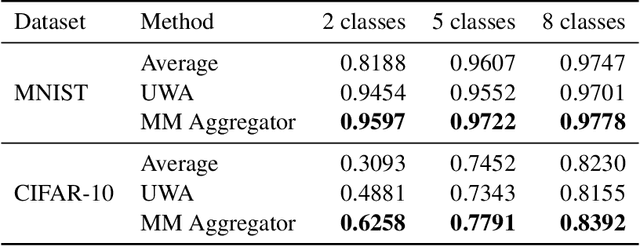
Federated learning (FL) usually shares model weights or gradients, which is costly for large models. Logit-based FL reduces this cost by sharing only logits computed on a public proxy dataset. However, aggregating information from heterogeneous clients is still challenging. This paper studies this problem, introduces and compares three logit aggregation methods: simple averaging, uncertainty-weighted averaging, and a learned meta-aggregator. Evaluated on MNIST and CIFAR-10, these methods reduce communication overhead, improve robustness under non-IID data, and achieve accuracy competitive with centralized training.
Simple Stepsize for Quasi-Newton Methods with Global Convergence Guarantees
Aug 27, 2025Quasi-Newton methods are widely used for solving convex optimization problems due to their ease of implementation, practical efficiency, and strong local convergence guarantees. However, their global convergence is typically established only under specific line search strategies and the assumption of strong convexity. In this work, we extend the theoretical understanding of Quasi-Newton methods by introducing a simple stepsize schedule that guarantees a global convergence rate of ${O}(1/k)$ for the convex functions. Furthermore, we show that when the inexactness of the Hessian approximation is controlled within a prescribed relative accuracy, the method attains an accelerated convergence rate of ${O}(1/k^2)$ -- matching the best-known rates of both Nesterov's accelerated gradient method and cubically regularized Newton methods. We validate our theoretical findings through empirical comparisons, demonstrating clear improvements over standard Quasi-Newton baselines. To further enhance robustness, we develop an adaptive variant that adjusts to the function's curvature while retaining the global convergence guarantees of the non-adaptive algorithm.
DES-LOC: Desynced Low Communication Adaptive Optimizers for Training Foundation Models
May 28, 2025Scaling foundation model training with Distributed Data Parallel (DDP) methods is bandwidth-limited. Existing infrequent communication methods like Local SGD were designed to synchronize only model parameters and cannot be trivially applied to adaptive optimizers due to additional optimizer states. Current approaches extending Local SGD either lack convergence guarantees or require synchronizing all optimizer states, tripling communication costs. We propose Desynced Low Communication Adaptive Optimizers (DES-LOC), a family of optimizers assigning independent synchronization periods to parameters and momenta, enabling lower communication costs while preserving convergence. Through extensive experiments on language models of up to 1.7B, we show that DES-LOC can communicate 170x less than DDP and 2x less than the previous state-of-the-art Local ADAM. Furthermore, unlike previous heuristic approaches, DES-LOC is suited for practical training scenarios prone to system failures. DES-LOC offers a scalable, bandwidth-efficient, and fault-tolerant solution for foundation model training.