 Add to Chrome
 Add to Firefox
 Add to Edge
UniDriveDreamer: A Single-Stage Multimodal World Model for Autonomous Driving
Feb 02, 2026
World models have demonstrated significant promise for data synthesis in autonomous driving. However, existing methods predominantly concentrate on single-modality generation, typically focusing on either multi-camera video or LiDAR sequence synthesis. In this paper, we propose UniDriveDreamer, a single-stage unified multimodal world model for autonomous driving, which directly generates multimodal future observations without relying on intermediate representations or cascaded modules. Our framework introduces a LiDAR-specific variational autoencoder (VAE) designed to encode input LiDAR sequences, alongside a video VAE for multi-camera images. To ensure cross-modal compatibility and training stability, we propose Unified Latent Anchoring (ULA), which explicitly aligns the latent distributions of the two modalities. The aligned features are fused and processed by a diffusion transformer that jointly models their geometric correspondence and temporal evolution. Additionally, structured scene layout information is projected per modality as a conditioning signal to guide the synthesis. Extensive experiments demonstrate that UniDriveDreamer outperforms previous state-of-the-art methods in both video and LiDAR generation, while also yielding measurable improvements in downstream

Open-sourced Data Ecosystem in Autonomous Driving: the Present and Future
Dec 06, 2023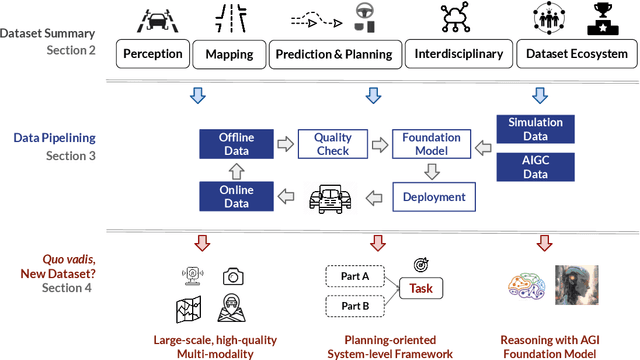
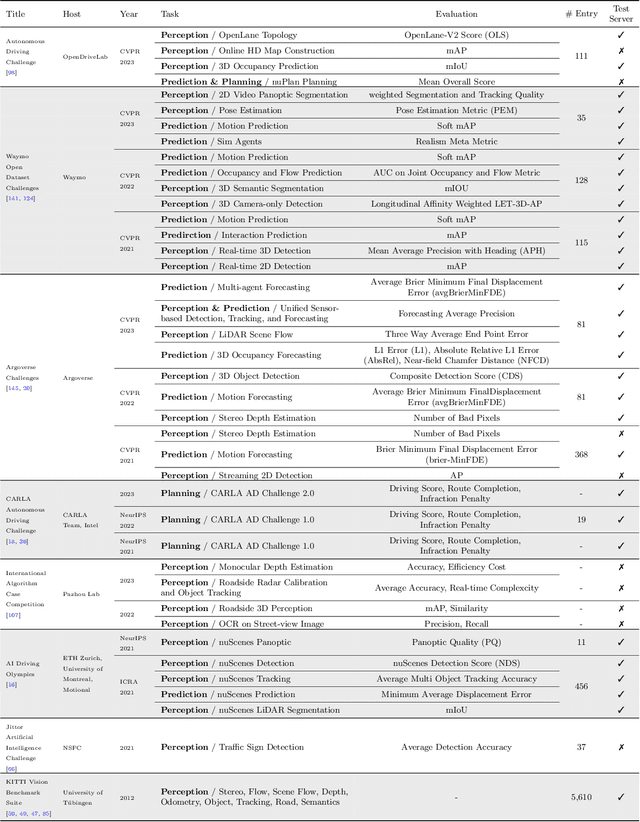
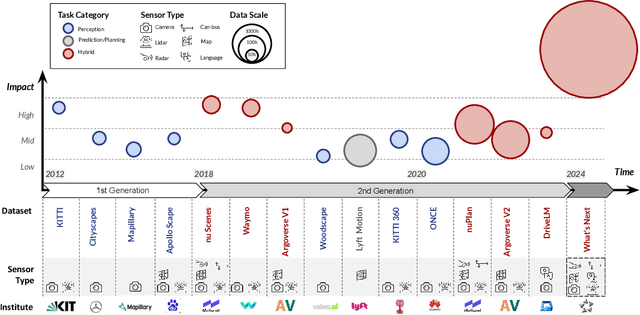
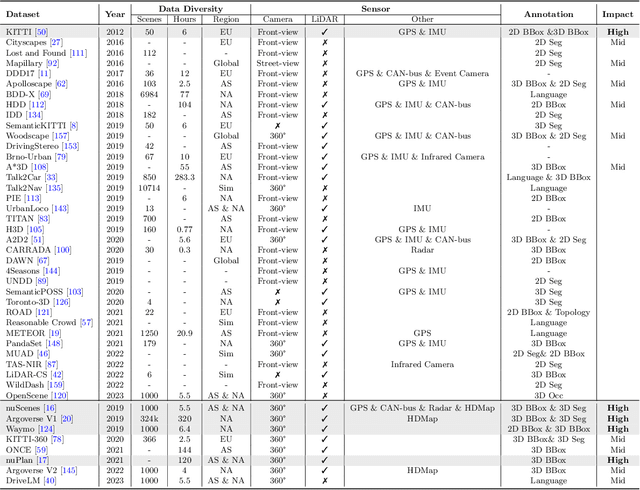
With the continuous maturation and application of autonomous driving technology, a systematic examination of open-source autonomous driving datasets becomes instrumental in fostering the robust evolution of the industry ecosystem. Current autonomous driving datasets can broadly be categorized into two generations. The first-generation autonomous driving datasets are characterized by relatively simpler sensor modalities, smaller data scale, and is limited to perception-level tasks. KITTI, introduced in 2012, serves as a prominent representative of this initial wave. In contrast, the second-generation datasets exhibit heightened complexity in sensor modalities, greater data scale and diversity, and an expansion of tasks from perception to encompass prediction and control. Leading examples of the second generation include nuScenes and Waymo, introduced around 2019. This comprehensive review, conducted in collaboration with esteemed colleagues from both academia and industry, systematically assesses over seventy open-source autonomous driving datasets from domestic and international sources. It offers insights into various aspects, such as the principles underlying the creation of high-quality datasets, the pivotal role of data engine systems, and the utilization of generative foundation models to facilitate scalable data generation. Furthermore, this review undertakes an exhaustive analysis and discourse regarding the characteristics and data scales that future third-generation autonomous driving datasets should possess. It also delves into the scientific and technical challenges that warrant resolution. These endeavors are pivotal in advancing autonomous innovation and fostering technological enhancement in critical domains. For further details, please refer to https://github.com/OpenDriveLab/DriveAGI.