 Add to Chrome
 Add to Firefox
 Add to Edge
SyncPlan: Long-Horizon LLM Coordination with Explicit Synchronization and Adaptive Correction
Aug 03, 2026
LLM-based multi-agent coordination faces a fundamental trade-off between efficiency and adaptivity in dynamic environments. Existing approaches typically rely on repeated LLM invocations or multi-round communication to adapt decisions during execution, introducing substantial latency and making coordination vulnerable to asynchronous progress and environmental changes. Conversely, one-shot planning reduces coordination overhead but produces open-loop plans that can quickly become stale or fail when actions depend on other agents and the environment. We introduce SyncPlan, a plan-execute-correct framework for long-horizon coordination through explicit synchronization and adaptive correction. Given the state and team-level task, a centralized LLM coordinator generates per-agent action chains in a single planning call. During execution, explicit wait primitives and deadlock detection enforce inter-agent and agent-environment dependencies, while a lightweight Plan Staleness Detector continuously assesses the remaining plan and triggers replanning when environmental changes invalidate its assumptions. We further optimize the coordinator through SFT and planning-oriented RL with dense task progress and outcome-level execution feedback. Experiments on the public Overcooked benchmark and the complex Honor of Kings environment show that SyncPlan achieves state-of-the-art task success rates while using less than 0.05% of the wall-clock runtime compared with existing LLM-based coordinators. Code and datasets will be made publicly available.

Learning Diverse Policies in MOBA Games via Macro-Goals
Oct 27, 2021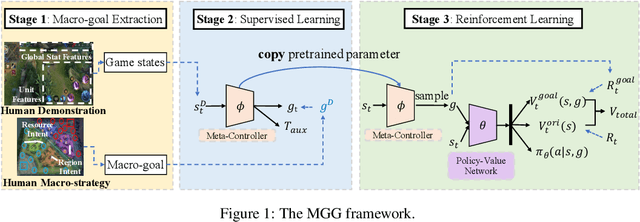
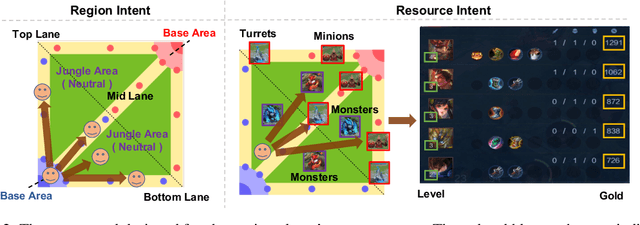
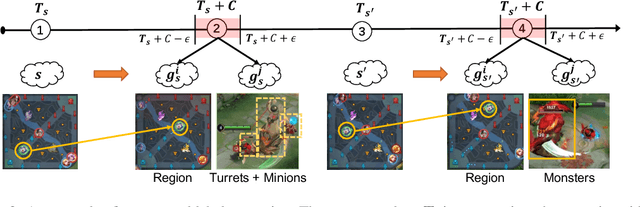
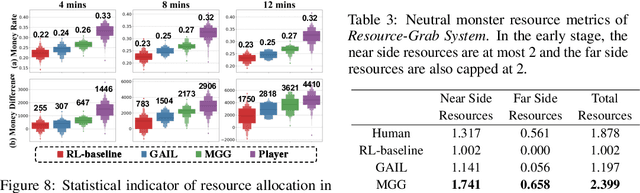
Recently, many researchers have made successful progress in building the AI systems for MOBA-game-playing with deep reinforcement learning, such as on Dota 2 and Honor of Kings. Even though these AI systems have achieved or even exceeded human-level performance, they still suffer from the lack of policy diversity. In this paper, we propose a novel Macro-Goals Guided framework, called MGG, to learn diverse policies in MOBA games. MGG abstracts strategies as macro-goals from human demonstrations and trains a Meta-Controller to predict these macro-goals. To enhance policy diversity, MGG samples macro-goals from the Meta-Controller prediction and guides the training process towards these goals. Experimental results on the typical MOBA game Honor of Kings demonstrate that MGG can execute diverse policies in different matches and lineups, and also outperform the state-of-the-art methods over 102 heroes.
Towards Playing Full MOBA Games with Deep Reinforcement Learning
Dec 31, 2020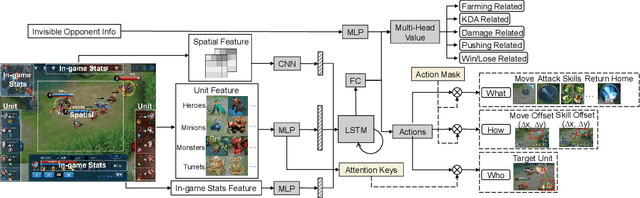
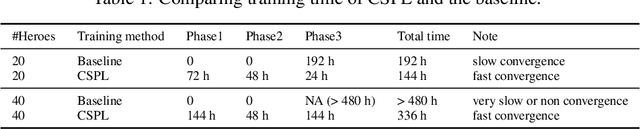
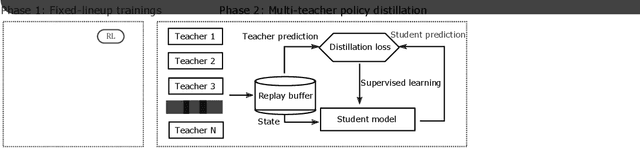

MOBA games, e.g., Honor of Kings, League of Legends, and Dota 2, pose grand challenges to AI systems such as multi-agent, enormous state-action space, complex action control, etc. Developing AI for playing MOBA games has raised much attention accordingly. However, existing work falls short in handling the raw game complexity caused by the explosion of agent combinations, i.e., lineups, when expanding the hero pool in case that OpenAI's Dota AI limits the play to a pool of only 17 heroes. As a result, full MOBA games without restrictions are far from being mastered by any existing AI system. In this paper, we propose a MOBA AI learning paradigm that methodologically enables playing full MOBA games with deep reinforcement learning. Specifically, we develop a combination of novel and existing learning techniques, including curriculum self-play learning, policy distillation, off-policy adaption, multi-head value estimation, and Monte-Carlo tree-search, in training and playing a large pool of heroes, meanwhile addressing the scalability issue skillfully. Tested on Honor of Kings, a popular MOBA game, we show how to build superhuman AI agents that can defeat top esports players. The superiority of our AI is demonstrated by the first large-scale performance test of MOBA AI agent in the literature.
Supervised Learning Achieves Human-Level Performance in MOBA Games: A Case Study of Honor of Kings
Nov 25, 2020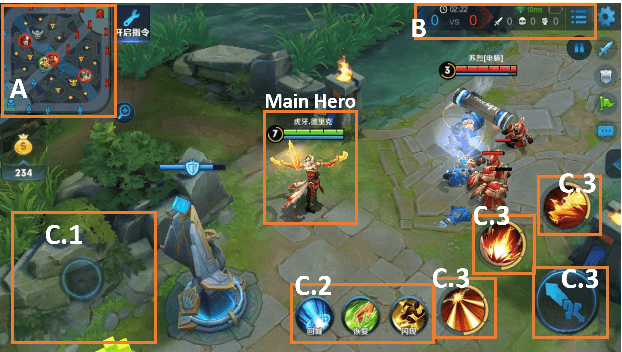
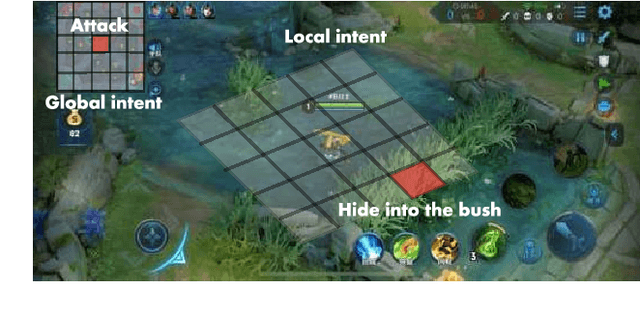
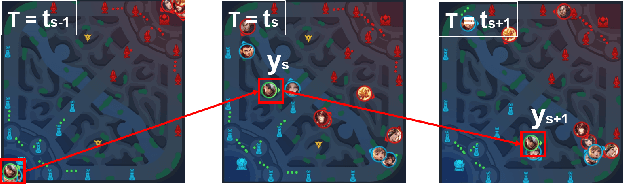
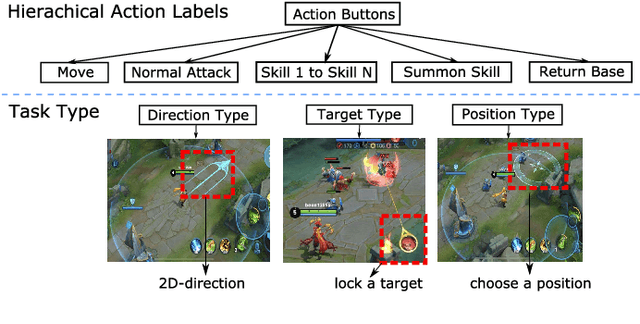
We present JueWu-SL, the first supervised-learning-based artificial intelligence (AI) program that achieves human-level performance in playing multiplayer online battle arena (MOBA) games. Unlike prior attempts, we integrate the macro-strategy and the micromanagement of MOBA-game-playing into neural networks in a supervised and end-to-end manner. Tested on Honor of Kings, the most popular MOBA at present, our AI performs competitively at the level of High King players in standard 5v5 games.