 Add to Chrome
 Add to Firefox
 Add to Edge
SyncPlan: Long-Horizon LLM Coordination with Explicit Synchronization and Adaptive Correction
Aug 03, 2026
LLM-based multi-agent coordination faces a fundamental trade-off between efficiency and adaptivity in dynamic environments. Existing approaches typically rely on repeated LLM invocations or multi-round communication to adapt decisions during execution, introducing substantial latency and making coordination vulnerable to asynchronous progress and environmental changes. Conversely, one-shot planning reduces coordination overhead but produces open-loop plans that can quickly become stale or fail when actions depend on other agents and the environment. We introduce SyncPlan, a plan-execute-correct framework for long-horizon coordination through explicit synchronization and adaptive correction. Given the state and team-level task, a centralized LLM coordinator generates per-agent action chains in a single planning call. During execution, explicit wait primitives and deadlock detection enforce inter-agent and agent-environment dependencies, while a lightweight Plan Staleness Detector continuously assesses the remaining plan and triggers replanning when environmental changes invalidate its assumptions. We further optimize the coordinator through SFT and planning-oriented RL with dense task progress and outcome-level execution feedback. Experiments on the public Overcooked benchmark and the complex Honor of Kings environment show that SyncPlan achieves state-of-the-art task success rates while using less than 0.05% of the wall-clock runtime compared with existing LLM-based coordinators. Code and datasets will be made publicly available.

Self-supervised Learning for Electroencephalogram: A Systematic Survey
Jan 09, 2024


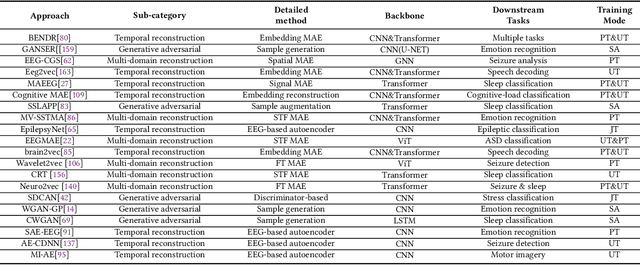
Electroencephalogram (EEG) is a non-invasive technique to record bioelectrical signals. Integrating supervised deep learning techniques with EEG signals has recently facilitated automatic analysis across diverse EEG-based tasks. However, the label issues of EEG signals have constrained the development of EEG-based deep models. Obtaining EEG annotations is difficult that requires domain experts to guide collection and labeling, and the variability of EEG signals among different subjects causes significant label shifts. To solve the above challenges, self-supervised learning (SSL) has been proposed to extract representations from unlabeled samples through well-designed pretext tasks. This paper concentrates on integrating SSL frameworks with temporal EEG signals to achieve efficient representation and proposes a systematic review of the SSL for EEG signals. In this paper, 1) we introduce the concept and theory of self-supervised learning and typical SSL frameworks. 2) We provide a comprehensive review of SSL for EEG analysis, including taxonomy, methodology, and technique details of the existing EEG-based SSL frameworks, and discuss the difference between these methods. 3) We investigate the adaptation of the SSL approach to various downstream tasks, including the task description and related benchmark datasets. 4) Finally, we discuss the potential directions for future SSL-EEG research.