 Add to Chrome
 Add to Firefox
 Add to Edge
SyncPlan: Long-Horizon LLM Coordination with Explicit Synchronization and Adaptive Correction
Aug 03, 2026
LLM-based multi-agent coordination faces a fundamental trade-off between efficiency and adaptivity in dynamic environments. Existing approaches typically rely on repeated LLM invocations or multi-round communication to adapt decisions during execution, introducing substantial latency and making coordination vulnerable to asynchronous progress and environmental changes. Conversely, one-shot planning reduces coordination overhead but produces open-loop plans that can quickly become stale or fail when actions depend on other agents and the environment. We introduce SyncPlan, a plan-execute-correct framework for long-horizon coordination through explicit synchronization and adaptive correction. Given the state and team-level task, a centralized LLM coordinator generates per-agent action chains in a single planning call. During execution, explicit wait primitives and deadlock detection enforce inter-agent and agent-environment dependencies, while a lightweight Plan Staleness Detector continuously assesses the remaining plan and triggers replanning when environmental changes invalidate its assumptions. We further optimize the coordinator through SFT and planning-oriented RL with dense task progress and outcome-level execution feedback. Experiments on the public Overcooked benchmark and the complex Honor of Kings environment show that SyncPlan achieves state-of-the-art task success rates while using less than 0.05% of the wall-clock runtime compared with existing LLM-based coordinators. Code and datasets will be made publicly available.

Diverse Policies Recovering via Pointwise Mutual Information Weighted Imitation Learning
Oct 21, 2024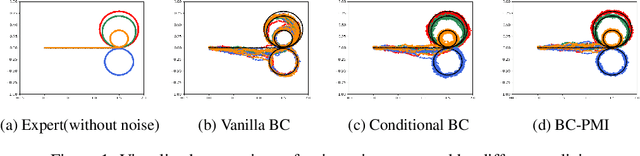


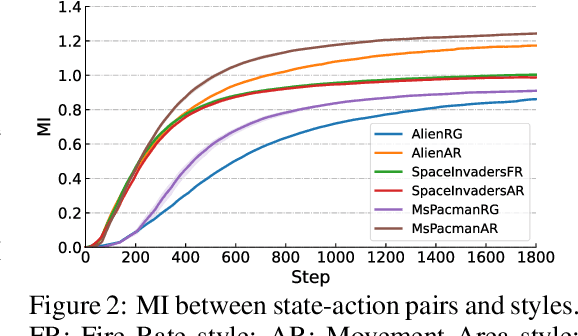
Recovering a spectrum of diverse policies from a set of expert trajectories is an important research topic in imitation learning. After determining a latent style for a trajectory, previous diverse policies recovering methods usually employ a vanilla behavioral cloning learning objective conditioned on the latent style, treating each state-action pair in the trajectory with equal importance. Based on an observation that in many scenarios, behavioral styles are often highly relevant with only a subset of state-action pairs, this paper presents a new principled method in diverse polices recovery. In particular, after inferring or assigning a latent style for a trajectory, we enhance the vanilla behavioral cloning by incorporating a weighting mechanism based on pointwise mutual information. This additional weighting reflects the significance of each state-action pair's contribution to learning the style, thus allowing our method to focus on state-action pairs most representative of that style. We provide theoretical justifications for our new objective, and extensive empirical evaluations confirm the effectiveness of our method in recovering diverse policies from expert data.
Hokoff: Real Game Dataset from Honor of Kings and its Offline Reinforcement Learning Benchmarks
Aug 20, 2024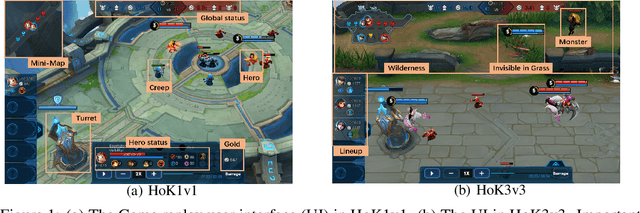

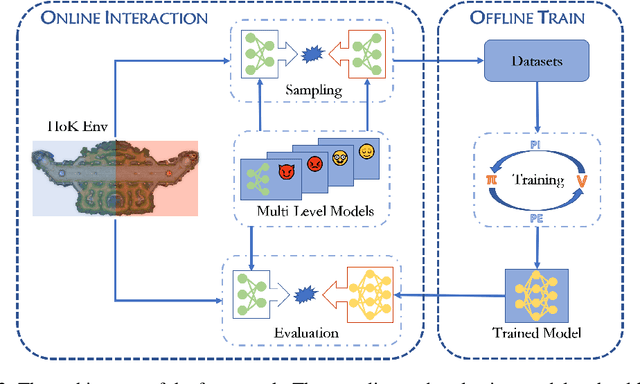
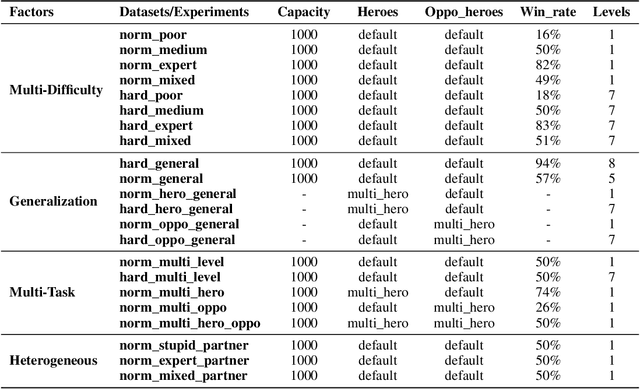
The advancement of Offline Reinforcement Learning (RL) and Offline Multi-Agent Reinforcement Learning (MARL) critically depends on the availability of high-quality, pre-collected offline datasets that represent real-world complexities and practical applications. However, existing datasets often fall short in their simplicity and lack of realism. To address this gap, we propose Hokoff, a comprehensive set of pre-collected datasets that covers both offline RL and offline MARL, accompanied by a robust framework, to facilitate further research. This data is derived from Honor of Kings, a recognized Multiplayer Online Battle Arena (MOBA) game known for its intricate nature, closely resembling real-life situations. Utilizing this framework, we benchmark a variety of offline RL and offline MARL algorithms. We also introduce a novel baseline algorithm tailored for the inherent hierarchical action space of the game. We reveal the incompetency of current offline RL approaches in handling task complexity, generalization and multi-task learning.