 Add to Chrome
 Add to Firefox
 Add to Edge
Initiation Safety: A Missing Dimension in Generalist-Robot Safety
Jul 08, 2026
Safety for generalist robots is usually discussed in terms of motion or dialogue. We argue a third question is missing: should the robot take its first hard-to-undo social action at all, such as a greeting, an uninvited grasp, or stepping into someone's space? We call this initiation authorization. Current frameworks rarely treat it as a separate safety layer. Today's stacks often skip this step: a high engagement score or a confident VLA rollout is treated as permission to act. But seeing a person is not the same as having their consent to be addressed. We frame initiation authorization within generalist-robot safety and contrast it with post-plan VLA guardrails, implementing PAS (probe-authorize-speak) on a doorway humanoid, comparing it with direct-init on logged traces, and proposing a three-condition user study, with open questions on metrics, governance, and where initiation ends and foundation-model generation begins.

Generating Natural and Expressive Robot Gestures through Iterative Reinforcement Learning with Human Feedback using LLMs
Jun 17, 2026Expressive gestures are essential for natural and effective communication, complementing speech when verbal cues alone are insufficient (e.g., pointing). For social robots such as the humanoid Pepper, producing natural and expressive movements is critical for improving human-robot interaction (HRI) and long-term acceptance. However, generating gestures remains challenging due to reliance on expert-authored animations, resulting in rigid behaviors that are impractical for dynamic and diverse environments. Alternatively, machine learning approaches often struggle to capture perceived naturalness, becoming increasingly challenging with more degrees of freedom. Consequently, producing expressive robot gestures requires a system that can adapt to the environment while adhering to social norms and physical constraints. Recent advances in large language models (LLMs) enable dynamic code generation, offering new opportunities for runtime gesture synthesis from natural language. In this paper, we integrate ChatGPT into the humanoid robot Pepper to generate co-speech gestures aligned with conversational output. While this baseline enables flexible gesture generation, the resulting motions are often perceived as stiff and unnatural. To address this limitation, we introduce an iterative reinforcement learning with human feedback (RLHF) system that finetunes gesture generation based on user evaluations, leveraging an iterative user study to compare Pepper's generated gestures. Our results show that RLHF improved the LLM's co-speech generative capabilities, producing more expressive, relevant and fluid movements.
Infant Spontaneous Movement Noise Improves Exploration in Deep RL
Jun 16, 2026Exploration in deep reinforcement learning (RL) is commonly implemented as temporally uncorrelated white noise. However, recent works show that temporally correlated colored noise can improve exploration efficiency by producing smooth trajectories with better coverage of the state space. We inquire whether action noise inspired by infant spontaneous movements can also improve exploration in deep RL. We find that the power spectral densities of babies' end-effector velocities follow a colored noise process where the spectral exponent increases with age. Inspired by this developmental pattern, we introduce a mechanism that progressively increases the temporal auto-correlation of exploration noise during RL training, matching the infant statistics. Experiments across several RL environments show that infant-inspired noise produces structured exploratory behavior and can improve learning efficiency compared to conventional exploration strategies. These findings suggest that human motor and cognitive development can provide useful guidance for designing learning mechanisms in artificial agents. Our code is available at https://github.com/trieschlab/baby-noise-rl.
Self-Predictive Representation for Autonomous UAV Object-Goal Navigation
Apr 22, 2026Autonomous Unmanned Aerial Vehicles (UAVs) have revolutionized industries through their versatility with applications including aerial surveillance, search and rescue, agriculture, and delivery. Their autonomous capabilities offer unique advantages, such as operating in large open space environments. Reinforcement Learning (RL) empowers UAVs to learn intricate navigation policies, enabling them to optimize flight behavior autonomously. However, one of its main challenge is the inefficiency in using data sample to achieve a good policy. In object-goal navigation (OGN) settings, target recognition arises as an extra challenge. Most UAV-related approaches use relative or absolute coordinates to move from an initial position to a predefined location, rather than to find the target directly. This study addresses the data sample efficiency issue in solving a 3D OGN problem, in addition to, the formalization of the unknown target location setting as a Markov decision process. Experiments are conducted to analyze the interplay of different state representation learning (SRL) methods for perception with a model-free RL algorithm for planning in an autonomous navigation system. The main contribution of this study is the development of the perception module, featuring a novel self-predictive model named AmelPred. Empirical results demonstrate that its stochastic version, AmelPredSto, is the best-performing SRL model when combined with actor-critic RL algorithms. The obtained results show substantial improvement in RL algorithms' efficiency by using AmelPredSto in solving the OGN problem.
Conservative Bias in Multi-Teacher Learning: Why Agents Prefer Low-Reward Advisors
Dec 23, 2025Interactive reinforcement learning (IRL) has shown promise in enabling autonomous agents and robots to learn complex behaviours from human teachers, yet the dynamics of teacher selection remain poorly understood. This paper reveals an unexpected phenomenon in IRL: when given a choice between teachers with different reward structures, learning agents overwhelmingly prefer conservative, low-reward teachers (93.16% selection rate) over those offering 20x higher rewards. Through 1,250 experimental runs in navigation tasks with multiple expert teachers, we discovered: (1) Conservative bias dominates teacher selection: agents systematically choose the lowest-reward teacher, prioritising consistency over optimality; (2) Critical performance thresholds exist at teacher availability rho >= 0.6 and accuracy omega >= 0.6, below which the framework fails catastrophically; (3) The framework achieves 159% improvement over baseline Q-learning under concept drift. These findings challenge fundamental assumptions about optimal teaching in RL and suggest potential implications for human-robot collaboration, where human preferences for safety and consistency may align with the observed agent selection behaviour, potentially informing training paradigms for safety-critical robotic applications.
Towards Senior-Robot Interaction: Reactive Robot Dog Gestures
Dec 22, 2025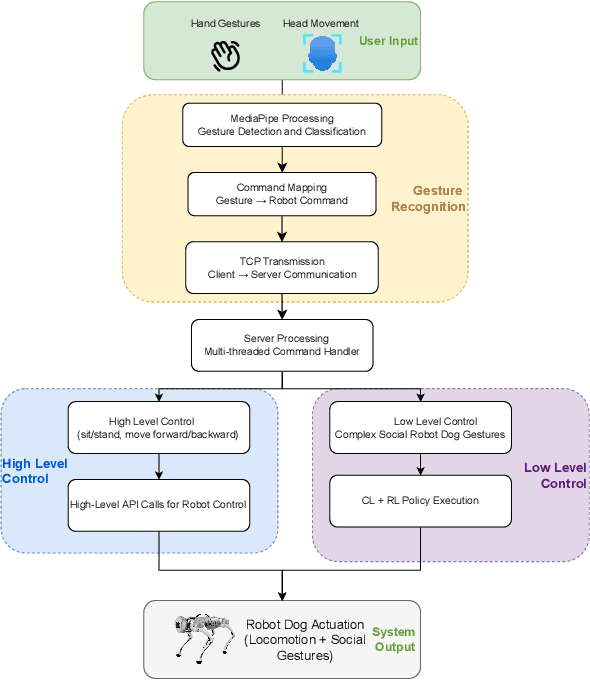
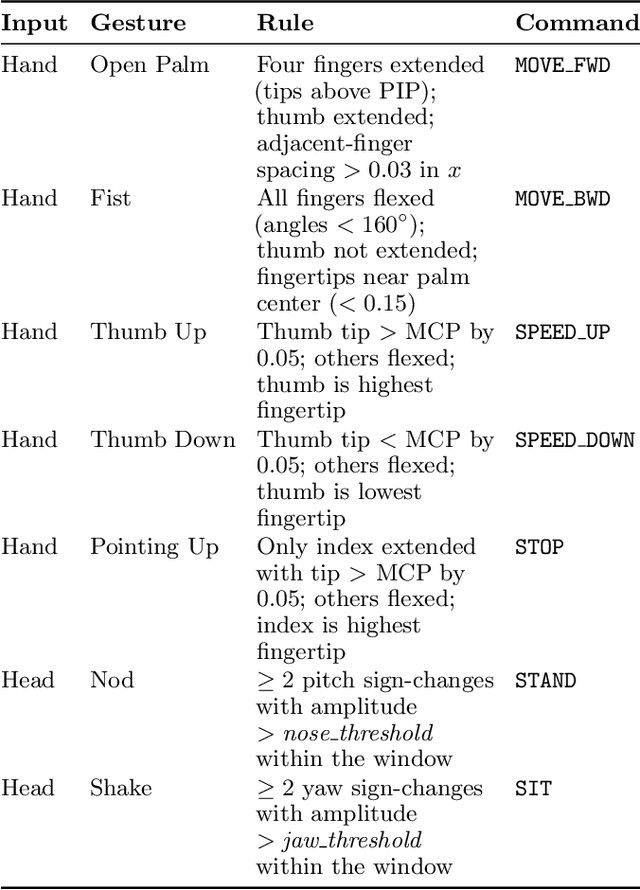
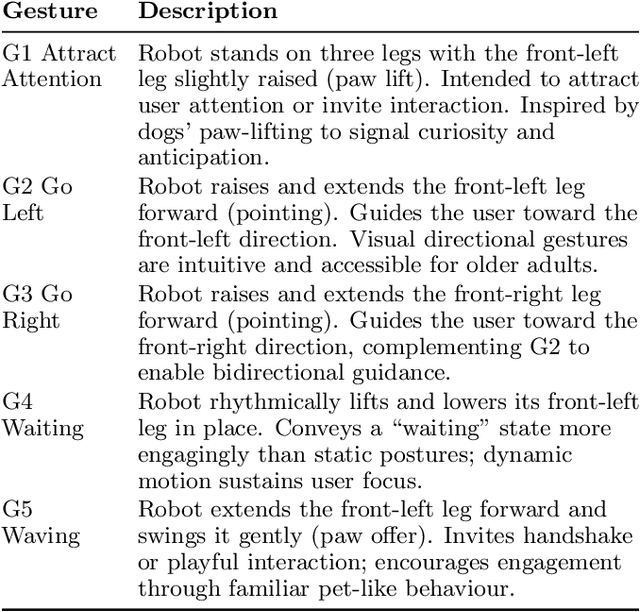

As the global population ages, many seniors face the problem of loneliness. Companion robots offer a potential solution. However, current companion robots often lack advanced functionality, while task-oriented robots are not designed for social interaction, limiting their suitability and acceptance by seniors. Our work introduces a senior-oriented system for quadruped robots that allows for more intuitive user input and provides more socially expressive output. For user input, we implemented a MediaPipe-based module for hand gesture and head movement recognition, enabling control without a remote. For output, we designed and trained robotic dog gestures using curriculum-based reinforcement learning in Isaac Gym, progressing from simple standing to three-legged balancing and leg extensions, and more. The final tests achieved over 95\% success on average in simulation, and we validated a key social gesture (the paw-lift) on a Unitree robot. Real-world tests demonstrated the feasibility and social expressiveness of this framework, while also revealing sim-to-real challenges in joint compliance, load distribution, and balance control. These contributions advance the development of practical quadruped robots as social companions for the senior and outline pathways for sim-to-real adaptation and inform future user studies.
LAPX: Lightweight Hourglass Network with Global Context
Dec 18, 2025Human pose estimation is a crucial task in computer vision. Methods that have SOTA (State-of-the-Art) accuracy, often involve a large number of parameters and incur substantial computational cost. Many lightweight variants have been proposed to reduce the model size and computational cost of them. However, several of these methods still contain components that are not well suited for efficient deployment on edge devices. Moreover, models that primarily emphasize inference speed on edge devices often suffer from limited accuracy due to their overly simplified designs. To address these limitations, we propose LAPX, an Hourglass network with self-attention that captures global contextual information, based on previous work, LAP. In addition to adopting the self-attention module, LAPX advances the stage design and refine the lightweight attention modules. It achieves competitive results on two benchmark datasets, MPII and COCO, with only 2.3M parameters, and demonstrates real-time performance, confirming its edge-device suitability.
Towards Closing the Domain Gap with Event Cameras
Dec 18, 2025Although traditional cameras are the primary sensor for end-to-end driving, their performance suffers greatly when the conditions of the data they were trained on does not match the deployment environment, a problem known as the domain gap. In this work, we consider the day-night lighting difference domain gap. Instead of traditional cameras we propose event cameras as a potential alternative which can maintain performance across lighting condition domain gaps without requiring additional adjustments. Our results show that event cameras maintain more consistent performance across lighting conditions, exhibiting domain-shift penalties that are generally comparable to or smaller than grayscale frames and provide superior baseline performance in cross-domain scenarios.
SWIFT-Nav: Stability-Aware Waypoint-Level TD3 with Fuzzy Arbitration for UAV Navigation in Cluttered Environments
Dec 17, 2025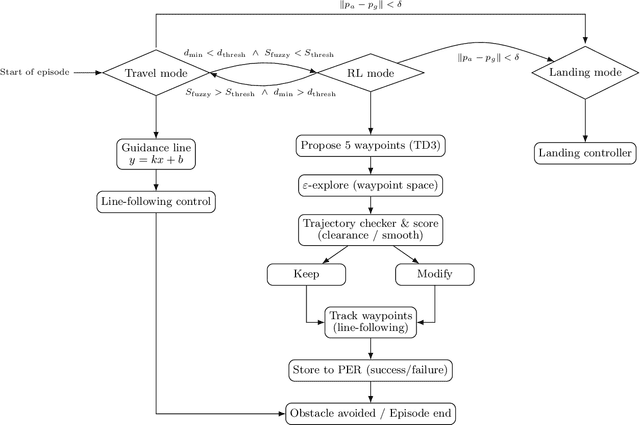
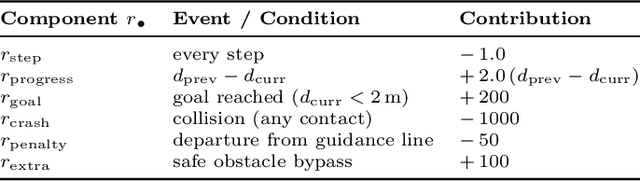
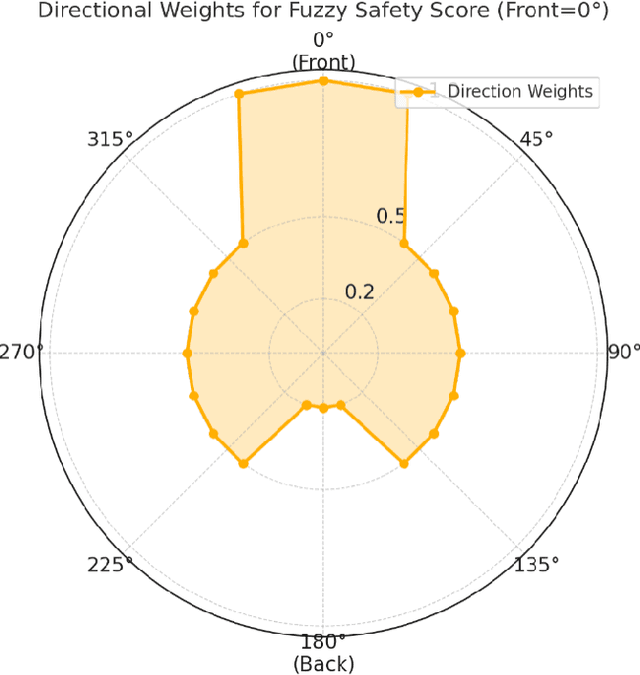
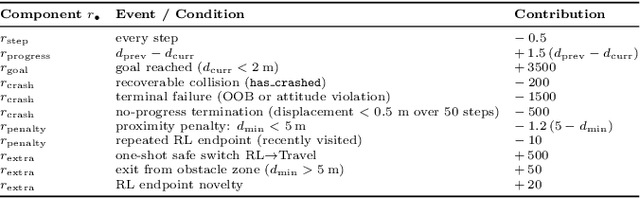
Efficient and reliable UAV navigation in cluttered and dynamic environments remains challenging. We propose SWIFT-Nav: Stability-aware Waypoint-level Integration of Fuzzy arbitration and TD3 for Navigation, a TD3-based navigation framework that achieves fast, stable convergence to obstacle-aware paths. The system couples a sensor-driven perception front end with a TD3 waypoint policy: the perception module converts LiDAR ranges into a confidence-weighted safety map and goal cues, while the TD3 policy is trained with Prioritised Experience Replay to focus on high-error transitions and a decaying epsilon-greedy exploration schedule that gradually shifts from exploration to exploitation. A lightweight fuzzy-logic layer computes a safety score from radial measurements and near obstacles, gates mode switching and clamps unsafe actions; in parallel, task-aligned reward shaping combining goal progress, clearance, and switch-economy terms provides dense, well-scaled feedback that accelerates learning. Implemented in Webots with proximity-based collision checking, our approach consistently outperforms baselines in trajectory smoothness and generalization to unseen layouts, while preserving real-time responsiveness. These results show that combining TD3 with replay prioritisation, calibrated exploration, and fuzzy-safety rules yields a robust and deployable solution for UAV navigation in cluttered scenes.
Ensemble Elastic DQN: A novel multi-step ensemble approach to address overestimation in deep value-based reinforcement learning
Jun 06, 2025While many algorithmic extensions to Deep Q-Networks (DQN) have been proposed, there remains limited understanding of how different improvements interact. In particular, multi-step and ensemble style extensions have shown promise in reducing overestimation bias, thereby improving sample efficiency and algorithmic stability. In this paper, we introduce a novel algorithm called Ensemble Elastic Step DQN (EEDQN), which unifies ensembles with elastic step updates to stabilise algorithmic performance. EEDQN is designed to address two major challenges in deep reinforcement learning: overestimation bias and sample efficiency. We evaluated EEDQN against standard and ensemble DQN variants across the MinAtar benchmark, a set of environments that emphasise behavioral learning while reducing representational complexity. Our results show that EEDQN achieves consistently robust performance across all tested environments, outperforming baseline DQN methods and matching or exceeding state-of-the-art ensemble DQNs in final returns on most of the MinAtar environments. These findings highlight the potential of systematically combining algorithmic improvements and provide evidence that ensemble and multi-step methods, when carefully integrated, can yield substantial gains.