 Add to Chrome
 Add to Firefox
 Add to Edge
HRI-SA: A Multimodal Dataset for Online Assessment of Human Situational Awareness during Remote Human-Robot Teaming
Mar 18, 2026
Maintaining situational awareness (SA) is critical in human-robot teams. Yet, under high workload and dynamic conditions, operators often experience SA gaps. Automated detection of SA gaps could provide timely assistance for operators. However, conventional SA measures either disrupt task flow or cannot capture real-time fluctuations, limiting their operational utility. To the best of our knowledge, no publicly available dataset currently supports the systematic evaluation of online human SA assessment in human-robot teaming. To advance the development of online SA assessment tools, we introduce HRI-SA, a multimodal dataset from 30 participants in a realistic search-and-rescue human-robot teaming context, incorporating eye movements, pupil diameter, biosignals, user interactions, and robot data. The experimental protocol included predefined events requiring timely operator assistance, with ground truth SA latency of two types (perceptual and comprehension) systematically obtained by measuring the time between assistance need onset and resolution. We illustrate the utility of this dataset by evaluating standard machine learning models for detecting perceptual SA latencies using generic eye-tracking features and contextual features. Results show that eye-tracking features alone effectively classified perceptual SA latency (recall=88.91%, F1=67.63%) using leave-one-group-out cross-validation, with performance improved through contextual data fusion (recall=91.51%, F1=80.38%). This paper contributes the first public dataset supporting the systematic evaluation of SA throughout a human-robot teaming mission, while also demonstrating the potential of generic eye-tracking features for continuous perceptual SA latency detection in remote human-robot teaming.

A Framework for Dynamic Situational Awareness in Human Robot Teams: An Interview Study
Jan 15, 2025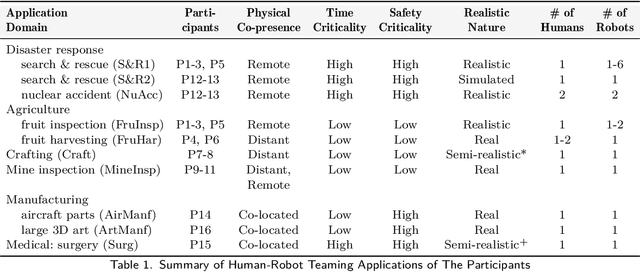

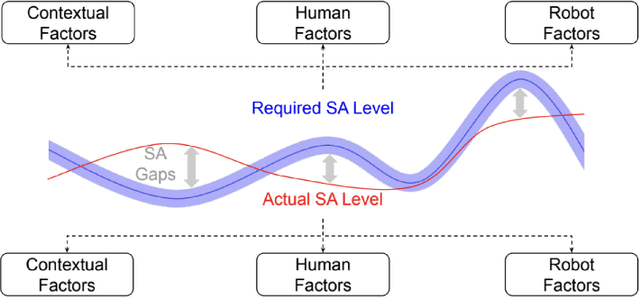

In human-robot teams, human situational awareness is the operator's conscious knowledge of the team's states, actions, plans and their environment. Appropriate human situational awareness is critical to successful human-robot collaboration. In human-robot teaming, it is often assumed that the best and required level of situational awareness is knowing everything at all times. This view is problematic, because what a human needs to know for optimal team performance varies given the dynamic environmental conditions, task context and roles and capabilities of team members. We explore this topic by interviewing 16 participants with active and repeated experience in diverse human-robot teaming applications. Based on analysis of these interviews, we derive a framework explaining the dynamic nature of required situational awareness in human-robot teaming. In addition, we identify a range of factors affecting the dynamic nature of required and actual levels of situational awareness (i.e., dynamic situational awareness), types of situational awareness inefficiencies resulting from gaps between actual and required situational awareness, and their main consequences. We also reveal various strategies, initiated by humans and robots, that assist in maintaining the required situational awareness. Our findings inform the implementation of accurate estimates of dynamic situational awareness and the design of user-adaptive human-robot interfaces. Therefore, this work contributes to the future design of more collaborative and effective human-robot teams.
Adaptive Alignment: Dynamic Preference Adjustments via Multi-Objective Reinforcement Learning for Pluralistic AI
Oct 31, 2024
Emerging research in Pluralistic Artificial Intelligence (AI) alignment seeks to address how intelligent systems can be designed and deployed in accordance with diverse human needs and values. We contribute to this pursuit with a dynamic approach for aligning AI with diverse and shifting user preferences through Multi Objective Reinforcement Learning (MORL), via post-learning policy selection adjustment. In this paper, we introduce the proposed framework for this approach, outline its anticipated advantages and assumptions, and discuss technical details about the implementation. We also examine the broader implications of adopting a retroactive alignment approach through the sociotechnical systems perspective.
Alternative Interfaces for Human-initiated Natural Language Communication and Robot-initiated Haptic Feedback: Towards Better Situational Awareness in Human-Robot Collaboration
Jan 25, 2024This article presents an implementation of a natural-language speech interface and a haptic feedback interface that enables a human supervisor to provide guidance to, request information, and receive status updates from a Spot robot. We provide insights gained during preliminary user testing of the interface in a realistic robot exploration scenario.