 Add to Chrome
 Add to Firefox
 Add to Edge
Towards Senior-Robot Interaction: Reactive Robot Dog Gestures
Dec 22, 2025
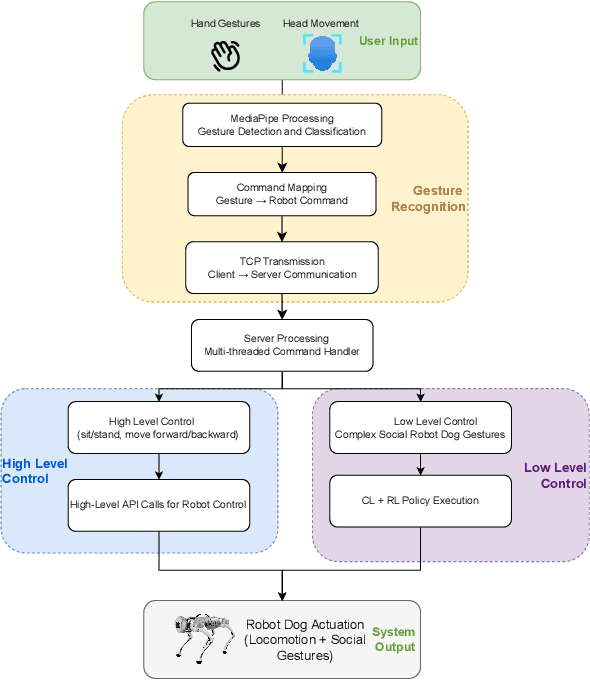
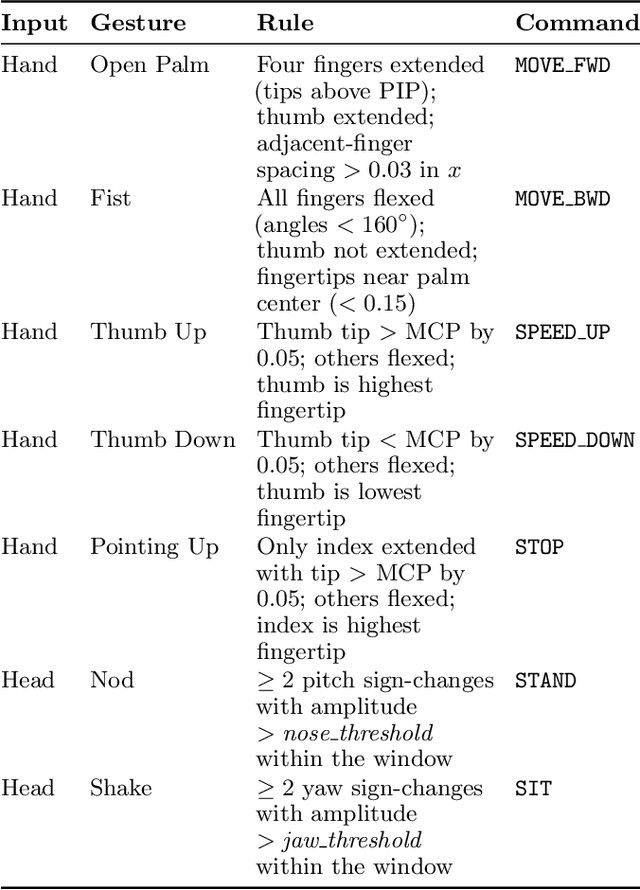
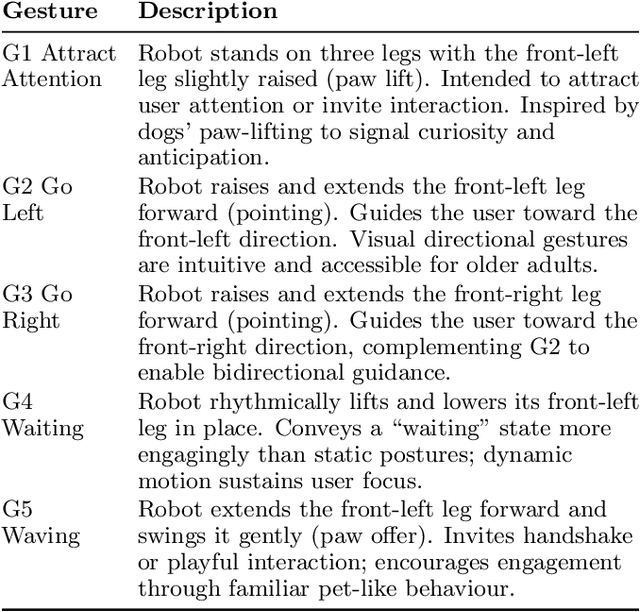

As the global population ages, many seniors face the problem of loneliness. Companion robots offer a potential solution. However, current companion robots often lack advanced functionality, while task-oriented robots are not designed for social interaction, limiting their suitability and acceptance by seniors. Our work introduces a senior-oriented system for quadruped robots that allows for more intuitive user input and provides more socially expressive output. For user input, we implemented a MediaPipe-based module for hand gesture and head movement recognition, enabling control without a remote. For output, we designed and trained robotic dog gestures using curriculum-based reinforcement learning in Isaac Gym, progressing from simple standing to three-legged balancing and leg extensions, and more. The final tests achieved over 95\% success on average in simulation, and we validated a key social gesture (the paw-lift) on a Unitree robot. Real-world tests demonstrated the feasibility and social expressiveness of this framework, while also revealing sim-to-real challenges in joint compliance, load distribution, and balance control. These contributions advance the development of practical quadruped robots as social companions for the senior and outline pathways for sim-to-real adaptation and inform future user studies.

Contextual Affordances for Safe Exploration in Robotic Scenarios
May 10, 2024Robotics has been a popular field of research in the past few decades, with much success in industrial applications such as manufacturing and logistics. This success is led by clearly defined use cases and controlled operating environments. However, robotics has yet to make a large impact in domestic settings. This is due in part to the difficulty and complexity of designing mass-manufactured robots that can succeed in the variety of homes and environments that humans live in and that can operate safely in close proximity to humans. This paper explores the use of contextual affordances to enable safe exploration and learning in robotic scenarios targeted in the home. In particular, we propose a simple state representation that allows us to extend contextual affordances to larger state spaces and showcase how affordances can improve the success and convergence rate of a reinforcement learning algorithm in simulation. Our results suggest that after further iterations, it is possible to consider the implementation of this approach in a real robot manipulator. Furthermore, in the long term, this work could be the foundation for future explorations of human-robot interactions in complex domestic environments. This could be possible once state-of-the-art robot manipulators achieve the required level of dexterity for the described affordances in this paper.
A Decision Support Design Framework for Selecting a Robotic Interface
Feb 08, 2022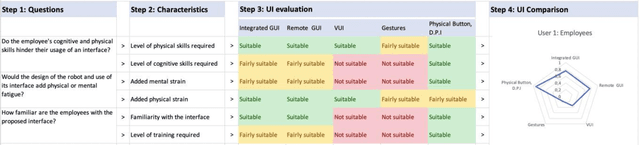
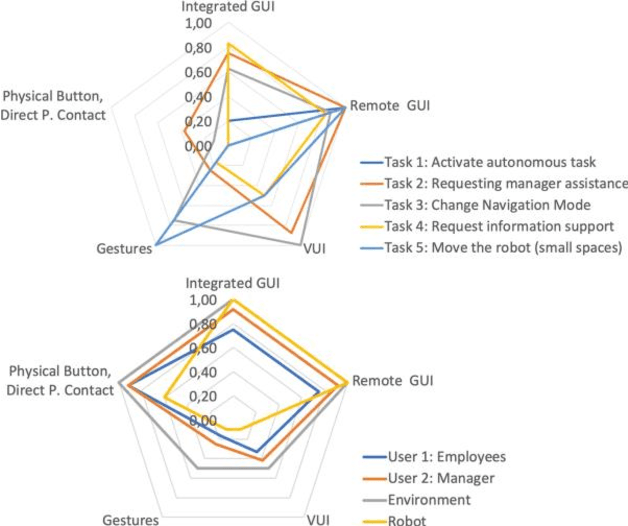
The design and development of robots involve the essential step of selecting and testing robotic interfaces. This interface selection requires careful consideration as the robot's physical embodiment influences and adds to the traditional interfaces' complexities. Our paper presents a decision support design framework for the a priori selection of robotic interface that was inductively formulated from our case study of designing a robot to collaborate with employees with cognitive disabilities. Our framework outlines the interface requirements according to User, Robot, Tasks and Environment and facilitates a structured comparison of interfaces against those requirements. The framework is assessed for its potential applicability and usefulness through a qualitative study with HRI experts. The framework is appreciated as a systematic tool that enables documentation and discussion, and identified issues inform the frameworks' iteration. The themes of ownership of this process in interdisciplinary teams and its role in iteratively designing interfaces are discussed.