 Add to Chrome
 Add to Firefox
 Add to Edge
ZipLoRA: Any Subject in Any Style by Effectively Merging LoRAs
Nov 22, 2023

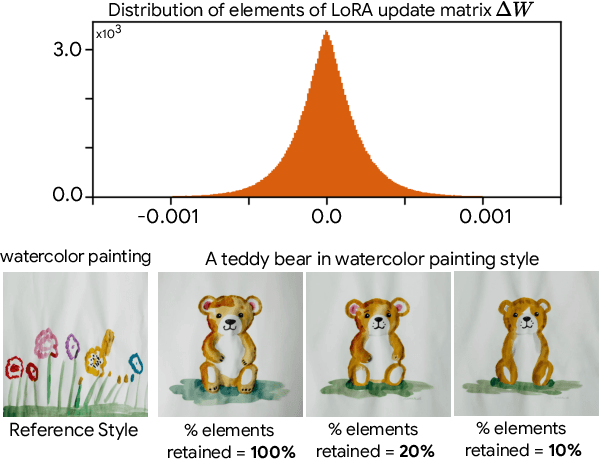


Methods for finetuning generative models for concept-driven personalization generally achieve strong results for subject-driven or style-driven generation. Recently, low-rank adaptations (LoRA) have been proposed as a parameter-efficient way of achieving concept-driven personalization. While recent work explores the combination of separate LoRAs to achieve joint generation of learned styles and subjects, existing techniques do not reliably address the problem; they often compromise either subject fidelity or style fidelity. We propose ZipLoRA, a method to cheaply and effectively merge independently trained style and subject LoRAs in order to achieve generation of any user-provided subject in any user-provided style. Experiments on a wide range of subject and style combinations show that ZipLoRA can generate compelling results with meaningful improvements over baselines in subject and style fidelity while preserving the ability to recontextualize. Project page: https://ziplora.github.io

Background Prompting for Improved Object Depth
Jun 08, 2023Estimating the depth of objects from a single image is a valuable task for many vision, robotics, and graphics applications. However, current methods often fail to produce accurate depth for objects in diverse scenes. In this work, we propose a simple yet effective Background Prompting strategy that adapts the input object image with a learned background. We learn the background prompts only using small-scale synthetic object datasets. To infer object depth on a real image, we place the segmented object into the learned background prompt and run off-the-shelf depth networks. Background Prompting helps the depth networks focus on the foreground object, as they are made invariant to background variations. Moreover, Background Prompting minimizes the domain gap between synthetic and real object images, leading to better sim2real generalization than simple finetuning. Results on multiple synthetic and real datasets demonstrate consistent improvements in real object depths for a variety of existing depth networks. Code and optimized background prompts can be found at: https://mbaradad.github.io/depth_prompt.
DynIBaR: Neural Dynamic Image-Based Rendering
Nov 28, 2022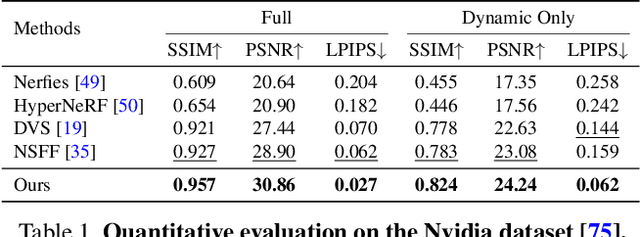
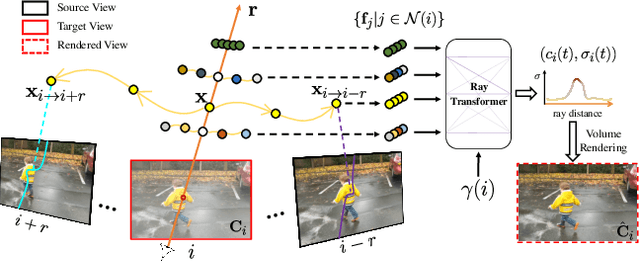
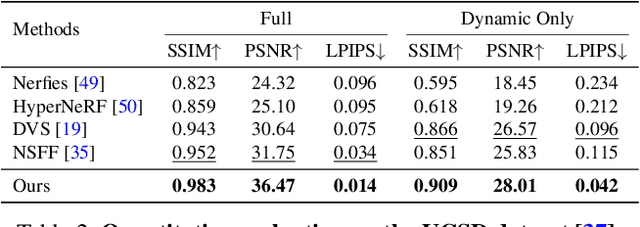
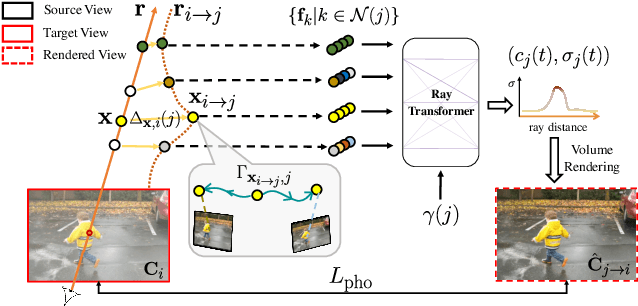
We address the problem of synthesizing novel views from a monocular video depicting a complex dynamic scene. State-of-the-art methods based on temporally varying Neural Radiance Fields (aka dynamic NeRFs) have shown impressive results on this task. However, for long videos with complex object motions and uncontrolled camera trajectories, these methods can produce blurry or inaccurate renderings, hampering their use in real-world applications. Instead of encoding the entire dynamic scene within the weights of an MLP, we present a new approach that addresses these limitations by adopting a volumetric image-based rendering framework that synthesizes new viewpoints by aggregating features from nearby views in a scene-motion-aware manner. Our system retains the advantages of prior methods in its ability to model complex scenes and view-dependent effects, but also enables synthesizing photo-realistic novel views from long videos featuring complex scene dynamics with unconstrained camera trajectories. We demonstrate significant improvements over state-of-the-art methods on dynamic scene datasets, and also apply our approach to in-the-wild videos with challenging camera and object motion, where prior methods fail to produce high-quality renderings. Our project webpage is at dynibar.github.io.
SCOOP: Self-Supervised Correspondence and Optimization-Based Scene Flow
Nov 25, 2022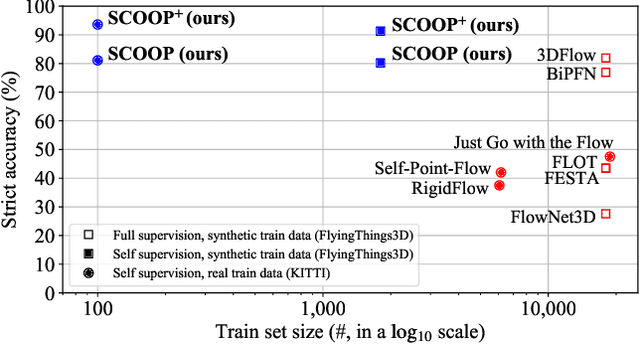
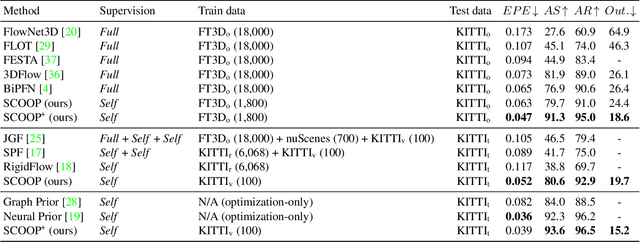

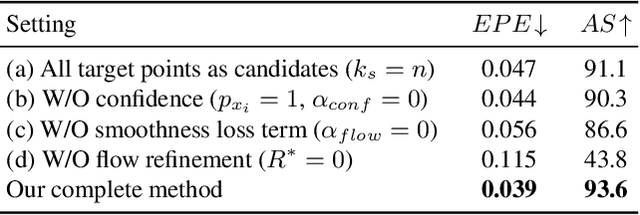
Scene flow estimation is a long-standing problem in computer vision, where the goal is to find the 3D motion of a scene from its consecutive observations. Recently, there have been efforts to compute the scene flow from 3D point clouds. A common approach is to train a regression model that consumes source and target point clouds and outputs the per-point translation vectors. An alternative is to learn point matches between the point clouds concurrently with regressing a refinement of the initial correspondence flow. In both cases, the learning task is very challenging since the flow regression is done in the free 3D space, and a typical solution is to resort to a large annotated synthetic dataset. We introduce SCOOP, a new method for scene flow estimation that can be learned on a small amount of data without employing ground-truth flow supervision. In contrast to previous work, we train a pure correspondence model focused on learning point feature representation and initialize the flow as the difference between a source point and its softly corresponding target point. Then, in the run-time phase, we directly optimize a flow refinement component with a self-supervised objective, which leads to a coherent and accurate flow field between the point clouds. Experiments on widespread datasets demonstrate the performance gains achieved by our method compared to existing leading techniques while using a fraction of the training data. Our code is publicly available at https://github.com/itailang/SCOOP.
D$^2$NeRF: Self-Supervised Decoupling of Dynamic and Static Objects from a Monocular Video
Jun 01, 2022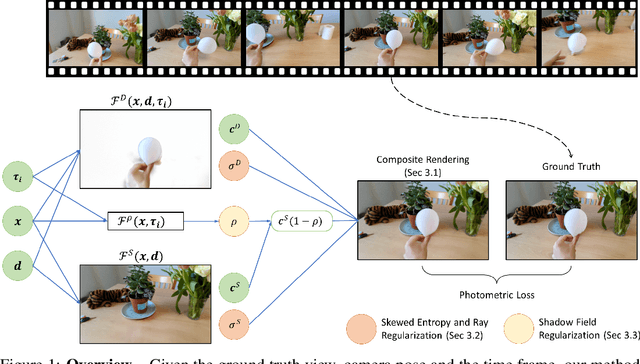
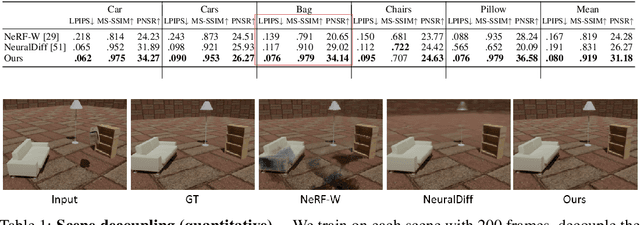
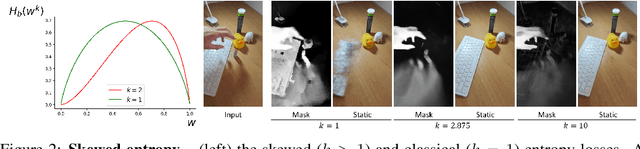

Given a monocular video, segmenting and decoupling dynamic objects while recovering the static environment is a widely studied problem in machine intelligence. Existing solutions usually approach this problem in the image domain, limiting their performance and understanding of the environment. We introduce Decoupled Dynamic Neural Radiance Field (D$^2$NeRF), a self-supervised approach that takes a monocular video and learns a 3D scene representation which decouples moving objects, including their shadows, from the static background. Our method represents the moving objects and the static background by two separate neural radiance fields with only one allowing for temporal changes. A naive implementation of this approach leads to the dynamic component taking over the static one as the representation of the former is inherently more general and prone to overfitting. To this end, we propose a novel loss to promote correct separation of phenomena. We further propose a shadow field network to detect and decouple dynamically moving shadows. We introduce a new dataset containing various dynamic objects and shadows and demonstrate that our method can achieve better performance than state-of-the-art approaches in decoupling dynamic and static 3D objects, occlusion and shadow removal, and image segmentation for moving objects.
Learning 3D Semantic Segmentation with only 2D Image Supervision
Oct 21, 2021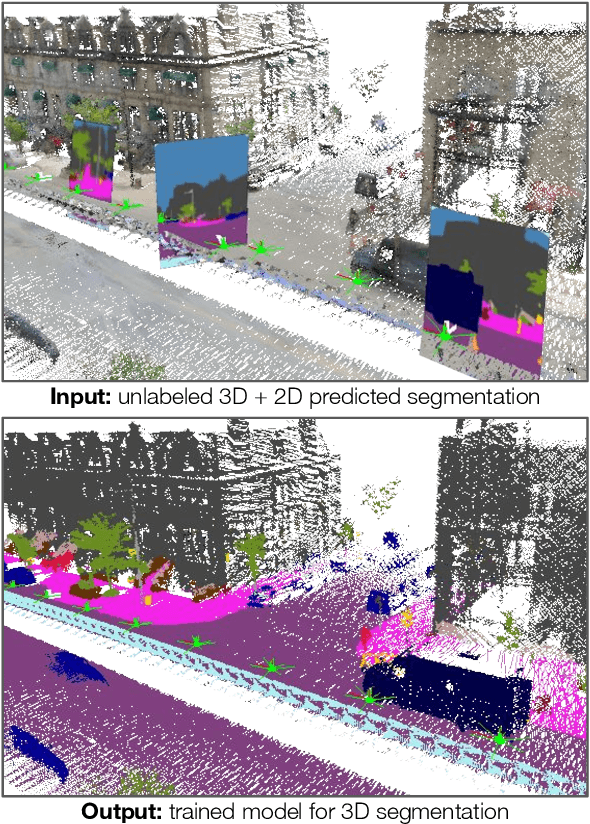
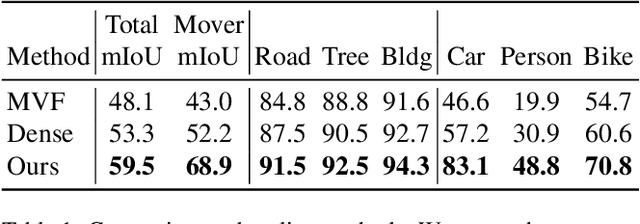
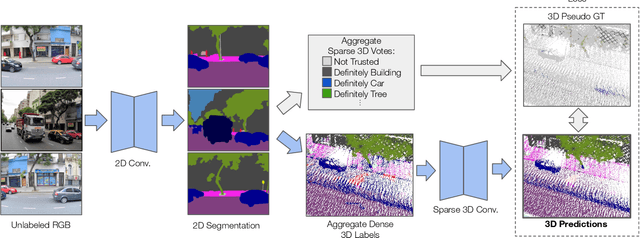
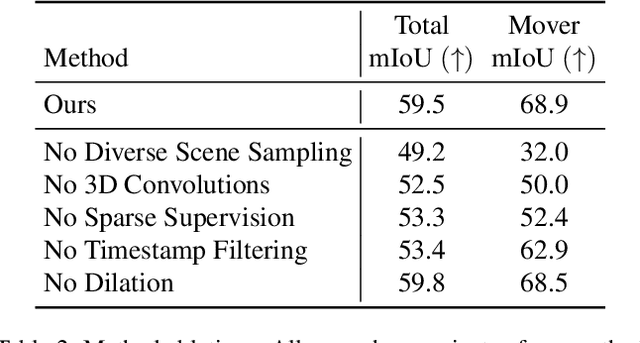
With the recent growth of urban mapping and autonomous driving efforts, there has been an explosion of raw 3D data collected from terrestrial platforms with lidar scanners and color cameras. However, due to high labeling costs, ground-truth 3D semantic segmentation annotations are limited in both quantity and geographic diversity, while also being difficult to transfer across sensors. In contrast, large image collections with ground-truth semantic segmentations are readily available for diverse sets of scenes. In this paper, we investigate how to use only those labeled 2D image collections to supervise training 3D semantic segmentation models. Our approach is to train a 3D model from pseudo-labels derived from 2D semantic image segmentations using multiview fusion. We address several novel issues with this approach, including how to select trusted pseudo-labels, how to sample 3D scenes with rare object categories, and how to decouple input features from 2D images from pseudo-labels during training. The proposed network architecture, 2D3DNet, achieves significantly better performance (+6.2-11.4 mIoU) than baselines during experiments on a new urban dataset with lidar and images captured in 20 cities across 5 continents.
Differentiable Surface Rendering via Non-Differentiable Sampling
Aug 10, 2021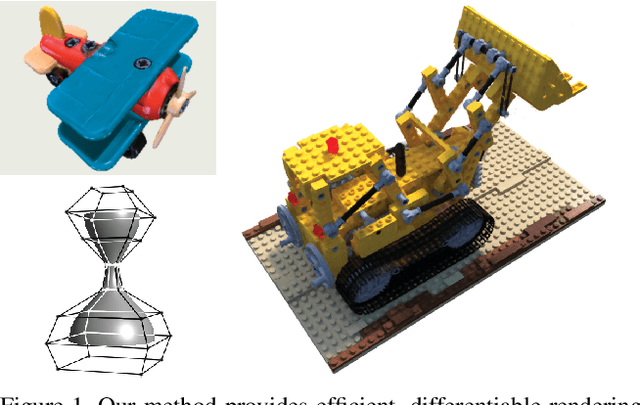
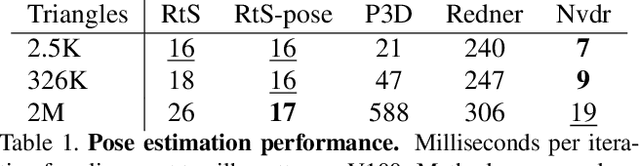
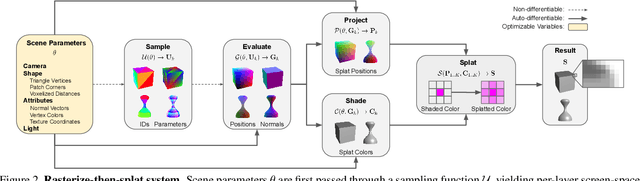
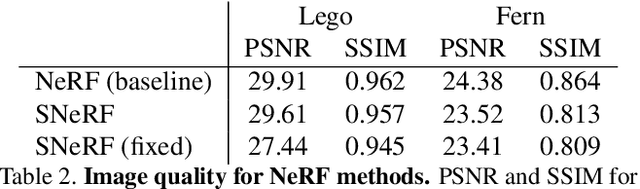
We present a method for differentiable rendering of 3D surfaces that supports both explicit and implicit representations, provides derivatives at occlusion boundaries, and is fast and simple to implement. The method first samples the surface using non-differentiable rasterization, then applies differentiable, depth-aware point splatting to produce the final image. Our approach requires no differentiable meshing or rasterization steps, making it efficient for large 3D models and applicable to isosurfaces extracted from implicit surface definitions. We demonstrate the effectiveness of our method for implicit-, mesh-, and parametric-surface-based inverse rendering and neural-network training applications. In particular, we show for the first time efficient, differentiable rendering of an isosurface extracted from a neural radiance field (NeRF), and demonstrate surface-based, rather than volume-based, rendering of a NeRF.
Consistent Depth of Moving Objects in Video
Aug 02, 2021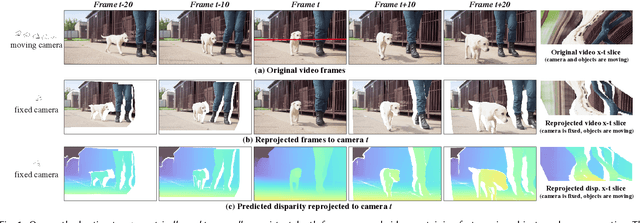
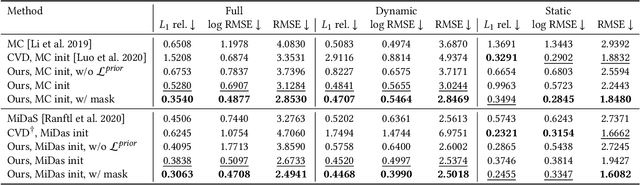
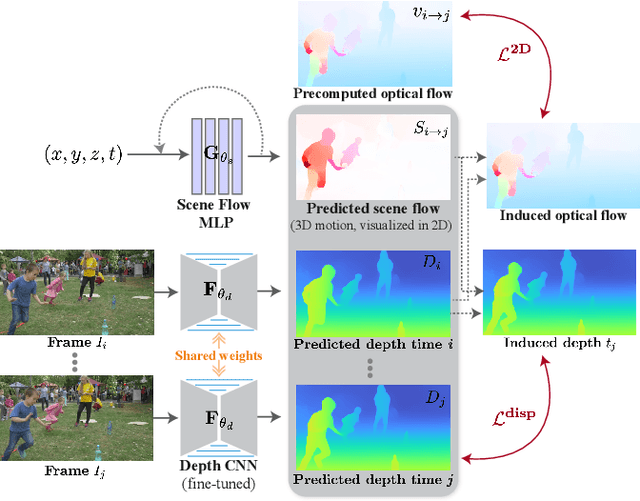
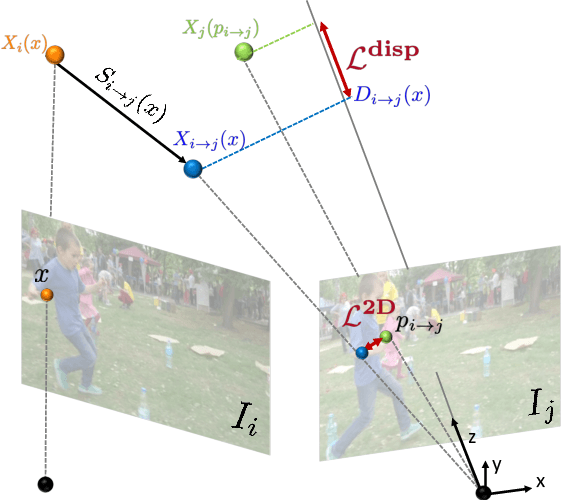
We present a method to estimate depth of a dynamic scene, containing arbitrary moving objects, from an ordinary video captured with a moving camera. We seek a geometrically and temporally consistent solution to this underconstrained problem: the depth predictions of corresponding points across frames should induce plausible, smooth motion in 3D. We formulate this objective in a new test-time training framework where a depth-prediction CNN is trained in tandem with an auxiliary scene-flow prediction MLP over the entire input video. By recursively unrolling the scene-flow prediction MLP over varying time steps, we compute both short-range scene flow to impose local smooth motion priors directly in 3D, and long-range scene flow to impose multi-view consistency constraints with wide baselines. We demonstrate accurate and temporally coherent results on a variety of challenging videos containing diverse moving objects (pets, people, cars), as well as camera motion. Our depth maps give rise to a number of depth-and-motion aware video editing effects such as object and lighting insertion.
* Published at SIGGRAPH 2021
Omnimatte: Associating Objects and Their Effects in Video
May 14, 2021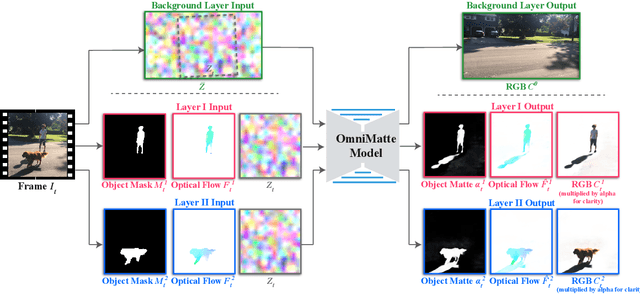
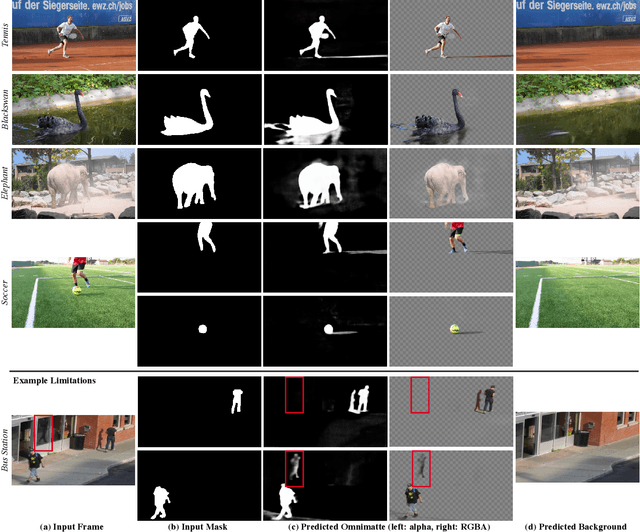
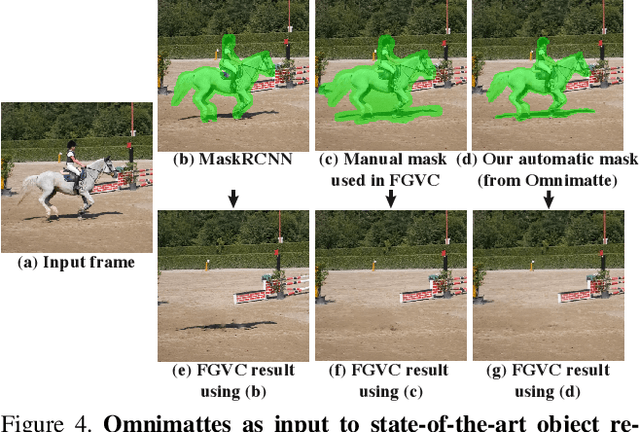
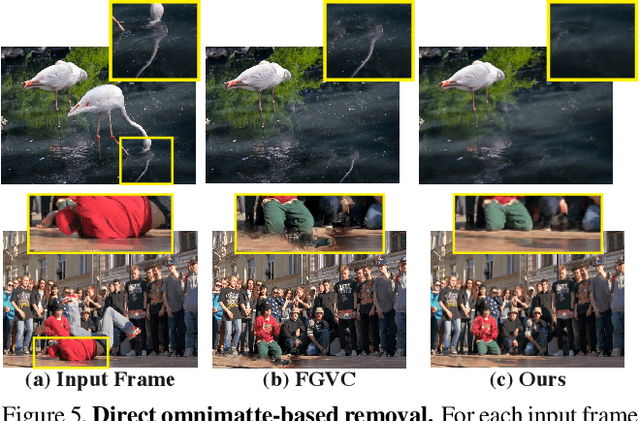
Computer vision is increasingly effective at segmenting objects in images and videos; however, scene effects related to the objects---shadows, reflections, generated smoke, etc---are typically overlooked. Identifying such scene effects and associating them with the objects producing them is important for improving our fundamental understanding of visual scenes, and can also assist a variety of applications such as removing, duplicating, or enhancing objects in video. In this work, we take a step towards solving this novel problem of automatically associating objects with their effects in video. Given an ordinary video and a rough segmentation mask over time of one or more subjects of interest, we estimate an omnimatte for each subject---an alpha matte and color image that includes the subject along with all its related time-varying scene elements. Our model is trained only on the input video in a self-supervised manner, without any manual labels, and is generic---it produces omnimattes automatically for arbitrary objects and a variety of effects. We show results on real-world videos containing interactions between different types of subjects (cars, animals, people) and complex effects, ranging from semi-transparent elements such as smoke and reflections, to fully opaque effects such as objects attached to the subject.
LASR: Learning Articulated Shape Reconstruction from a Monocular Video
May 06, 2021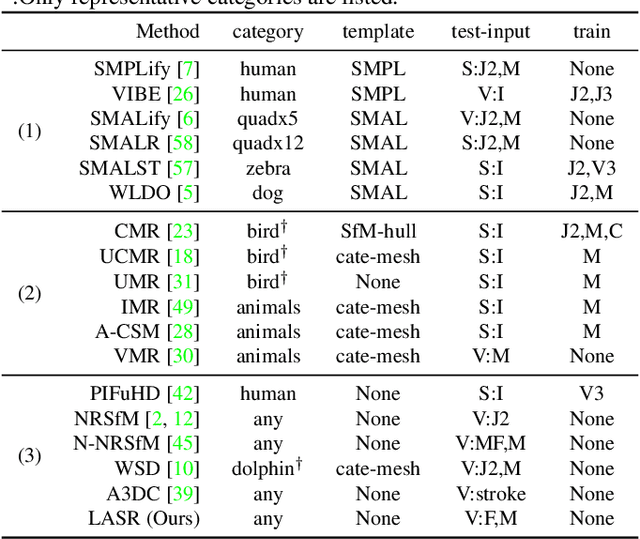
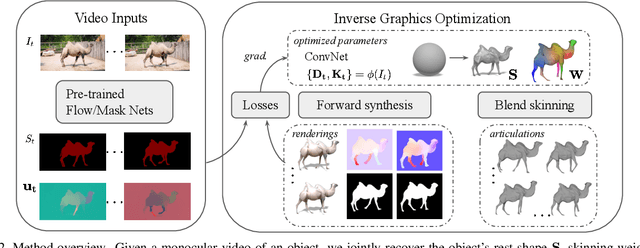
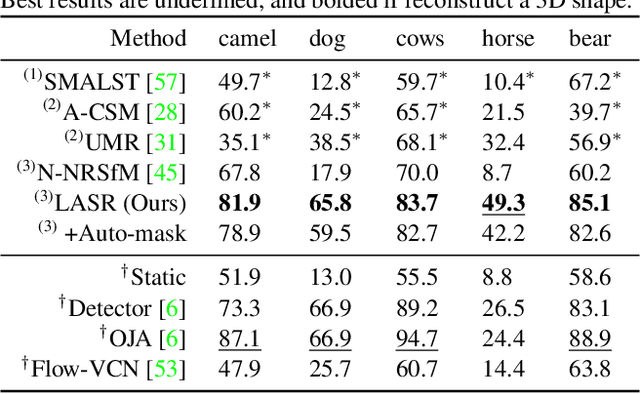
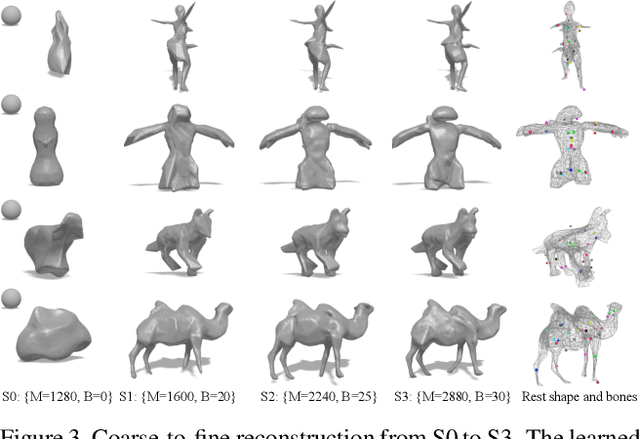
Remarkable progress has been made in 3D reconstruction of rigid structures from a video or a collection of images. However, it is still challenging to reconstruct nonrigid structures from RGB inputs, due to its under-constrained nature. While template-based approaches, such as parametric shape models, have achieved great success in modeling the "closed world" of known object categories, they cannot well handle the "open-world" of novel object categories or outlier shapes. In this work, we introduce a template-free approach to learn 3D shapes from a single video. It adopts an analysis-by-synthesis strategy that forward-renders object silhouette, optical flow, and pixel values to compare with video observations, which generates gradients to adjust the camera, shape and motion parameters. Without using a category-specific shape template, our method faithfully reconstructs nonrigid 3D structures from videos of human, animals, and objects of unknown classes. Code will be available at lasr-google.github.io .