 Add to Chrome
 Add to Firefox
 Add to Edge
The GaoYao Benchmark: A Comprehensive Framework for Evaluating Multilingual and Multicultural Abilities of Large Language Models
Apr 22, 2026
Evaluating the multilingual and multicultural capabilities of Large Language Models (LLMs) is essential for their global utility. However, current benchmarks face three critical limitations: (1) fragmented evaluation dimensions that often neglect deep cultural nuances; (2) insufficient language coverage in subjective tasks relying on low-quality machine translation; and (3) shallow analysis that lacks diagnostic depth beyond simple rankings. To address these, we introduce GaoYao, a comprehensive benchmark with 182.3k samples, 26 languages and 51 nations/areas. First, GaoYao proposes a unified framework categorizing evaluation tasks into three cultural layers (General Multilingual, Cross-cultural, Monocultural) and nine cognitive sub-layers. Second, we achieve native-quality expansion by leveraging experts to rigorously localize subjective benchmarks into 19 languages and synthesizing cross-cultural test sets for 34 cultures, surpassing prior coverage by up to 111%. Third, we conduct an in-depth diagnostic analysis on 20+ flagship and compact LLMs. Our findings reveal significant geographical performance disparities and distinct gaps between tasks, offering a reliable map for future work. We release the benchmark (https://github.com/lunyiliu/GaoYao).

Transferable text data distillation by trajectory matching
Apr 14, 2025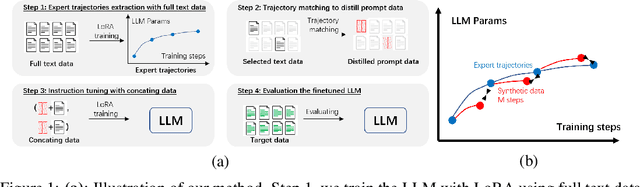
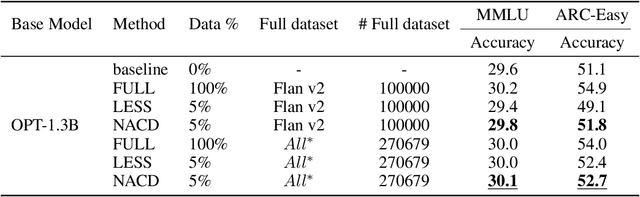
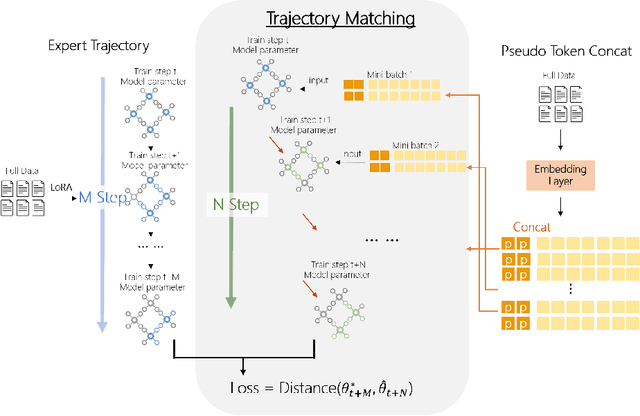
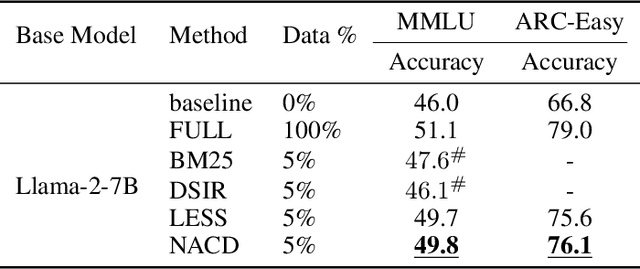
In the realm of large language model (LLM), as the size of large models increases, it also brings higher training costs. There is a urgent need to minimize the data size in LLM training. Compared with data selection method, the data distillation method aims to synthesize a small number of data samples to achieve the training effect of the full data set and has better flexibility. Despite its successes in computer vision, the discreteness of text data has hitherto stymied its exploration in natural language processing (NLP). In this work, we proposed a method that involves learning pseudo prompt data based on trajectory matching and finding its nearest neighbor ID to achieve cross-architecture transfer. During the distillation process, we introduce a regularization loss to improve the robustness of our distilled data. To our best knowledge, this is the first data distillation work suitable for text generation tasks such as instruction tuning. Evaluations on two benchmarks, including ARC-Easy and MMLU instruction tuning datasets, established the superiority of our distillation approach over the SOTA data selection method LESS. Furthermore, our method demonstrates a good transferability over LLM structures (i.e., OPT to Llama).
LightCLIP: Learning Multi-Level Interaction for Lightweight Vision-Language Models
Dec 01, 2023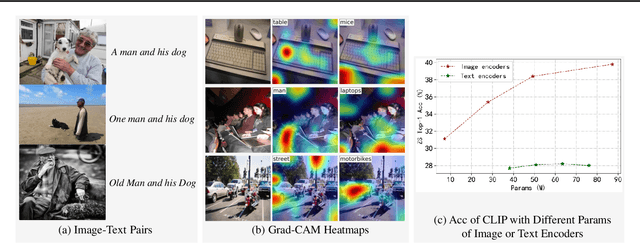
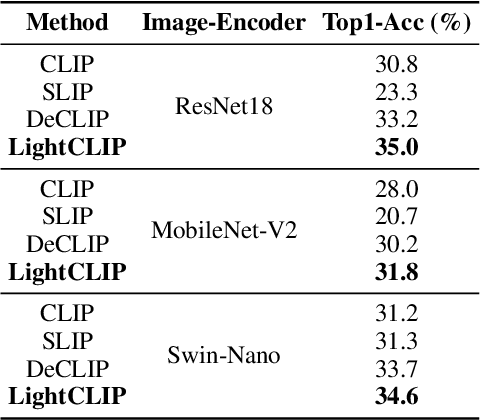
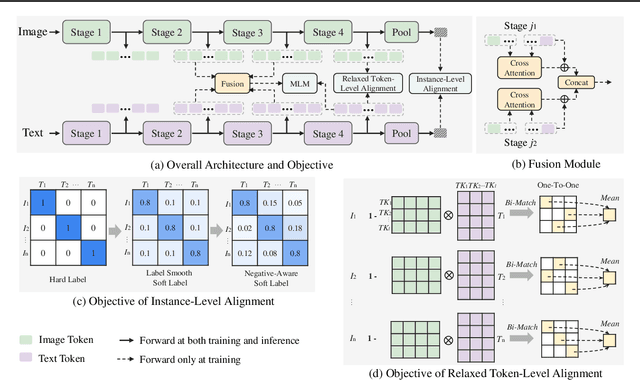
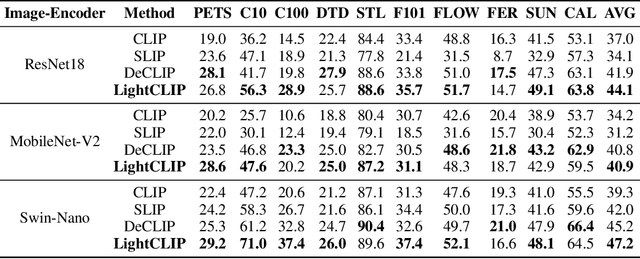
Vision-language pre-training like CLIP has shown promising performance on various downstream tasks such as zero-shot image classification and image-text retrieval. Most of the existing CLIP-alike works usually adopt relatively large image encoders like ResNet50 and ViT, while the lightweight counterparts are rarely discussed. In this paper, we propose a multi-level interaction paradigm for training lightweight CLIP models. Firstly, to mitigate the problem that some image-text pairs are not strictly one-to-one correspondence, we improve the conventional global instance-level alignment objective by softening the label of negative samples progressively. Secondly, a relaxed bipartite matching based token-level alignment objective is introduced for finer-grained alignment between image patches and textual words. Moreover, based on the observation that the accuracy of CLIP model does not increase correspondingly as the parameters of text encoder increase, an extra objective of masked language modeling (MLM) is leveraged for maximizing the potential of the shortened text encoder. In practice, an auxiliary fusion module injecting unmasked image embedding into masked text embedding at different network stages is proposed for enhancing the MLM. Extensive experiments show that without introducing additional computational cost during inference, the proposed method achieves a higher performance on multiple downstream tasks.