 Add to Chrome
 Add to Firefox
 Add to Edge
MindMemOS: A Portable and Self-Evolving Memory Operating Layer for AI Agents
Aug 12, 2026
Memory is a core component of AI agents, enabling them to accumulate experience, maintain personalization, and adapt over long-term interactions. However, existing memory systems often remain fixed after development, limiting their ability to adapt their memory models, organization strategies, and procedural knowledge through continued use. We present MindMemOS, a portable and self-evolving memory operating layer that organizes open-world information using a unified entity property timestructure. MindMemOS supports scenario-adaptive memory modeling, higher-order pattern discovery, autonomous memory refinement, and continuous skill evolution. Its MindMemEvolve algorithm employs validation-driven evolutionary search to optimize memory schemas for target scenarios, whiledreaming consolidates accumulated memories by merging redundant records and resolving conflicts. In addition, implicit corrective feedback serves as a human-in-the-loop signal for identifying and revising potentially inaccurate or misaligned memories. Its MindSkillEvolve algorithm further transforms agent execution trajectories into reusable and progressively refined skills. MindMemOS achieves 94.03% accuracy on LOCOMO and 70.63% on PersonaMem. MindSkillEvolve improves SpreadsheetBench success by 9.2 percentage points over the initial-skill baseline.

Transferable text data distillation by trajectory matching
Apr 14, 2025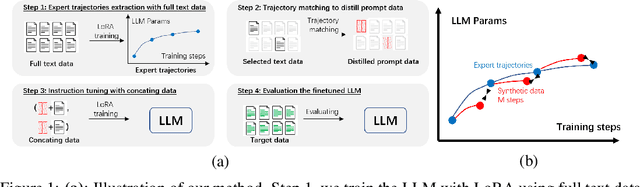
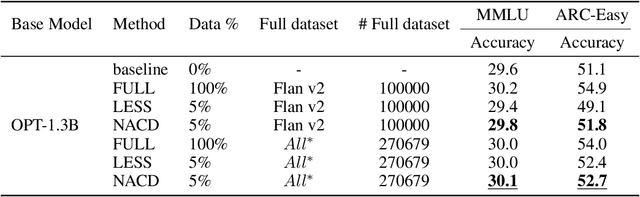
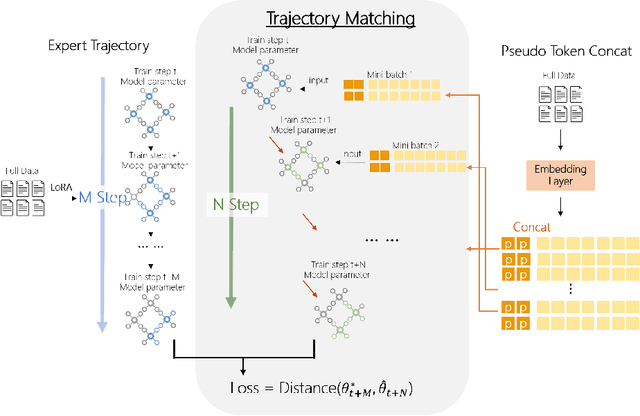
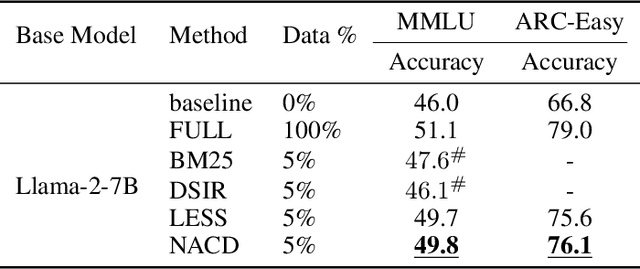
In the realm of large language model (LLM), as the size of large models increases, it also brings higher training costs. There is a urgent need to minimize the data size in LLM training. Compared with data selection method, the data distillation method aims to synthesize a small number of data samples to achieve the training effect of the full data set and has better flexibility. Despite its successes in computer vision, the discreteness of text data has hitherto stymied its exploration in natural language processing (NLP). In this work, we proposed a method that involves learning pseudo prompt data based on trajectory matching and finding its nearest neighbor ID to achieve cross-architecture transfer. During the distillation process, we introduce a regularization loss to improve the robustness of our distilled data. To our best knowledge, this is the first data distillation work suitable for text generation tasks such as instruction tuning. Evaluations on two benchmarks, including ARC-Easy and MMLU instruction tuning datasets, established the superiority of our distillation approach over the SOTA data selection method LESS. Furthermore, our method demonstrates a good transferability over LLM structures (i.e., OPT to Llama).