 Add to Chrome
 Add to Firefox
 Add to Edge
Effectiveness Assessment of Recent Large Vision-Language Models
Mar 07, 2024
The advent of large vision-language models (LVLMs) represents a noteworthy advancement towards the pursuit of artificial general intelligence. However, the extent of their efficacy across both specialized and general tasks warrants further investigation. This article endeavors to evaluate the competency of popular LVLMs in specialized and general tasks, respectively, aiming to offer a comprehensive comprehension of these innovative methodologies. To gauge their efficacy in specialized tasks, we tailor a comprehensive testbed comprising three distinct scenarios: natural, healthcare, and industrial, encompassing six challenging tasks. These tasks include salient, camouflaged, and transparent object detection, as well as polyp and skin lesion detection, alongside industrial anomaly detection. We examine the performance of three recent open-source LVLMs -- MiniGPT-v2, LLaVA-1.5, and Shikra -- in the realm of visual recognition and localization. Moreover, we conduct empirical investigations utilizing the aforementioned models alongside GPT-4V, assessing their multi-modal understanding capacities in general tasks such as object counting, absurd question answering, affordance reasoning, attribute recognition, and spatial relation reasoning. Our investigations reveal that these models demonstrate limited proficiency not only in specialized tasks but also in general tasks. We delve deeper into this inadequacy and suggest several potential factors, including limited cognition in specialized tasks, object hallucination, text-to-image interference, and decreased robustness in complex problems. We hope this study would provide valuable insights for the future development of LVLMs, augmenting their power in coping with both general and specialized applications.

MobiLlama: Towards Accurate and Lightweight Fully Transparent GPT
Feb 26, 2024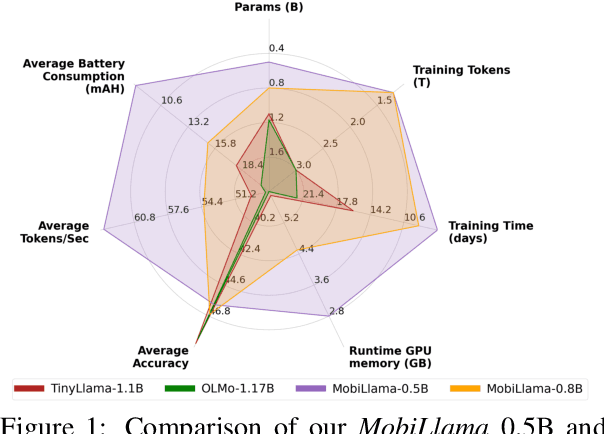

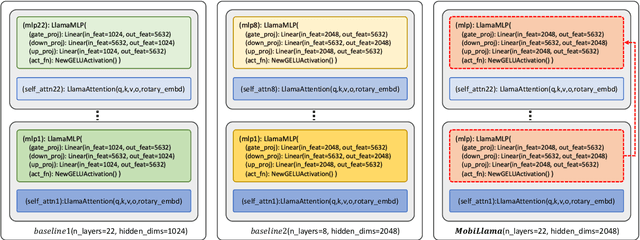
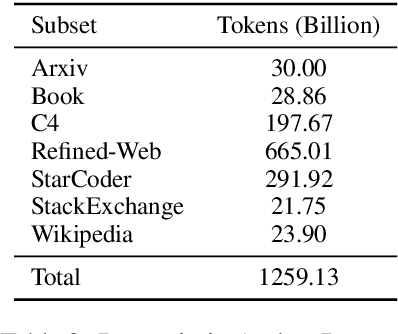
"Bigger the better" has been the predominant trend in recent Large Language Models (LLMs) development. However, LLMs do not suit well for scenarios that require on-device processing, energy efficiency, low memory footprint, and response efficiency. These requisites are crucial for privacy, security, and sustainable deployment. This paper explores the "less is more" paradigm by addressing the challenge of designing accurate yet efficient Small Language Models (SLMs) for resource constrained devices. Our primary contribution is the introduction of an accurate and fully transparent open-source 0.5 billion (0.5B) parameter SLM, named MobiLlama, catering to the specific needs of resource-constrained computing with an emphasis on enhanced performance with reduced resource demands. MobiLlama is a SLM design that initiates from a larger model and applies a careful parameter sharing scheme to reduce both the pre-training and the deployment cost. Our work strives to not only bridge the gap in open-source SLMs but also ensures full transparency, where complete training data pipeline, training code, model weights, and over 300 checkpoints along with evaluation codes is available at : https://github.com/mbzuai-oryx/MobiLlama.
Semi-supervised Open-World Object Detection
Feb 25, 2024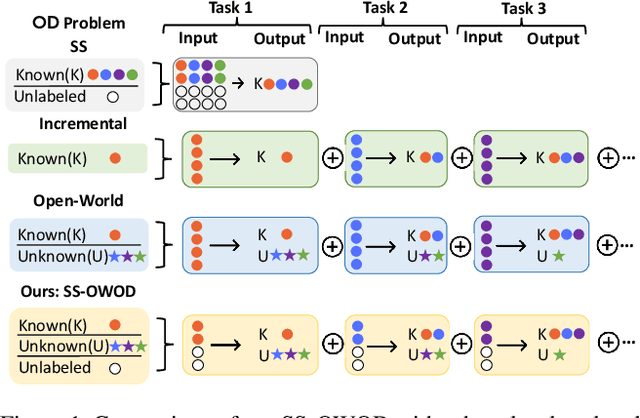
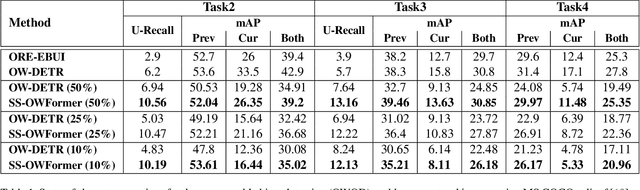
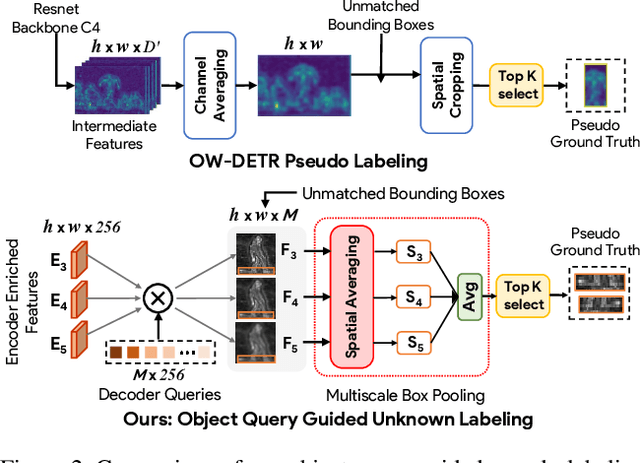
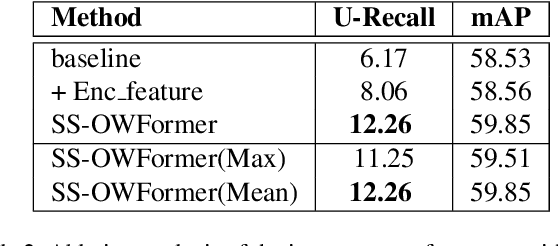
Conventional open-world object detection (OWOD) problem setting first distinguishes known and unknown classes and then later incrementally learns the unknown objects when introduced with labels in the subsequent tasks. However, the current OWOD formulation heavily relies on the external human oracle for knowledge input during the incremental learning stages. Such reliance on run-time makes this formulation less realistic in a real-world deployment. To address this, we introduce a more realistic formulation, named semi-supervised open-world detection (SS-OWOD), that reduces the annotation cost by casting the incremental learning stages of OWOD in a semi-supervised manner. We demonstrate that the performance of the state-of-the-art OWOD detector dramatically deteriorates in the proposed SS-OWOD setting. Therefore, we introduce a novel SS-OWOD detector, named SS-OWFormer, that utilizes a feature-alignment scheme to better align the object query representations between the original and augmented images to leverage the large unlabeled and few labeled data. We further introduce a pseudo-labeling scheme for unknown detection that exploits the inherent capability of decoder object queries to capture object-specific information. We demonstrate the effectiveness of our SS-OWOD problem setting and approach for remote sensing object detection, proposing carefully curated splits and baseline performance evaluations. Our experiments on 4 datasets including MS COCO, PASCAL, Objects365 and DOTA demonstrate the effectiveness of our approach. Our source code, models and splits are available here - https://github.com/sahalshajim/SS-OWFormer
BiMediX: Bilingual Medical Mixture of Experts LLM
Feb 20, 2024In this paper, we introduce BiMediX, the first bilingual medical mixture of experts LLM designed for seamless interaction in both English and Arabic. Our model facilitates a wide range of medical interactions in English and Arabic, including multi-turn chats to inquire about additional details such as patient symptoms and medical history, multiple-choice question answering, and open-ended question answering. We propose a semi-automated English-to-Arabic translation pipeline with human refinement to ensure high-quality translations. We also introduce a comprehensive evaluation benchmark for Arabic medical LLMs. Furthermore, we introduce BiMed1.3M, an extensive Arabic-English bilingual instruction set covering 1.3 Million diverse medical interactions, resulting in over 632 million healthcare specialized tokens for instruction tuning. Our BiMed1.3M dataset includes 250k synthesized multi-turn doctor-patient chats and maintains a 1:2 Arabic-to-English ratio. Our model outperforms state-of-the-art Med42 and Meditron by average absolute gains of 2.5% and 4.1%, respectively, computed across multiple medical evaluation benchmarks in English, while operating at 8-times faster inference. Moreover, our BiMediX outperforms the generic Arabic-English bilingual LLM, Jais-30B, by average absolute gains of 10% on our Arabic medical benchmark and 15% on bilingual evaluations across multiple datasets. Our project page with source code and trained model is available at https://github.com/mbzuai-oryx/BiMediX .
Get What You Want, Not What You Don't: Image Content Suppression for Text-to-Image Diffusion Models
Feb 08, 2024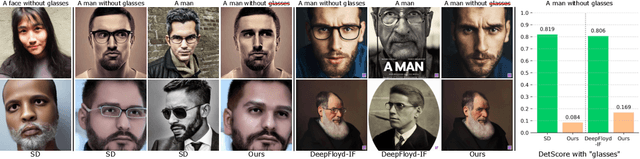
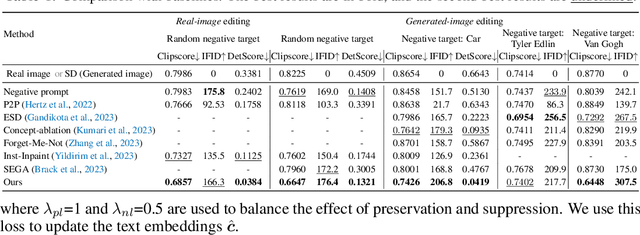
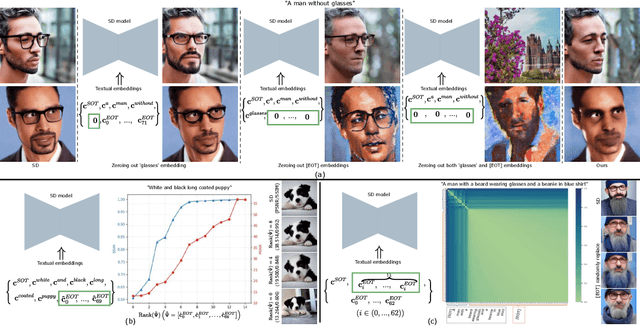
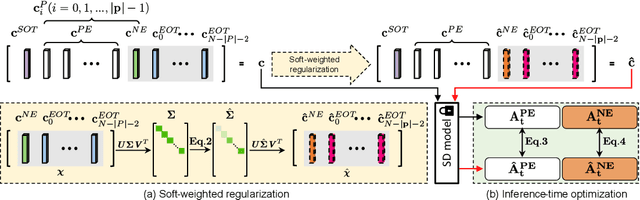
The success of recent text-to-image diffusion models is largely due to their capacity to be guided by a complex text prompt, which enables users to precisely describe the desired content. However, these models struggle to effectively suppress the generation of undesired content, which is explicitly requested to be omitted from the generated image in the prompt. In this paper, we analyze how to manipulate the text embeddings and remove unwanted content from them. We introduce two contributions, which we refer to as $\textit{soft-weighted regularization}$ and $\textit{inference-time text embedding optimization}$. The first regularizes the text embedding matrix and effectively suppresses the undesired content. The second method aims to further suppress the unwanted content generation of the prompt, and encourages the generation of desired content. We evaluate our method quantitatively and qualitatively on extensive experiments, validating its effectiveness. Furthermore, our method is generalizability to both the pixel-space diffusion models (i.e. DeepFloyd-IF) and the latent-space diffusion models (i.e. Stable Diffusion).
Video-GroundingDINO: Towards Open-Vocabulary Spatio-Temporal Video Grounding
Dec 31, 2023Video grounding aims to localize a spatio-temporal section in a video corresponding to an input text query. This paper addresses a critical limitation in current video grounding methodologies by introducing an Open-Vocabulary Spatio-Temporal Video Grounding task. Unlike prevalent closed-set approaches that struggle with open-vocabulary scenarios due to limited training data and predefined vocabularies, our model leverages pre-trained representations from foundational spatial grounding models. This empowers it to effectively bridge the semantic gap between natural language and diverse visual content, achieving strong performance in closed-set and open-vocabulary settings. Our contributions include a novel spatio-temporal video grounding model, surpassing state-of-the-art results in closed-set evaluations on multiple datasets and demonstrating superior performance in open-vocabulary scenarios. Notably, the proposed model outperforms state-of-the-art methods in closed-set settings on VidSTG (Declarative and Interrogative) and HC-STVG (V1 and V2) datasets. Furthermore, in open-vocabulary evaluations on HC-STVG V1 and YouCook-Interactions, our model surpasses the recent best-performing models by $4.26$ m_vIoU and $1.83\%$ accuracy, demonstrating its efficacy in handling diverse linguistic and visual concepts for improved video understanding. Our codes will be released at https://github.com/TalalWasim/Video-GroundingDINO.
Faster Diffusion: Rethinking the Role of UNet Encoder in Diffusion Models
Dec 15, 2023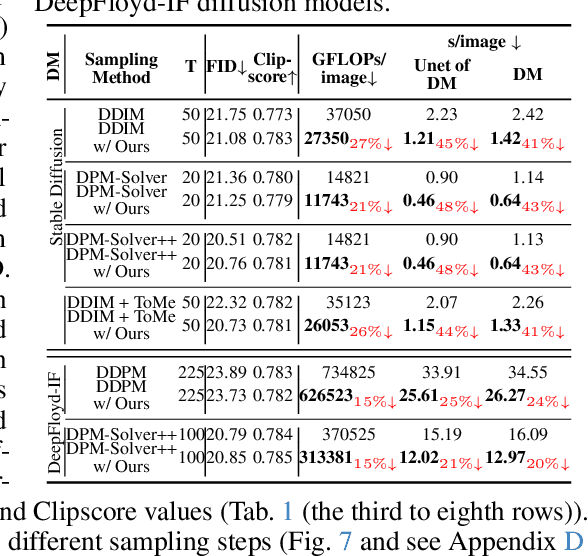

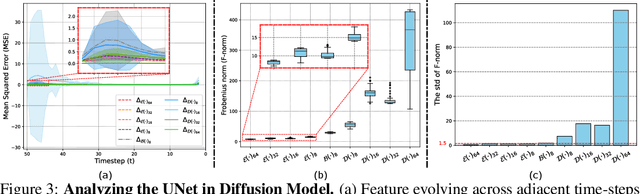
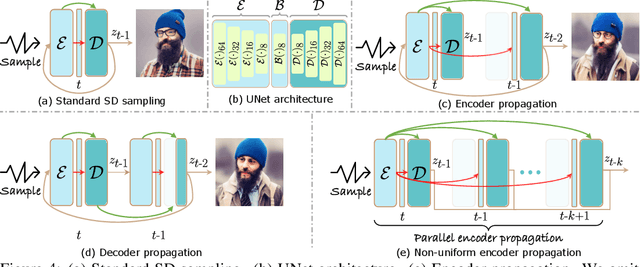
One of the key components within diffusion models is the UNet for noise prediction. While several works have explored basic properties of the UNet decoder, its encoder largely remains unexplored. In this work, we conduct the first comprehensive study of the UNet encoder. We empirically analyze the encoder features and provide insights to important questions regarding their changes at the inference process. In particular, we find that encoder features change gently, whereas the decoder features exhibit substantial variations across different time-steps. This finding inspired us to omit the encoder at certain adjacent time-steps and reuse cyclically the encoder features in the previous time-steps for the decoder. Further based on this observation, we introduce a simple yet effective encoder propagation scheme to accelerate the diffusion sampling for a diverse set of tasks. By benefiting from our propagation scheme, we are able to perform in parallel the decoder at certain adjacent time-steps. Additionally, we introduce a prior noise injection method to improve the texture details in the generated image. Besides the standard text-to-image task, we also validate our approach on other tasks: text-to-video, personalized generation and reference-guided generation. Without utilizing any knowledge distillation technique, our approach accelerates both the Stable Diffusion (SD) and the DeepFloyd-IF models sampling by 41$\%$ and 24$\%$ respectively, while maintaining high-quality generation performance. Our code is available in \href{https://github.com/hutaiHang/Faster-Diffusion}{FasterDiffusion}.
Arabic Mini-ClimateGPT : A Climate Change and Sustainability Tailored Arabic LLM
Dec 14, 2023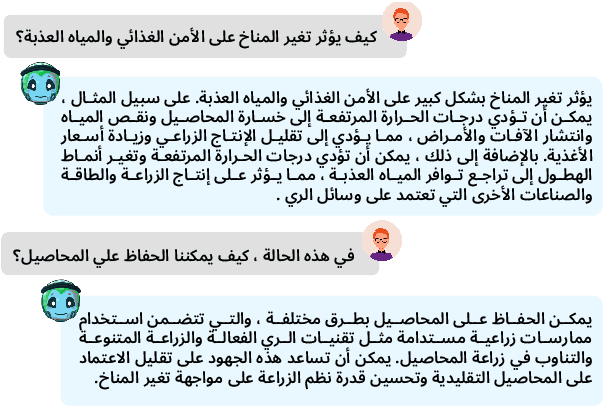
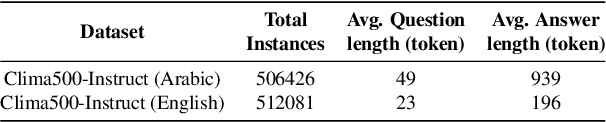
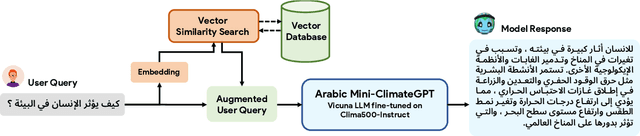
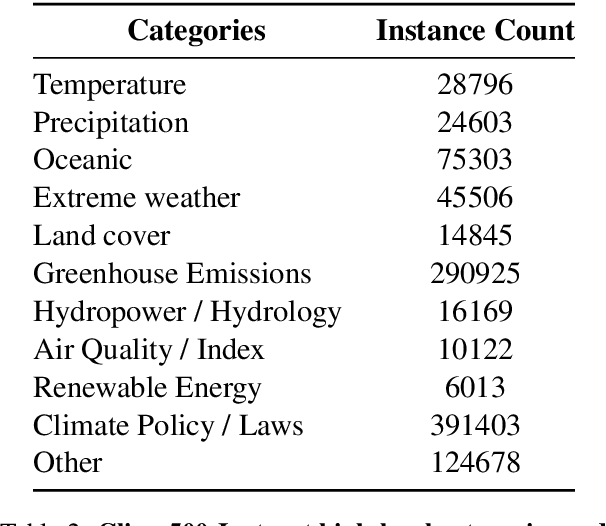
Climate change is one of the most significant challenges we face together as a society. Creating awareness and educating policy makers the wide-ranging impact of climate change is an essential step towards a sustainable future. Recently, Large Language Models (LLMs) like ChatGPT and Bard have shown impressive conversational abilities and excel in a wide variety of NLP tasks. While these models are close-source, recently alternative open-source LLMs such as Stanford Alpaca and Vicuna have shown promising results. However, these open-source models are not specifically tailored for climate related domain specific information and also struggle to generate meaningful responses in other languages such as, Arabic. To this end, we propose a light-weight Arabic Mini-ClimateGPT that is built on an open-source LLM and is specifically fine-tuned on a conversational-style instruction tuning curated Arabic dataset Clima500-Instruct with over 500k instructions about climate change and sustainability. Further, our model also utilizes a vector embedding based retrieval mechanism during inference. We validate our proposed model through quantitative and qualitative evaluations on climate-related queries. Our model surpasses the baseline LLM in 88.3% of cases during ChatGPT-based evaluation. Furthermore, our human expert evaluation reveals an 81.6% preference for our model's responses over multiple popular open-source models. Our open-source demos, code-base and models are available here https://github.com/mbzuai-oryx/ClimateGPT.
* Accepted to EMNLP 2023 (Findings)
SED: A Simple Encoder-Decoder for Open-Vocabulary Semantic Segmentation
Nov 27, 2023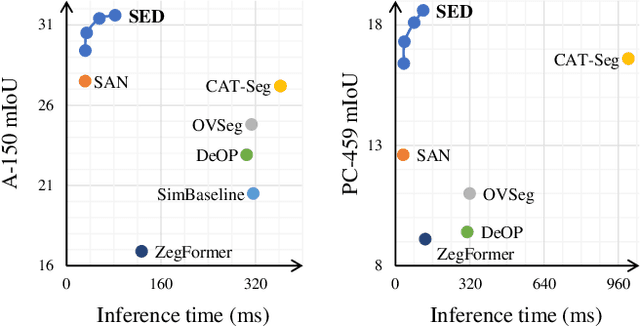
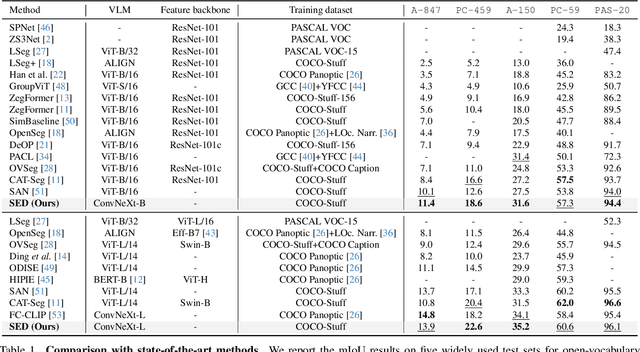
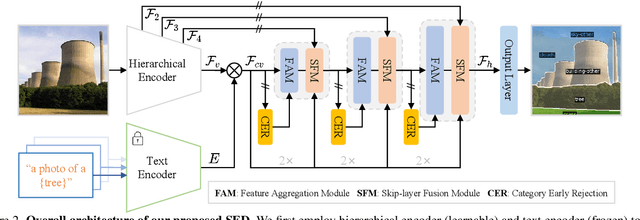
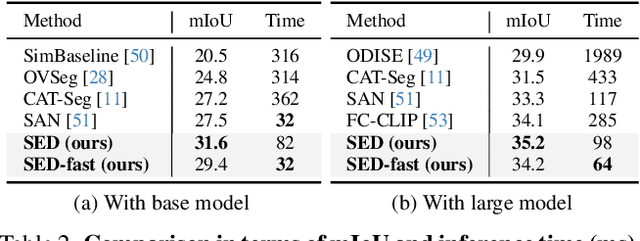
Open-vocabulary semantic segmentation strives to distinguish pixels into different semantic groups from an open set of categories. Most existing methods explore utilizing pre-trained vision-language models, in which the key is to adopt the image-level model for pixel-level segmentation task. In this paper, we propose a simple encoder-decoder, named SED, for open-vocabulary semantic segmentation, which comprises a hierarchical encoder-based cost map generation and a gradual fusion decoder with category early rejection. The hierarchical encoder-based cost map generation employs hierarchical backbone, instead of plain transformer, to predict pixel-level image-text cost map. Compared to plain transformer, hierarchical backbone better captures local spatial information and has linear computational complexity with respect to input size. Our gradual fusion decoder employs a top-down structure to combine cost map and the feature maps of different backbone levels for segmentation. To accelerate inference speed, we introduce a category early rejection scheme in the decoder that rejects many no-existing categories at the early layer of decoder, resulting in at most 4.7 times acceleration without accuracy degradation. Experiments are performed on multiple open-vocabulary semantic segmentation datasets, which demonstrates the efficacy of our SED method. When using ConvNeXt-B, our SED method achieves mIoU score of 31.6\% on ADE20K with 150 categories at 82 millisecond ($ms$) per image on a single A6000. We will release it at \url{https://github.com/xb534/SED.git}.
GeoChat: Grounded Large Vision-Language Model for Remote Sensing
Nov 24, 2023Recent advancements in Large Vision-Language Models (VLMs) have shown great promise in natural image domains, allowing users to hold a dialogue about given visual content. However, such general-domain VLMs perform poorly for Remote Sensing (RS) scenarios, leading to inaccurate or fabricated information when presented with RS domain-specific queries. Such a behavior emerges due to the unique challenges introduced by RS imagery. For example, to handle high-resolution RS imagery with diverse scale changes across categories and many small objects, region-level reasoning is necessary alongside holistic scene interpretation. Furthermore, the lack of domain-specific multimodal instruction following data as well as strong backbone models for RS make it hard for the models to align their behavior with user queries. To address these limitations, we propose GeoChat - the first versatile remote sensing VLM that offers multitask conversational capabilities with high-resolution RS images. Specifically, GeoChat can not only answer image-level queries but also accepts region inputs to hold region-specific dialogue. Furthermore, it can visually ground objects in its responses by referring to their spatial coordinates. To address the lack of domain-specific datasets, we generate a novel RS multimodal instruction-following dataset by extending image-text pairs from existing diverse RS datasets. We establish a comprehensive benchmark for RS multitask conversations and compare with a number of baseline methods. GeoChat demonstrates robust zero-shot performance on various RS tasks, e.g., image and region captioning, visual question answering, scene classification, visually grounded conversations and referring detection. Our code is available at https://github.com/mbzuai-oryx/geochat.