 Add to Chrome
 Add to Firefox
 Add to Edge
Swarm Skills: A Portable, Self-Evolving Multi-Agent System Specification for Coordination Engineering
May 11, 2026
As artificial intelligence engineering paradigms shift from single-agent Prompt and Context Engineering toward multi-agent \textbf{Coordination Engineering}, the ability to codify and systematically improve how multiple agents collaborate has emerged as a critical bottleneck. While single-agent skills can now be distributed as portable assets, multi-agent coordination protocols remain locked within framework-internal code or static configurations, preventing them from being shared across systems or autonomously improved over time. We propose \textbf{Swarm Skills}, a portable specification that extends the Anthropic Skills standard with multi-agent semantics. Swarm Skills turns multi-agent workflows into first-class, distributable assets that consist of roles, workflows, execution bounds, and a built-in semantic structure for self-evolution. To operationalize the specification's evolving nature, we present a companion self-evolution algorithm that automatically distills successful execution trajectories into new Swarm Skills and continuously patches existing ones based on multi-dimensional scoring (Effectiveness, Utilization, and Freshness), eliminating the need for human-in-the-loop oversight during the refinement process. Through an architectural compatibility analysis and a comprehensive qualitative case study using the open-source JiuwenSwarm reference implementation, we demonstrate how Swarm Skills achieves zero-adapter cross-agent portability via progressive disclosure, enabling agent teams to self-evolve their coordination strategies without framework lock-in.

Hyperlink-induced Pre-training for Passage Retrieval in Open-domain Question Answering
Apr 12, 2022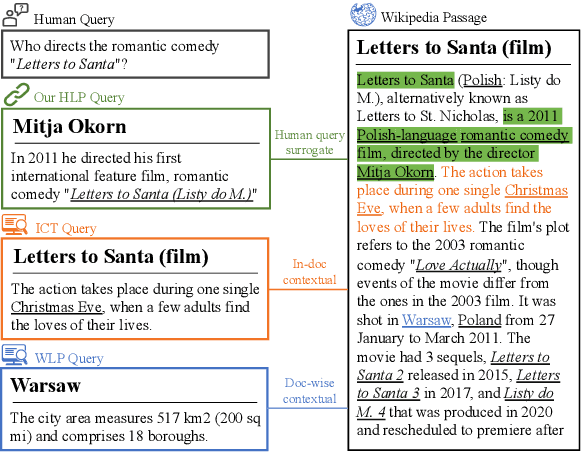
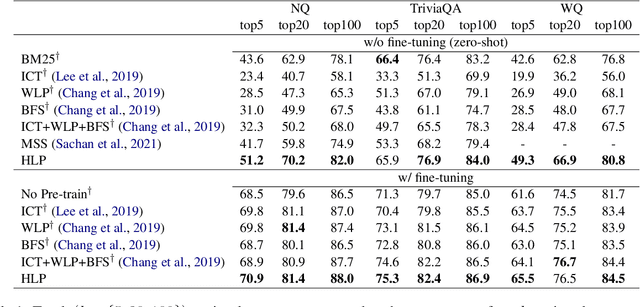
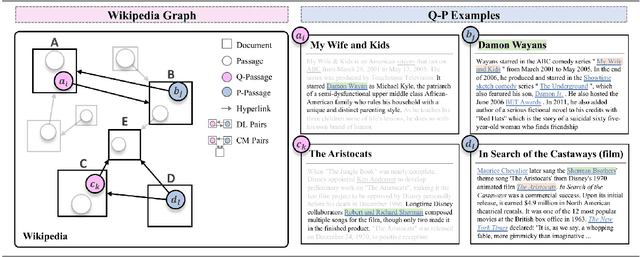
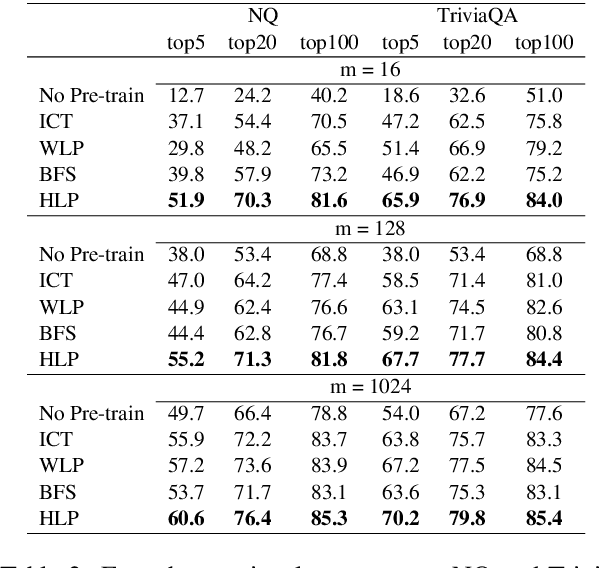
To alleviate the data scarcity problem in training question answering systems, recent works propose additional intermediate pre-training for dense passage retrieval (DPR). However, there still remains a large discrepancy between the provided upstream signals and the downstream question-passage relevance, which leads to less improvement. To bridge this gap, we propose the HyperLink-induced Pre-training (HLP), a method to pre-train the dense retriever with the text relevance induced by hyperlink-based topology within Web documents. We demonstrate that the hyperlink-based structures of dual-link and co-mention can provide effective relevance signals for large-scale pre-training that better facilitate downstream passage retrieval. We investigate the effectiveness of our approach across a wide range of open-domain QA datasets under zero-shot, few-shot, multi-hop, and out-of-domain scenarios. The experiments show our HLP outperforms the BM25 by up to 7 points as well as other pre-training methods by more than 10 points in terms of top-20 retrieval accuracy under the zero-shot scenario. Furthermore, HLP significantly outperforms other pre-training methods under the other scenarios.
Towards More Effective and Economic Sparsely-Activated Model
Oct 14, 2021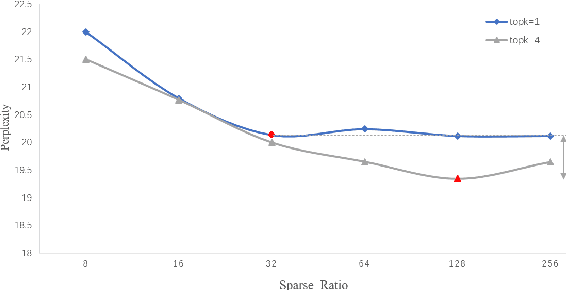
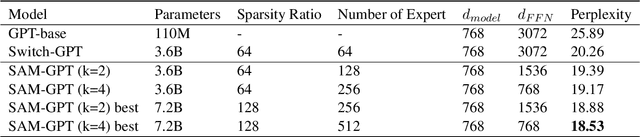
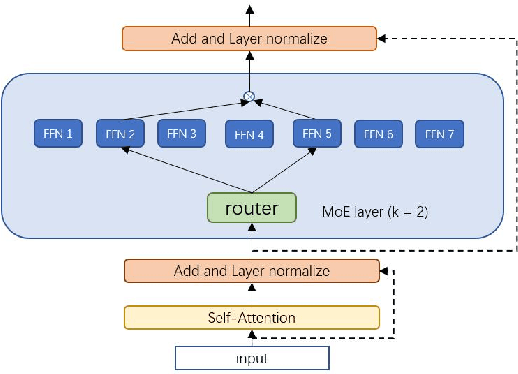
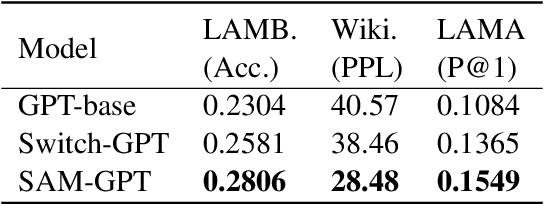
The sparsely-activated models have achieved great success in natural language processing through large-scale parameters and relatively low computational cost, and gradually become a feasible technique for training and implementing extremely large models. Due to the limit of communication cost, activating multiple experts is hardly affordable during training and inference. Therefore, previous work usually activate just one expert at a time to alleviate additional communication cost. Such routing mechanism limits the upper bound of model performance. In this paper, we first investigate a phenomenon that increasing the number of activated experts can boost the model performance with higher sparse ratio. To increase the number of activated experts without an increase in computational cost, we propose SAM (Switch and Mixture) routing, an efficient hierarchical routing mechanism that activates multiple experts in a same device (GPU). Our methods shed light on the training of extremely large sparse models and experiments prove that our models can achieve significant performance gain with great efficiency improvement.