 Add to Chrome
 Add to Firefox
 Add to Edge
Reinforced Collaboration in Multi-Agent Flow Networks
May 13, 2026
Multi-agent systems provide a powerful way to extend large language models (LLMs) by decomposing a complex task into specialized subtasks handled by different agents. However, their performance is often hindered by error propagation, arising from suboptimal workflow design or inaccurate agent outputs, which can propagate through the agent collaboration process and degrade final results. To address the challenges, we present MANGO (Multi-Agent Network Gradient Optimization), a data-driven framework that organizes and refines agent collaboration via a flow network constructed from past successful workflows. MANGO integrates reinforcement learning and textual gradients to jointly optimize workflow paths and agent behaviors, while a skipping mechanism prevents redundant updates to well-optimized agents for improving efficiency. Extensive experiments on seven benchmarks show that MANGO achieves up to 12.8% performance improvement over state-of-the-art baselines, enhances efficiency by 47.4%, and generalizes effectively to unseen domains. Our code and datasets are publicly available at https://github.com/openJiuwen-ai/agent-store/tree/main/community/mango.

Swarm Skills: A Portable, Self-Evolving Multi-Agent System Specification for Coordination Engineering
May 11, 2026As artificial intelligence engineering paradigms shift from single-agent Prompt and Context Engineering toward multi-agent \textbf{Coordination Engineering}, the ability to codify and systematically improve how multiple agents collaborate has emerged as a critical bottleneck. While single-agent skills can now be distributed as portable assets, multi-agent coordination protocols remain locked within framework-internal code or static configurations, preventing them from being shared across systems or autonomously improved over time. We propose \textbf{Swarm Skills}, a portable specification that extends the Anthropic Skills standard with multi-agent semantics. Swarm Skills turns multi-agent workflows into first-class, distributable assets that consist of roles, workflows, execution bounds, and a built-in semantic structure for self-evolution. To operationalize the specification's evolving nature, we present a companion self-evolution algorithm that automatically distills successful execution trajectories into new Swarm Skills and continuously patches existing ones based on multi-dimensional scoring (Effectiveness, Utilization, and Freshness), eliminating the need for human-in-the-loop oversight during the refinement process. Through an architectural compatibility analysis and a comprehensive qualitative case study using the open-source JiuwenSwarm reference implementation, we demonstrate how Swarm Skills achieves zero-adapter cross-agent portability via progressive disclosure, enabling agent teams to self-evolve their coordination strategies without framework lock-in.
OTTER: Open-Tagging via Text-Image Representation for Multi-modal Understanding
Oct 01, 2025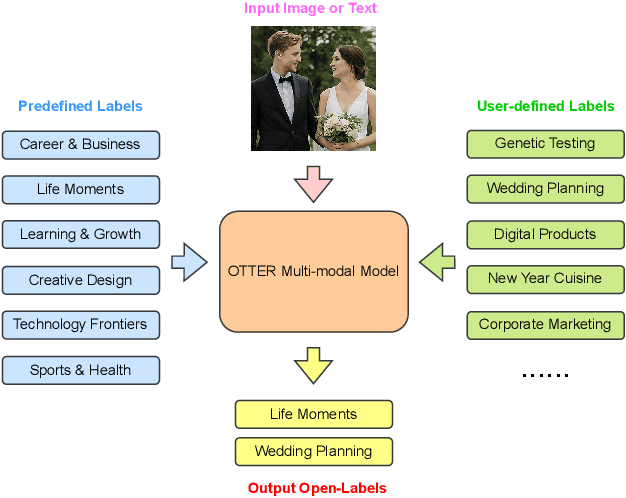
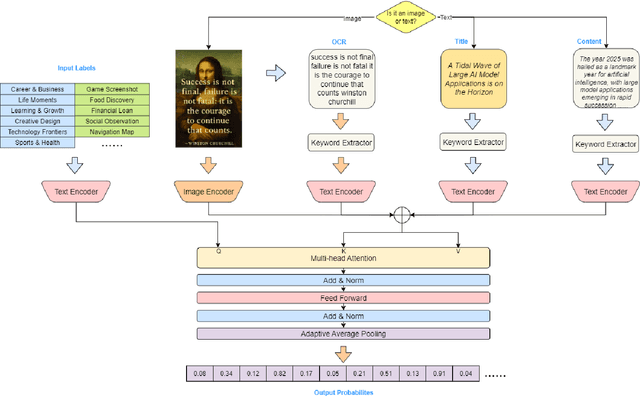
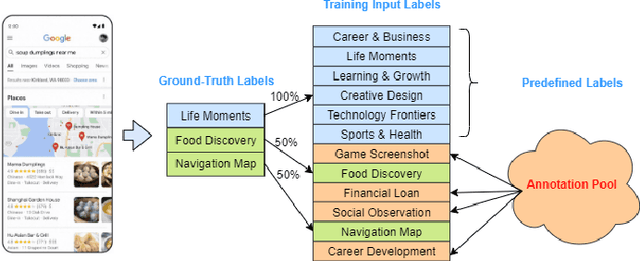
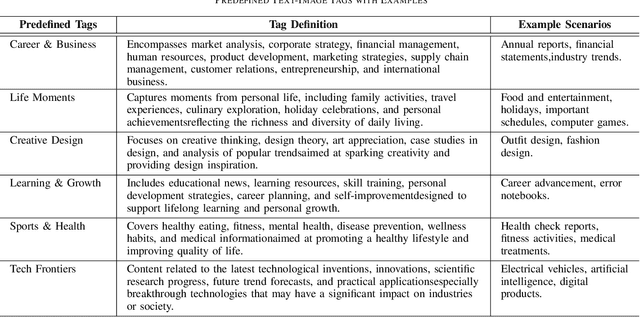
We introduce OTTER, a unified open-set multi-label tagging framework that harmonizes the stability of a curated, predefined category set with the adaptability of user-driven open tags. OTTER is built upon a large-scale, hierarchically organized multi-modal dataset, collected from diverse online repositories and annotated through a hybrid pipeline combining automated vision-language labeling with human refinement. By leveraging a multi-head attention architecture, OTTER jointly aligns visual and textual representations with both fixed and open-set label embeddings, enabling dynamic and semantically consistent tagging. OTTER consistently outperforms competitive baselines on two benchmark datasets: it achieves an overall F1 score of 0.81 on Otter and 0.75 on Favorite, surpassing the next-best results by margins of 0.10 and 0.02, respectively. OTTER attains near-perfect performance on open-set labels, with F1 of 0.99 on Otter and 0.97 on Favorite, while maintaining competitive accuracy on predefined labels. These results demonstrate OTTER's effectiveness in bridging closed-set consistency with open-vocabulary flexibility for multi-modal tagging applications.