 Add to Chrome
 Add to Firefox
 Add to Edge
LoopFM: Learning frOm HistOrical RePresentations of Foundation Model for Recommendation
May 28, 2026
Knowledge distillation (KD) transfers a single scalar prediction from a large foundation model (FM) to compact vertical models (VMs), suffering from diminishing transfer ratio -- the fraction of FM improvement captured by the VM -- as a single scalar cannot convey the rich intermediate knowledge that larger FMs learn. To address this bottleneck, we propose LoopFM (Learning frOm HistOrical ReP*resentations of FM), a framework that opens a high-bandwidth transfer channel by structuring FM intermediate embeddings as input features (e.g., user history sequence) for downstream VMs, without requiring real-time FM inference at serving and architectural coupling between FM and VM. We provide a theoretical framework for LoopFM with a gain decomposition and transfer-ratio analysis. On three public benchmarks, LoopFM demonstrates strong AUC improvements (e.g., 6\%+ on TaobaoAd) and complementary knowledge transfer capability with KD. On industrial-scale systems (billions of examples, trillion-parameter FMs), LoopFM approximately doubles the knowledge transfer ratio on top of KD, delivering a +0.5\% conversion improvement in Y1H1, and a +1.03\% and +1.22\% conversion improvement from two individual launches respectively in Y1H2.

Implicit Turn-Wise Policy Optimization for Proactive User-LLM Interaction
Mar 21, 2026Multi-turn human-AI collaboration is fundamental to deploying interactive services such as adaptive tutoring, conversational recommendation, and professional consultation. However, optimizing these interactions via reinforcement learning is hindered by the sparsity of verifiable intermediate rewards and the high stochasticity of user responses. To address these challenges, we introduce Implicit Turn-wise Policy Optimization (ITPO). ITPO leverages an implicit process reward model to derive fine-grained, turn-wise process rewards from sparse outcome signals. Unlike volatile token-level rewards, these turn-level signals exhibit superior robustness and may utilize a normalization mechanism to further enhance training stability. We evaluate ITPO across three representative multi-turn collaborative tasks: math tutoring, document writing, and medical recommendation. Empirical results demonstrate that ITPO, when combined with PPO, GRPO, or RLOO, consistently achieves improved convergence than existing baselines. Elaborate trajectory analysis confirms that ITPO infers turn-wise preferences that are semantically aligned with human judgment. Code is publicly available at https://github.com/Graph-COM/ITPO.
Meta Lattice: Model Space Redesign for Cost-Effective Industry-Scale Ads Recommendations
Dec 15, 2025The rapidly evolving landscape of products, surfaces, policies, and regulations poses significant challenges for deploying state-of-the-art recommendation models at industry scale, primarily due to data fragmentation across domains and escalating infrastructure costs that hinder sustained quality improvements. To address this challenge, we propose Lattice, a recommendation framework centered around model space redesign that extends Multi-Domain, Multi-Objective (MDMO) learning beyond models and learning objectives. Lattice addresses these challenges through a comprehensive model space redesign that combines cross-domain knowledge sharing, data consolidation, model unification, distillation, and system optimizations to achieve significant improvements in both quality and cost-efficiency. Our deployment of Lattice at Meta has resulted in 10% revenue-driving top-line metrics gain, 11.5% user satisfaction improvement, 6% boost in conversion rate, with 20% capacity saving.
Wukong: Towards a Scaling Law for Large-Scale Recommendation
Mar 08, 2024


Scaling laws play an instrumental role in the sustainable improvement in model quality. Unfortunately, recommendation models to date do not exhibit such laws similar to those observed in the domain of large language models, due to the inefficiencies of their upscaling mechanisms. This limitation poses significant challenges in adapting these models to increasingly more complex real-world datasets. In this paper, we propose an effective network architecture based purely on stacked factorization machines, and a synergistic upscaling strategy, collectively dubbed Wukong, to establish a scaling law in the domain of recommendation. Wukong's unique design makes it possible to capture diverse, any-order of interactions simply through taller and wider layers. We conducted extensive evaluations on six public datasets, and our results demonstrate that Wukong consistently outperforms state-of-the-art models quality-wise. Further, we assessed Wukong's scalability on an internal, large-scale dataset. The results show that Wukong retains its superiority in quality over state-of-the-art models, while holding the scaling law across two orders of magnitude in model complexity, extending beyond 100 Gflop or equivalently up to Large Language Model (GPT-3) training compute scale, where prior arts fall short.
Disaggregated Multi-Tower: Topology-aware Modeling Technique for Efficient Large-Scale Recommendation
Mar 07, 2024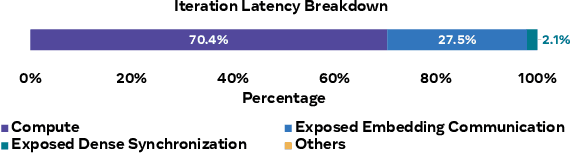
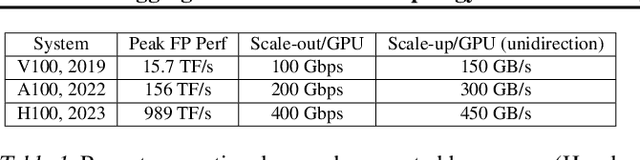
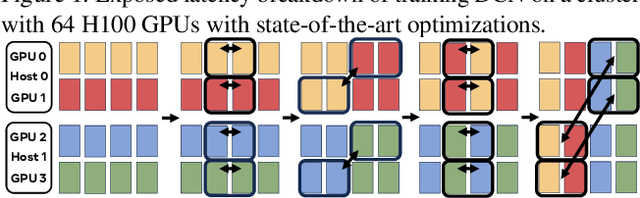
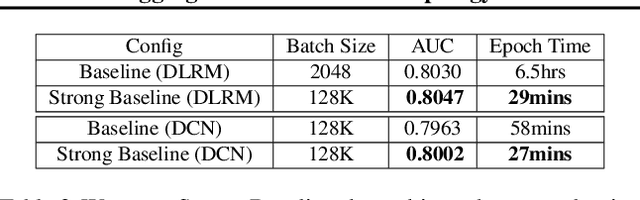
We study a mismatch between the deep learning recommendation models' flat architecture, common distributed training paradigm and hierarchical data center topology. To address the associated inefficiencies, we propose Disaggregated Multi-Tower (DMT), a modeling technique that consists of (1) Semantic-preserving Tower Transform (SPTT), a novel training paradigm that decomposes the monolithic global embedding lookup process into disjoint towers to exploit data center locality; (2) Tower Module (TM), a synergistic dense component attached to each tower to reduce model complexity and communication volume through hierarchical feature interaction; and (3) Tower Partitioner (TP), a feature partitioner to systematically create towers with meaningful feature interactions and load balanced assignments to preserve model quality and training throughput via learned embeddings. We show that DMT can achieve up to 1.9x speedup compared to the state-of-the-art baselines without losing accuracy across multiple generations of hardware at large data center scales.