 Add to Chrome
 Add to Firefox
 Add to Edge
LoopFM: Learning frOm HistOrical RePresentations of Foundation Model for Recommendation
May 28, 2026
Knowledge distillation (KD) transfers a single scalar prediction from a large foundation model (FM) to compact vertical models (VMs), suffering from diminishing transfer ratio -- the fraction of FM improvement captured by the VM -- as a single scalar cannot convey the rich intermediate knowledge that larger FMs learn. To address this bottleneck, we propose LoopFM (Learning frOm HistOrical ReP*resentations of FM), a framework that opens a high-bandwidth transfer channel by structuring FM intermediate embeddings as input features (e.g., user history sequence) for downstream VMs, without requiring real-time FM inference at serving and architectural coupling between FM and VM. We provide a theoretical framework for LoopFM with a gain decomposition and transfer-ratio analysis. On three public benchmarks, LoopFM demonstrates strong AUC improvements (e.g., 6\%+ on TaobaoAd) and complementary knowledge transfer capability with KD. On industrial-scale systems (billions of examples, trillion-parameter FMs), LoopFM approximately doubles the knowledge transfer ratio on top of KD, delivering a +0.5\% conversion improvement in Y1H1, and a +1.03\% and +1.22\% conversion improvement from two individual launches respectively in Y1H2.

DSGD-CECA: Decentralized SGD with Communication-Optimal Exact Consensus Algorithm
Jun 01, 2023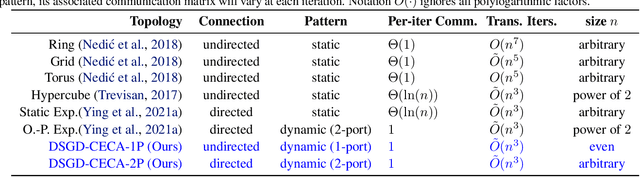
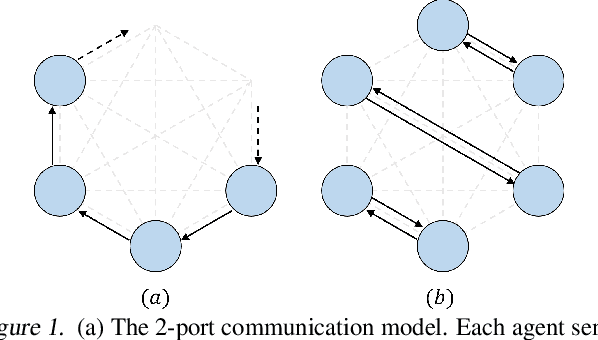
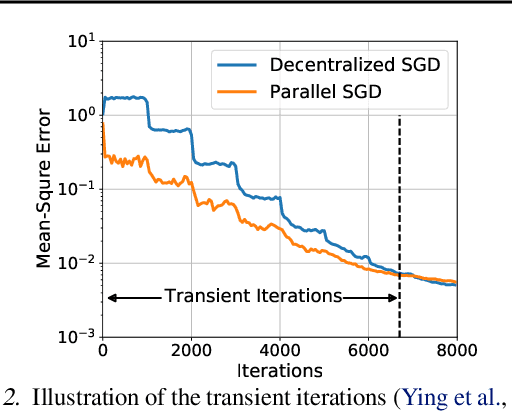
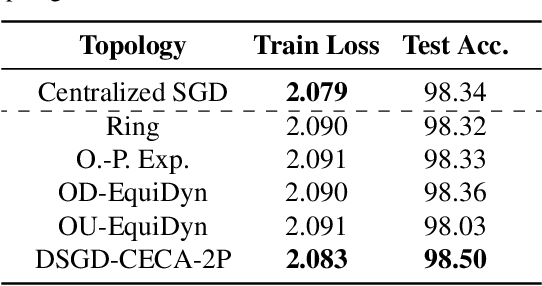
Decentralized Stochastic Gradient Descent (SGD) is an emerging neural network training approach that enables multiple agents to train a model collaboratively and simultaneously. Rather than using a central parameter server to collect gradients from all the agents, each agent keeps a copy of the model parameters and communicates with a small number of other agents to exchange model updates. Their communication, governed by the communication topology and gossip weight matrices, facilitates the exchange of model updates. The state-of-the-art approach uses the dynamic one-peer exponential-2 topology, achieving faster training times and improved scalability than the ring, grid, torus, and hypercube topologies. However, this approach requires a power-of-2 number of agents, which is impractical at scale. In this paper, we remove this restriction and propose \underline{D}ecentralized \underline{SGD} with \underline{C}ommunication-optimal \underline{E}xact \underline{C}onsensus \underline{A}lgorithm (DSGD-CECA), which works for any number of agents while still achieving state-of-the-art properties. In particular, DSGD-CECA incurs a unit per-iteration communication overhead and an $\tilde{O}(n^3)$ transient iteration complexity. Our proof is based on newly discovered properties of gossip weight matrices and a novel approach to combine them with DSGD's convergence analysis. Numerical experiments show the efficiency of DSGD-CECA.