 Add to Chrome
 Add to Firefox
 Add to Edge
MARCO: Click-Intent Decomposition for Calibrated Ads Conversion Prediction
Aug 11, 2026
Not all clicks are equal. Industrial ads ranking decouples conversion probability into click-through rate (CTR) and post-click conversion rate (CVR), yet treats every click as the same event. In reality, users provide a free, self-generated signal of intent through their physical UI interactions. Different click types on the same ad exhibit a 4-fold difference in actual conversion rates. By conflating these signals, the standard CVR model under-predicts high-intent clicks and over-predicts low-intent ones, which is a bias masked by near-perfect aggregate calibration. We propose MARCO (Multi-intent Ads Ranking Composition Optimization), a framework that resolves this bias by decomposing each click by intent. Using the logged click type as a free behavioral label, MARCO trains per-intent CVR heads on homogeneous populations, and at serving time composes their per-intent CVR estimates under a predicted distribution over intents. Theoretically, we prove that decomposition never raises population risk, give the exact headroom under squared loss and non-negativity under the deployed loss, and show through a routing-efficiency dial how much of it reaches serving. Because the population-optimal score is unchanged, any gain is a finite-capacity estimation and calibration effect that we validated both offline and online. For deployment at scale, we further cast multi-impression, multi-click attribution as credit assignment with a bias-variance tradeoff analogous to RL return estimation, showing last-impression, first-click attribution is the low-bias, low-variance, deterministic choice under production constraints, and derive three consistency conditions enforced end-to-end at scale. Deployed at binary intent granularity, MARCO corrects per-intent calibration to approximately 100%, lifts conversions per click by +2.80%, and drives +0.98% cumulative improvement in topline metrics.

ROCS: Request-Oriented Compute Sharing for Efficient Large-Scale Recommendation
Jul 30, 2026Modern recommendation models gain prediction quality by scaling feature-interaction and sequence modules, but production cost constraints cap how far systems can scale. In this work, we propose Request-Oriented Compute Sharing (ROCS), a modeling and inference paradigm that exploits a unique property of recommendation inference: each user request is evaluated against many candidates, while request-side features are shared across candidates. ROCS defers request-candidate interactions as late as possible, isolates candidate-dependent representations, and evaluates substantial portions of the model once per request rather than once per candidate, significantly improving inference efficiency while maintaining or improving prediction quality. To realize this paradigm, we develop Generalized Layer Masking (GLM) to enforce candidate isolation in feature-interaction architectures, and Deep Cross Attention (DCA) to extend request-oriented sharing to sequence architectures. To support efficient GPU deployment, we co-design In-Kernel Broadcast Optimization (IKBO) that significantly accelerates ROCS model execution. Experiments on public benchmarks show that ROCS consistently improves the quality-efficiency tradeoff across recommendation backbones. On production-scale workloads, ROCS achieves up to a 3x QPS improvement on retrieval models without quality degradation and a 0.5% relative LogLoss improvement with a 50% QPS gain on a short-form video ranking model. ROCS has been deployed across large-scale recommendation systems spanning ads and organic surfaces, retrieval and ranking stages, and more than two orders of magnitude in inference complexity, delivering significant online gains at reduced infrastructure cost.
LoKA: Low-precision Kernel Applications for Recommendation Models At Scale
May 11, 2026Recent GPU generations deliver significantly higher FLOPs using lower-precision arithmetic, such as FP8. While successfully applied to large language models (LLMs), its adoption in large recommendation models (LRMs) has been limited. This is because LRMs are numerically sensitive, dominated by small matrix multiplications (GEMMs) followed by normalization, and trained in communication-intensive environments. Applying FP8 directly to LRMs often degrades model quality and prolongs training time. These challenges are inherent to LRM workloads and cannot be resolved merely by introducing better FP8 kernels. Instead, a system-model co-design approach is needed to successfully integrate FP8. We present LoKA (Low-precision Kernel Applications), a framework that makes FP8 practical for LRMs through three principles: profile under realistic distributions to know where low precision is safe, co-design model components with hardware to expand where it is safe, and orchestrate across kernel libraries to maximize the gains. Concretely, LoKA Probe is a statistically grounded, online benchmarking method that learns activation and weight statistics, and quantifies per-layer errors. This process pinpoints safe and unsafe, fast and slow sites for FP8 adoption. LoKA Mods is a set of reusable model adaptations that improve both numerical stability and execution efficiency with FP8. LoKA Dispatch is a runtime that leverages the statistical insights from LoKA Probe to select the fastest FP8 kernel that satisfies the accuracy requirements.
SOLARIS: Speculative Offloading of Latent-bAsed Representation for Inference Scaling
Apr 13, 2026Recent advances in recommendation scaling laws have led to foundation models of unprecedented complexity. While these models offer superior performance, their computational demands make real-time serving impractical, often forcing practitioners to rely on knowledge distillation-compromising serving quality for efficiency. To address this challenge, we present SOLARIS (Speculative Offloading of Latent-bAsed Representation for Inference Scaling), a novel framework inspired by speculative decoding. SOLARIS proactively precomputes user-item interaction embeddings by predicting which user-item pairs are likely to appear in future requests, and asynchronously generating their foundation model representations ahead of time. This approach decouples the costly foundation model inference from the latency-critical serving path, enabling real-time knowledge transfer from models previously considered too expensive for online use. Deployed across Meta's advertising system serving billions of daily requests, SOLARIS achieves 0.67% revenue-driving top-line metrics gain, demonstrating its effectiveness at scale.
Meta Lattice: Model Space Redesign for Cost-Effective Industry-Scale Ads Recommendations
Dec 15, 2025The rapidly evolving landscape of products, surfaces, policies, and regulations poses significant challenges for deploying state-of-the-art recommendation models at industry scale, primarily due to data fragmentation across domains and escalating infrastructure costs that hinder sustained quality improvements. To address this challenge, we propose Lattice, a recommendation framework centered around model space redesign that extends Multi-Domain, Multi-Objective (MDMO) learning beyond models and learning objectives. Lattice addresses these challenges through a comprehensive model space redesign that combines cross-domain knowledge sharing, data consolidation, model unification, distillation, and system optimizations to achieve significant improvements in both quality and cost-efficiency. Our deployment of Lattice at Meta has resulted in 10% revenue-driving top-line metrics gain, 11.5% user satisfaction improvement, 6% boost in conversion rate, with 20% capacity saving.
External Large Foundation Model: How to Efficiently Serve Trillions of Parameters for Online Ads Recommendation
Feb 26, 2025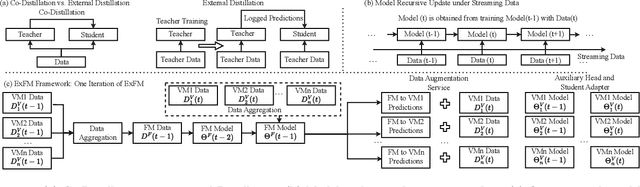
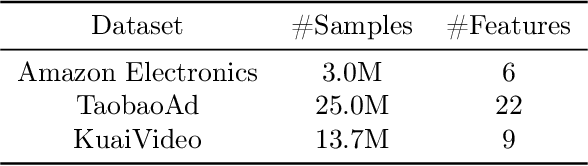
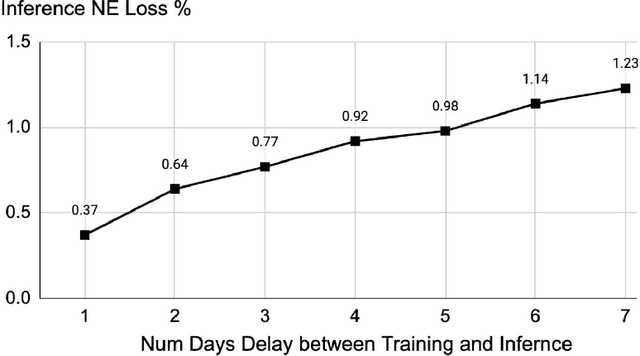
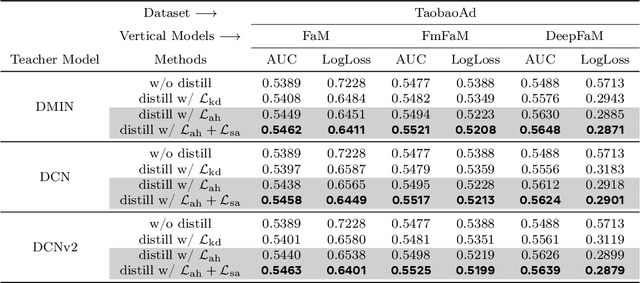
Ads recommendation is a prominent service of online advertising systems and has been actively studied. Recent studies indicate that scaling-up and advanced design of the recommendation model can bring significant performance improvement. However, with a larger model scale, such prior studies have a significantly increasing gap from industry as they often neglect two fundamental challenges in industrial-scale applications. First, training and inference budgets are restricted for the model to be served, exceeding which may incur latency and impair user experience. Second, large-volume data arrive in a streaming mode with data distributions dynamically shifting, as new users/ads join and existing users/ads leave the system. We propose the External Large Foundation Model (ExFM) framework to address the overlooked challenges. Specifically, we develop external distillation and a data augmentation system (DAS) to control the computational cost of training/inference while maintaining high performance. We design the teacher in a way like a foundation model (FM) that can serve multiple students as vertical models (VMs) to amortize its building cost. We propose Auxiliary Head and Student Adapter to mitigate the data distribution gap between FM and VMs caused by the streaming data issue. Comprehensive experiments on internal industrial-scale applications and public datasets demonstrate significant performance gain by ExFM.
Wukong: Towards a Scaling Law for Large-Scale Recommendation
Mar 08, 2024


Scaling laws play an instrumental role in the sustainable improvement in model quality. Unfortunately, recommendation models to date do not exhibit such laws similar to those observed in the domain of large language models, due to the inefficiencies of their upscaling mechanisms. This limitation poses significant challenges in adapting these models to increasingly more complex real-world datasets. In this paper, we propose an effective network architecture based purely on stacked factorization machines, and a synergistic upscaling strategy, collectively dubbed Wukong, to establish a scaling law in the domain of recommendation. Wukong's unique design makes it possible to capture diverse, any-order of interactions simply through taller and wider layers. We conducted extensive evaluations on six public datasets, and our results demonstrate that Wukong consistently outperforms state-of-the-art models quality-wise. Further, we assessed Wukong's scalability on an internal, large-scale dataset. The results show that Wukong retains its superiority in quality over state-of-the-art models, while holding the scaling law across two orders of magnitude in model complexity, extending beyond 100 Gflop or equivalently up to Large Language Model (GPT-3) training compute scale, where prior arts fall short.