 Add to Chrome
 Add to Firefox
 Add to Edge
RMGS-SLAM: Real-time Multi-sensor Gaussian Splatting SLAM
Apr 14, 2026
Real-time 3D Gaussian splatting (3DGS)-based Simultaneous Localization and Mapping (SLAM) in large-scale real-world environments remains challenging, as existing methods often struggle to jointly achieve low-latency pose estimation, 3D Gaussian reconstruction in step with incoming sensor streams, and long-term global consistency. In this paper, we present a tightly coupled LiDAR-Inertial-Visual (LIV) 3DGS-based SLAM framework for real-time pose estimation and photorealistic mapping in large-scale real-world scenes. The system executes state estimation and 3D Gaussian primitive initialization in parallel with global Gaussian optimization, thereby enabling continuous dense mapping. To improve Gaussian initialization quality and accelerate optimization convergence, we introduce a cascaded strategy that combines feed-forward predictions with voxel-based principal component analysis (voxel-PCA) geometric priors. To enhance global consistency in large scenes, we further perform loop closure directly on the optimized global Gaussian map by estimating loop constraints through Gaussian-based Generalized Iterative Closest Point (GICP) registration, followed by pose-graph optimization. In addition, we collected challenging large-scale looped outdoor SLAM sequences with hardware-synchronized LiDAR-camera-IMU and ground-truth trajectories to support realistic and comprehensive evaluation. Extensive experiments on both public datasets and our dataset demonstrate that the proposed method achieves a strong balance among real-time efficiency, localization accuracy, and rendering quality across diverse and challenging real-world scenes.

AGI-Elo: How Far Are We From Mastering A Task?
May 19, 2025As the field progresses toward Artificial General Intelligence (AGI), there is a pressing need for more comprehensive and insightful evaluation frameworks that go beyond aggregate performance metrics. This paper introduces a unified rating system that jointly models the difficulty of individual test cases and the competency of AI models (or humans) across vision, language, and action domains. Unlike existing metrics that focus solely on models, our approach allows for fine-grained, difficulty-aware evaluations through competitive interactions between models and tasks, capturing both the long-tail distribution of real-world challenges and the competency gap between current models and full task mastery. We validate the generalizability and robustness of our system through extensive experiments on multiple established datasets and models across distinct AGI domains. The resulting rating distributions offer novel perspectives and interpretable insights into task difficulty, model progression, and the outstanding challenges that remain on the path to achieving full AGI task mastery.
DRAMA: An Efficient End-to-end Motion Planner for Autonomous Driving with Mamba
Aug 07, 2024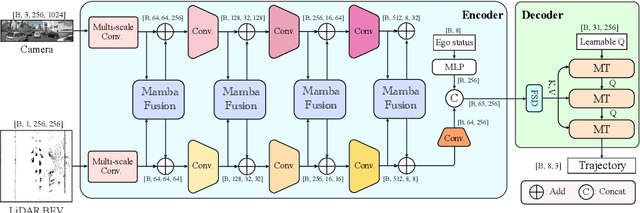
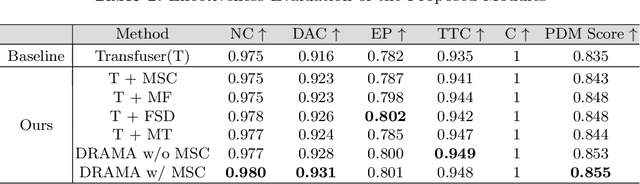

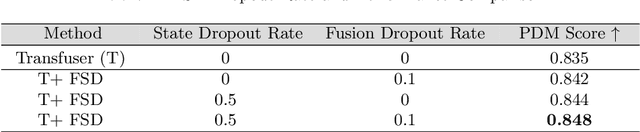
Motion planning is a challenging task to generate safe and feasible trajectories in highly dynamic and complex environments, forming a core capability for autonomous vehicles. In this paper, we propose DRAMA, the first Mamba-based end-to-end motion planner for autonomous vehicles. DRAMA fuses camera, LiDAR Bird's Eye View images in the feature space, as well as ego status information, to generate a series of future ego trajectories. Unlike traditional transformer-based methods with quadratic attention complexity for sequence length, DRAMA is able to achieve a less computationally intensive attention complexity, demonstrating potential to deal with increasingly complex scenarios. Leveraging our Mamba fusion module, DRAMA efficiently and effectively fuses the features of the camera and LiDAR modalities. In addition, we introduce a Mamba-Transformer decoder that enhances the overall planning performance. This module is universally adaptable to any Transformer-based model, especially for tasks with long sequence inputs. We further introduce a novel feature state dropout which improves the planner's robustness without increasing training and inference times. Extensive experimental results show that DRAMA achieves higher accuracy on the NAVSIM dataset compared to the baseline Transfuser, with fewer parameters and lower computational costs.
DriveSceneGen: Generating Diverse and Realistic Driving Scenarios from Scratch
Sep 26, 2023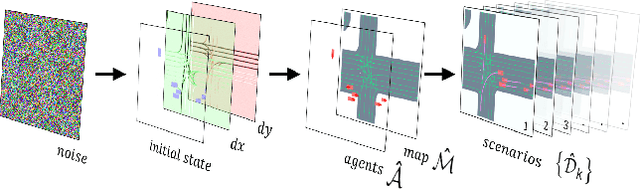
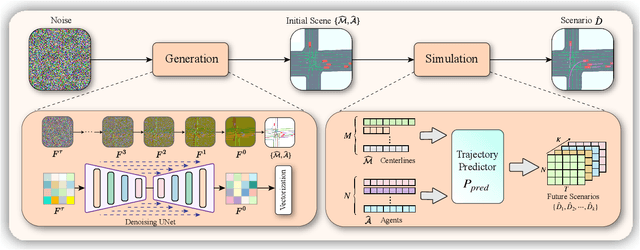
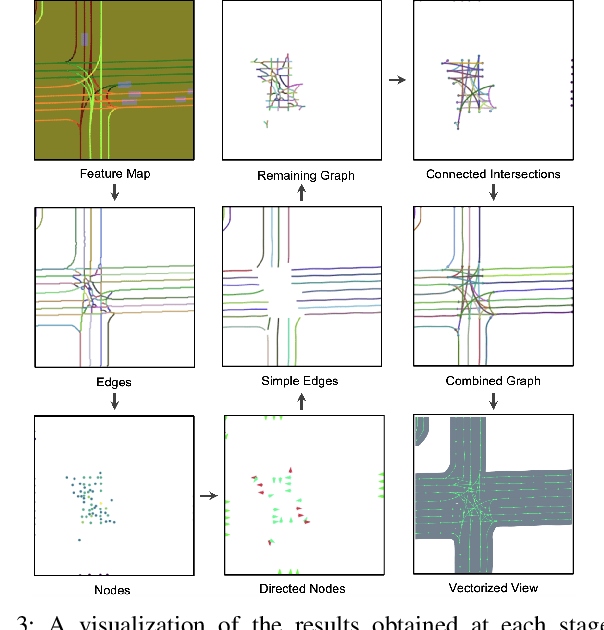
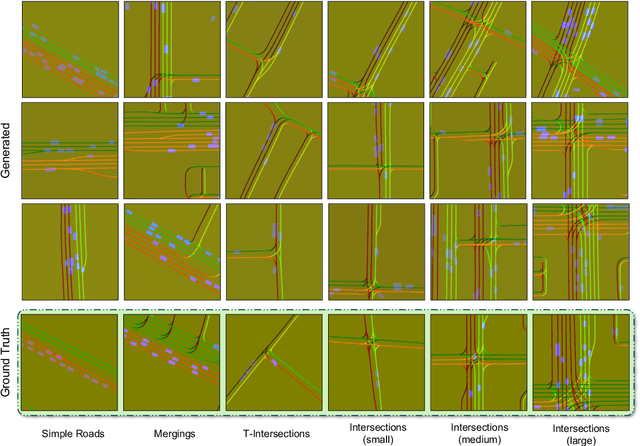
Realistic and diverse traffic scenarios in large quantities are crucial for the development and validation of autonomous driving systems. However, owing to numerous difficulties in the data collection process and the reliance on intensive annotations, real-world datasets lack sufficient quantity and diversity to support the increasing demand for data. This work introduces DriveSceneGen, a data-driven driving scenario generation method that learns from the real-world driving dataset and generates entire dynamic driving scenarios from scratch. DriveSceneGen is able to generate novel driving scenarios that align with real-world data distributions with high fidelity and diversity. Experimental results on 5k generated scenarios highlight the generation quality, diversity, and scalability compared to real-world datasets. To the best of our knowledge, DriveSceneGen is the first method that generates novel driving scenarios involving both static map elements and dynamic traffic participants from scratch.
CARLA-Loc: Synthetic SLAM Dataset with Full-stack Sensor Setup in Challenging Weather and Dynamic Environments
Sep 16, 2023The robustness of SLAM algorithms in challenging environmental conditions is crucial for autonomous driving, but the impact of these conditions are unknown while given the difficulty of arbitrarily changing the relevant environmental parameters of the same environment in the real world. Therefore, we propose CARLA-Loc, a synthetic dataset of challenging and dynamic environments built on CARLA simulator. We integrate multiple sensors into the dataset with strict calibration, synchronization and precise timestamping. 7 maps and 42 sequences are posed in our dataset with different dynamic levels and weather conditions. Objects in both stereo images and point clouds are well-segmented with their class labels. We evaluate 5 visual-based and 4 LiDAR-based approaches on varies sequences and analyze the effect of challenging environmental factors on the localization accuracy, showing the applicability of proposed dataset for validating SLAM algorithms.