 Add to Chrome
 Add to Firefox
 Add to Edge
Dexterity-BEV: Aligning 3D World and Actions for Generalizable Robot Policies Learning
Jun 01, 2026
End-to-end manipulation policies, combined with web-scale pretrained Vision-Language Models (VLMs), show the promise for generalizable and dexterous robotic manipulation. However, they inherit two key limitations from 2D foundation models: 1) the reliance on 2D RGB inputs that ignores the intrinsically 3D nature of manipulation; and 2) the lack of spatial 3D alignment between input-output spaces as well as across diverse robot embodiments, camera setups, and trajectory datasets. In this paper, we present a series of contributions to address these issues. First, we introduce aligned vertex map and vertex spectrum -- a pixel-wise 3D representation that elevates 2D visual inputs to 3D, using camera calibration and optional depth. This novel input representation marries 3D awareness with the generalization of 2D large VLMs. Then, we propose to align the inputs and outputs of manipulation policies by expressing per-pixel 3D information of each camera view and robot actions to a shared coordinate. Based on this, we designate a canonical Bird's-Eye-View (BEV) alignment frame and innovatively propose to construct BEV images, producing a view-invariant representation robust to camera pose variations. To enable training and evaluation at scale, we develop a comprehensive data processing pipeline to perform such alignments; we also introduce a novel temporal alignment scheme for trajectories across diverse robots, human operators, and datasets. These contributions collectively mitigate input and output spatial-temporal misalignments, improving the consistency and generalization for real-world manipulation. Pretrained checkpoint, source code and data processing pipeline are available in https://hnuzhy.github.io/projects/Dex-BEV.

ALIGN: Adversarial Learning for Generalizable Speech Neuroprosthesis
Mar 18, 2026Intracortical brain-computer interfaces (BCIs) can decode speech from neural activity with high accuracy when trained on data pooled across recording sessions. In realistic deployment, however, models must generalize to new sessions without labeled data, and performance often degrades due to cross-session nonstationarities (e.g., electrode shifts, neural turnover, and changes in user strategy). In this paper, we propose ALIGN, a session-invariant learning framework based on multi-domain adversarial neural networks for semi-supervised cross-session adaptation. ALIGN trains a feature encoder jointly with a phoneme classifier and a domain classifier operating on the latent representation. Through adversarial optimization, the encoder is encouraged to preserve task-relevant information while suppressing session-specific cues. We evaluate ALIGN on intracortical speech decoding and find that it generalizes consistently better to previously unseen sessions, improving both phoneme error rate and word error rate relative to baselines. These results indicate that adversarial domain alignment is an effective approach for mitigating session-level distribution shift and enabling robust longitudinal BCI decoding.
See Once, Then Act: Vision-Language-Action Model with Task Learning from One-Shot Video Demonstrations
Dec 08, 2025Developing robust and general-purpose manipulation policies represents a fundamental objective in robotics research. While Vision-Language-Action (VLA) models have demonstrated promising capabilities for end-to-end robot control, existing approaches still exhibit limited generalization to tasks beyond their training distributions. In contrast, humans possess remarkable proficiency in acquiring novel skills by simply observing others performing them once. Inspired by this capability, we propose ViVLA, a generalist robotic manipulation policy that achieves efficient task learning from a single expert demonstration video at test time. Our approach jointly processes an expert demonstration video alongside the robot's visual observations to predict both the demonstrated action sequences and subsequent robot actions, effectively distilling fine-grained manipulation knowledge from expert behavior and transferring it seamlessly to the agent. To enhance the performance of ViVLA, we develop a scalable expert-agent pair data generation pipeline capable of synthesizing paired trajectories from easily accessible human videos, further augmented by curated pairs from publicly available datasets. This pipeline produces a total of 892,911 expert-agent samples for training ViVLA. Experimental results demonstrate that our ViVLA is able to acquire novel manipulation skills from only a single expert demonstration video at test time. Our approach achieves over 30% improvement on unseen LIBERO tasks and maintains above 35% gains with cross-embodiment videos. Real-world experiments demonstrate effective learning from human videos, yielding more than 38% improvement on unseen tasks.
DRAMA: An Efficient End-to-end Motion Planner for Autonomous Driving with Mamba
Aug 07, 2024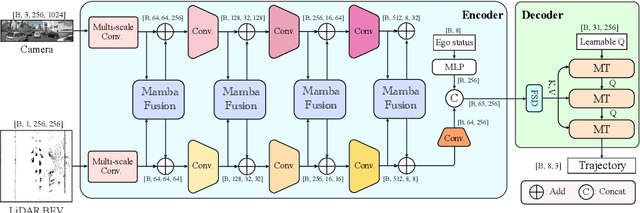
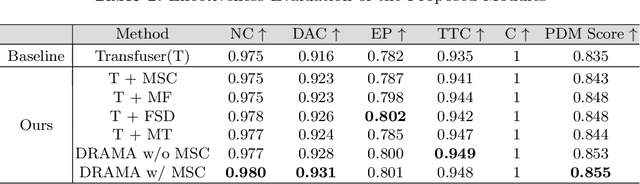

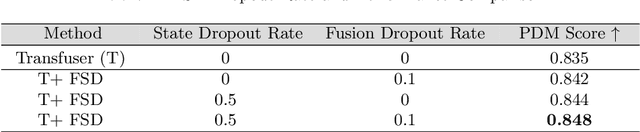
Motion planning is a challenging task to generate safe and feasible trajectories in highly dynamic and complex environments, forming a core capability for autonomous vehicles. In this paper, we propose DRAMA, the first Mamba-based end-to-end motion planner for autonomous vehicles. DRAMA fuses camera, LiDAR Bird's Eye View images in the feature space, as well as ego status information, to generate a series of future ego trajectories. Unlike traditional transformer-based methods with quadratic attention complexity for sequence length, DRAMA is able to achieve a less computationally intensive attention complexity, demonstrating potential to deal with increasingly complex scenarios. Leveraging our Mamba fusion module, DRAMA efficiently and effectively fuses the features of the camera and LiDAR modalities. In addition, we introduce a Mamba-Transformer decoder that enhances the overall planning performance. This module is universally adaptable to any Transformer-based model, especially for tasks with long sequence inputs. We further introduce a novel feature state dropout which improves the planner's robustness without increasing training and inference times. Extensive experimental results show that DRAMA achieves higher accuracy on the NAVSIM dataset compared to the baseline Transfuser, with fewer parameters and lower computational costs.