 Add to Chrome
 Add to Firefox
 Add to Edge
MentalThink: Shaping Thoughts in Mental SVG World
Jul 03, 2026
We introduce MentalThink, a visual-symbolic reasoning paradigm that equips Multimodal LLMs (MLLMs) with an executable mechanism for "mental" visualization. The core of MentalThink is a think-with-SVG pipeline, where the model learns to generate, render, and interpret scalable vector graphics (SVG) code as an intermediate visual representation for multi-turn reasoning. By creating structured vector sketches, the model can externalize spatial hypotheses, inspect them through deterministic rendering, and reason within a constrained geometric space, effectively mimicking the human process of mental imagery. We instantiate this paradigm through a two-stage training framework, combining Supervised Fine-Tuning (SFT) for SVG syntactic alignment with multi-turn Reinforcement Learning (RL) to encourage iterative inspection, revision, and refinement of intermediate visual hypotheses. Extensive evaluations demonstrate that MentalThink achieves superior performance on spatial understanding and reasoning benchmarks (e.g., 55.1% on VSIBench, 76.0% on MindCube), showing that executable vector graphics provide a verifiable visual workspace for dynamic perspective taking, visual reflection, and compositional scene construction.

Perceive-to-Reason: Decoupling Perception and Reasoning for Fine-Grained Visual Reasoning
Jul 01, 2026Fine-grained visual reasoning remains challenging for vision-language models, especially when small but critical visual cues are buried in high-resolution images. Existing approaches rely on repeated cropping or test-time visual search to introduce local evidence, but they typically do not explicitly distinguish perception from reasoning. In this paper, we propose Perceive-to-Reason (P2R), a unified framework that formulates fine-grained visual reasoning as a two-stage process: the model first localizes question-relevant evidence as a Perceiver, and then answers the question as a Reasoner based on the annotated image and cropped regions. To better align training with this decoupled formulation, we further introduce Perception-Reasoning Alternating GRPO (PRA-GRPO), a role-aware reinforcement learning strategy that alternates between perception-focused and reasoning-focused updates using only final-answer supervision. Built on top of Qwen3-VL-Instruct-2B/4B/8B, P2R consistently improves performance across model scales. In particular, P2R-4B achieves 93.2% on V-Star, 81.9% on HR-Bench-4K, and 80.5% on HR-Bench-8K, substantially outperforming its corresponding backbone. Further experiments show that the benefits of P2R extend beyond high-resolution benchmarks to broader multimodal reasoning tasks. These results suggest that explicitly decoupling perception from reasoning provides an effective framework for fine-grained visual reasoning.
Milestone-Guided Policy Learning for Long-Horizon Language Agents
May 07, 2026While long-horizon agentic tasks require language agents to perform dozens of sequential decisions, training such agents with reinforcement learning remains challenging. We identify two root causes: credit misattribution, where correct early actions are penalized due to terminal failures, and sample inefficiency, where scarce successful trajectories result in near-total loss of learning signal. We introduce a milestone-guided policy learning framework, BEACON, that leverages the compositional structure of long-horizon tasks to ensure precise credit assignment. BEACON partitions trajectories at milestone boundaries, applies temporal reward shaping within segments to credit partial progress, and estimates advantages at dual scales to prevent distant failures from corrupting the evaluation of local actions. On ALFWorld, WebShop, and ScienceWorld, BEACON consistently outperforms GRPO and GiGPO. Notably, on long-horizon ALFWorld tasks, BEACON achieves 92.9% success rate, nearly doubling GRPO's 53.5%, while improving effective sample utilization from 23.7% to 82.0%. These results establish milestone-anchored credit assignment as an effective paradigm for training long-horizon language agents. Code is available at https://github.com/ZJU-REAL/BEACON.
WebVR: Benchmarking Multimodal LLMs for WebPage Recreation from Videos via Human-Aligned Visual Rubrics
Mar 11, 2026Existing web-generation benchmarks rely on text prompts or static screenshots as input. However, videos naturally convey richer signals such as interaction flow, transition timing, and motion continuity, which are essential for faithful webpage recreation. Despite this potential, video-conditioned webpage generation remains largely unexplored, with no dedicated benchmark for this task. To fill this gap, we introduce WebVR, a benchmark that evaluates whether MLLMs can faithfully recreate webpages from demonstration videos. WebVR contains 175 webpages across diverse categories, all constructed through a controlled synthesis pipeline rather than web crawling, ensuring varied and realistic demonstrations without overlap with existing online pages. We also design a fine-grained, human-aligned visual rubric that evaluates the generated webpages across multiple dimensions. Experiments on 19 models reveal substantial gaps in recreating fine-grained style and motion quality, while the rubric-based automatic evaluation achieves 96% agreement with human preferences. We release the dataset, evaluation toolkit, and baseline results to support future research on video-to-webpage generation.
CoCo: Code as CoT for Text-to-Image Preview and Rare Concept Generation
Mar 09, 2026Recent advancements in Unified Multimodal Models (UMMs) have significantly advanced text-to-image (T2I) generation, particularly through the integration of Chain-of-Thought (CoT) reasoning. However, existing CoT-based T2I methods largely rely on abstract natural-language planning, which lacks the precision required for complex spatial layouts, structured visual elements, and dense textual content. In this work, we propose CoCo (Code-as-CoT), a code-driven reasoning framework that represents the reasoning process as executable code, enabling explicit and verifiable intermediate planning for image generation. Given a text prompt, CoCo first generates executable code that specifies the structural layout of the scene, which is then executed in a sandboxed environment to render a deterministic draft image. The model subsequently refines this draft through fine-grained image editing to produce the final high-fidelity result. To support this training paradigm, we construct CoCo-10K, a curated dataset containing structured draft-final image pairs designed to teach both structured draft construction and corrective visual refinement. Empirical evaluations on StructT2IBench, OneIG-Bench, and LongText-Bench show that CoCo achieves improvements of +68.83%, +54.8%, and +41.23% over direct generation, while also outperforming other generation methods empowered by CoT. These results demonstrate that executable code is an effective and reliable reasoning paradigm for precise, controllable, and structured text-to-image generation. The code is available at: https://github.com/micky-li-hd/CoCo
STEP3-VL-10B Technical Report
Jan 15, 2026We present STEP3-VL-10B, a lightweight open-source foundation model designed to redefine the trade-off between compact efficiency and frontier-level multimodal intelligence. STEP3-VL-10B is realized through two strategic shifts: first, a unified, fully unfrozen pre-training strategy on 1.2T multimodal tokens that integrates a language-aligned Perception Encoder with a Qwen3-8B decoder to establish intrinsic vision-language synergy; and second, a scaled post-training pipeline featuring over 1k iterations of reinforcement learning. Crucially, we implement Parallel Coordinated Reasoning (PaCoRe) to scale test-time compute, allocating resources to scalable perceptual reasoning that explores and synthesizes diverse visual hypotheses. Consequently, despite its compact 10B footprint, STEP3-VL-10B rivals or surpasses models 10$\times$-20$\times$ larger (e.g., GLM-4.6V-106B, Qwen3-VL-235B) and top-tier proprietary flagships like Gemini 2.5 Pro and Seed-1.5-VL. Delivering best-in-class performance, it records 92.2% on MMBench and 80.11% on MMMU, while excelling in complex reasoning with 94.43% on AIME2025 and 75.95% on MathVision. We release the full model suite to provide the community with a powerful, efficient, and reproducible baseline.
OmniEAR: Benchmarking Agent Reasoning in Embodied Tasks
Aug 07, 2025Large language models excel at abstract reasoning but their capacity for embodied agent reasoning remains largely unexplored. We present OmniEAR, a comprehensive framework for evaluating how language models reason about physical interactions, tool usage, and multi-agent coordination in embodied tasks. Unlike existing benchmarks that provide predefined tool sets or explicit collaboration directives, OmniEAR requires agents to dynamically acquire capabilities and autonomously determine coordination strategies based on task demands. Through text-based environment representation, we model continuous physical properties and complex spatial relationships across 1,500 scenarios spanning household and industrial domains. Our systematic evaluation reveals severe performance degradation when models must reason from constraints: while achieving 85-96% success with explicit instructions, performance drops to 56-85% for tool reasoning and 63-85% for implicit collaboration, with compound tasks showing over 50% failure rates. Surprisingly, complete environmental information degrades coordination performance, indicating models cannot filter task-relevant constraints. Fine-tuning improves single-agent tasks dramatically (0.6% to 76.3%) but yields minimal multi-agent gains (1.5% to 5.5%), exposing fundamental architectural limitations. These findings demonstrate that embodied reasoning poses fundamentally different challenges than current models can address, establishing OmniEAR as a rigorous benchmark for evaluating and advancing embodied AI systems. Our code and data are included in the supplementary materials and will be open-sourced upon acceptance.
ViewSpatial-Bench: Evaluating Multi-perspective Spatial Localization in Vision-Language Models
May 27, 2025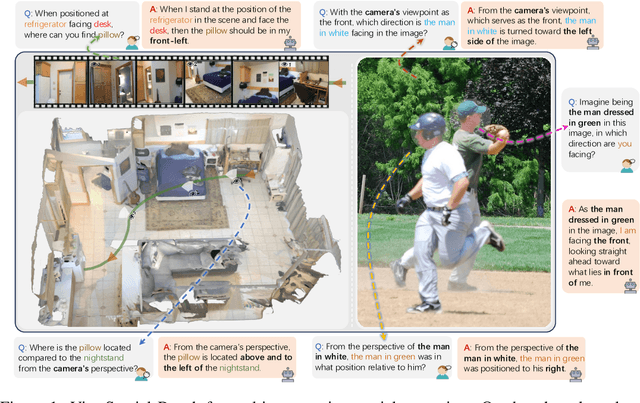
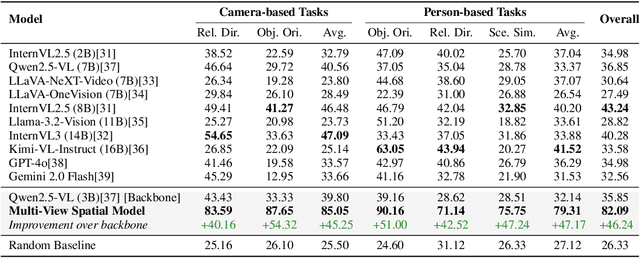
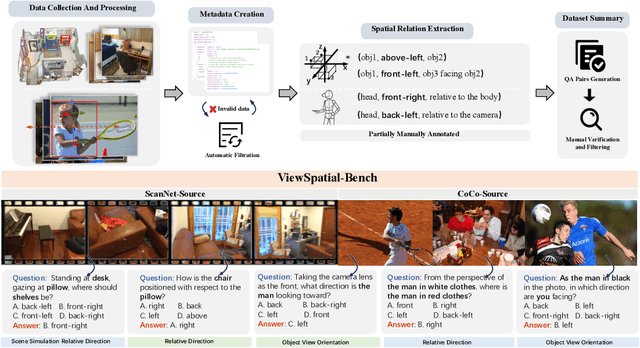

Vision-language models (VLMs) have demonstrated remarkable capabilities in understanding and reasoning about visual content, but significant challenges persist in tasks requiring cross-viewpoint understanding and spatial reasoning. We identify a critical limitation: current VLMs excel primarily at egocentric spatial reasoning (from the camera's perspective) but fail to generalize to allocentric viewpoints when required to adopt another entity's spatial frame of reference. We introduce ViewSpatial-Bench, the first comprehensive benchmark designed specifically for multi-viewpoint spatial localization recognition evaluation across five distinct task types, supported by an automated 3D annotation pipeline that generates precise directional labels. Comprehensive evaluation of diverse VLMs on ViewSpatial-Bench reveals a significant performance disparity: models demonstrate reasonable performance on camera-perspective tasks but exhibit reduced accuracy when reasoning from a human viewpoint. By fine-tuning VLMs on our multi-perspective spatial dataset, we achieve an overall performance improvement of 46.24% across tasks, highlighting the efficacy of our approach. Our work establishes a crucial benchmark for spatial intelligence in embodied AI systems and provides empirical evidence that modeling 3D spatial relationships enhances VLMs' corresponding spatial comprehension capabilities.