 Add to Chrome
 Add to Firefox
 Add to Edge
ELoG-GS: Dual-Branch Gaussian Splatting with Luminance-Guided Enhancement for Extreme Low-light 3D Reconstruction
Apr 14, 2026
This paper presents our approach to the NTIRE 2026 3D Restoration and Reconstruction Challenge (Track 1), which focuses on reconstructing high-quality 3D representations from degraded multi-view inputs. The challenge involves recovering geometrically consistent and photorealistic 3D scenes in extreme low-light environments. To address this task, we propose Extreme Low-light Optimized Gaussian Splatting (ELoG-GS), a robust low-light 3D reconstruction pipeline that integrates learning-based point cloud initialization and luminance-guided color enhancement for stable and photorealistic Gaussian Splatting. Our method incorporates both geometry-aware initialization and photometric adaptation strategies to improve reconstruction fidelity under challenging conditions. Extensive experiments on the NTIRE Track 1 benchmark demonstrate that our approach significantly improves reconstruction quality over the baselines, achieving superior visual fidelity and geometric consistency. The proposed method provides a practical solution for robust 3D reconstruction in real-world degraded scenarios. In the final testing phase, our method achieved a PSNR of 18.6626 and an SSIM of 0.6855 on the official platform leaderboard. Code is available at https://github.com/lyh120/FSGS_EAPGS.

NTIRE 2026 3D Restoration and Reconstruction in Real-world Adverse Conditions: RealX3D Challenge Results
Apr 05, 2026This paper presents a comprehensive review of the NTIRE 2026 3D Restoration and Reconstruction (3DRR) Challenge, detailing the proposed methods and results. The challenge seeks to identify robust reconstruction pipelines that are robust under real-world adverse conditions, specifically extreme low-light and smoke-degraded environments, as captured by our RealX3D benchmark. A total of 279 participants registered for the competition, of whom 33 teams submitted valid results. We thoroughly evaluate the submitted approaches against state-of-the-art baselines, revealing significant progress in 3D reconstruction under adverse conditions. Our analysis highlights shared design principles among top-performing methods and provides insights into effective strategies for handling 3D scene degradation.
ChatDyn: Language-Driven Multi-Actor Dynamics Generation in Street Scenes
Dec 11, 2024Generating realistic and interactive dynamics of traffic participants according to specific instruction is critical for street scene simulation. However, there is currently a lack of a comprehensive method that generates realistic dynamics of different types of participants including vehicles and pedestrians, with different kinds of interactions between them. In this paper, we introduce ChatDyn, the first system capable of generating interactive, controllable and realistic participant dynamics in street scenes based on language instructions. To achieve precise control through complex language, ChatDyn employs a multi-LLM-agent role-playing approach, which utilizes natural language inputs to plan the trajectories and behaviors for different traffic participants. To generate realistic fine-grained dynamics based on the planning, ChatDyn designs two novel executors: the PedExecutor, a unified multi-task executor that generates realistic pedestrian dynamics under different task plannings; and the VehExecutor, a physical transition-based policy that generates physically plausible vehicle dynamics. Extensive experiments show that ChatDyn can generate realistic driving scene dynamics with multiple vehicles and pedestrians, and significantly outperforms previous methods on subtasks. Code and model will be available at https://vfishc.github.io/chatdyn.
Self-Localized Collaborative Perception
Jun 18, 2024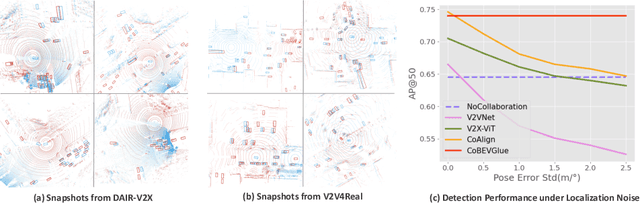
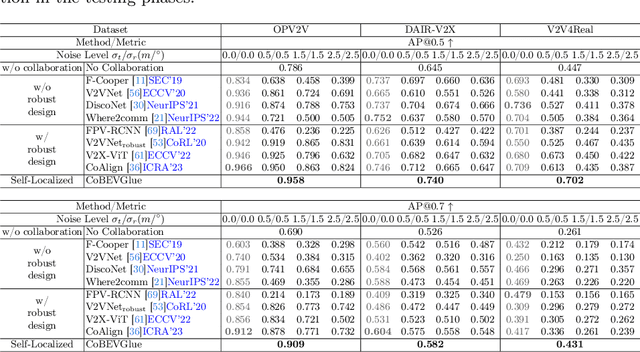
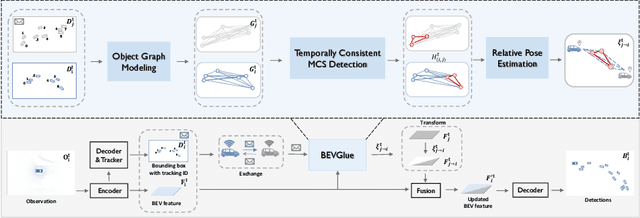

Collaborative perception has garnered considerable attention due to its capacity to address several inherent challenges in single-agent perception, including occlusion and out-of-range issues. However, existing collaborative perception systems heavily rely on precise localization systems to establish a consistent spatial coordinate system between agents. This reliance makes them susceptible to large pose errors or malicious attacks, resulting in substantial reductions in perception performance. To address this, we propose~$\mathtt{CoBEVGlue}$, a novel self-localized collaborative perception system, which achieves more holistic and robust collaboration without using an external localization system. The core of~$\mathtt{CoBEVGlue}$ is a novel spatial alignment module, which provides the relative poses between agents by effectively matching co-visible objects across agents. We validate our method on both real-world and simulated datasets. The results show that i) $\mathtt{CoBEVGlue}$ achieves state-of-the-art detection performance under arbitrary localization noises and attacks; and ii) the spatial alignment module can seamlessly integrate with a majority of previous methods, enhancing their performance by an average of $57.7\%$. Code is available at https://github.com/VincentNi0107/CoBEVGlue