 Add to Chrome
 Add to Firefox
 Add to Edge
Demonstration of Space Robot Teleoperation over a Lossy and Delayed Network using ATMOS
Aug 14, 2026
We present a demonstration showcasing the Autonomy Testbed for Multi-purpose Orbiting Systems (ATMOS), a planar spacecraft-analog robot designed for hardware-in-the-loop evaluation of guidance and control strategies in microgravity-like conditions. Using ATMOS as the physical test platform, we investigate the design, analysis, and performance evaluation of control architectures for remotely operated spacecraft under round-trip communication delays. In this work, we develop and experimentally validate a control strategy that combines state prediction and trajectory tracking control to perform a docking maneuver, accounting for time-varying random communication latency between ground operators and the ATMOS system. The demonstration includes a long-distance remote control experiment between Seoul and Stockholm, introducing realistic intercontinental delays and variability. The results highlight the capability of ATMOS to support rapid, reliable, and cost-effective testing of spacecraft teleoperation concepts, establishing a first step toward robust validation of on-orbit operations in microgravity-like environments.

Modeling and Validation of Quality of Control for Edge-Offloaded Collaborative Navigation
Jul 16, 2026Collaborative control in complex environments is severely challenged by stochastic wireless delay and reliability variations, which can degrade navigation, tracking, and collision avoidance. These network-induced uncertainties complicate the maintenance of energy efficiency during collaborative tasks, and can potentially lead to over-provisioning of resources. In this paper, for a navigation setup with dynamic collision avoidance, we address this challenge by expanding the quality of control (QoC) framework from prior works to practical robotic models. Our approach (i) models end-to-end network effects on closed-loop performance, (ii) systematically explores the impact of various control parameters dictating robotic motion on network latency-reliability (iii) validates these models through experiments on a private 5G testbed across varying delay, reliability and control configurations. Our analysis indicates the optimal control-communication co-design operating regimes for practical robots and also compares the QoC performance of standard ROS~2 quality of service (QoS) policies under real-world conditions and showing how RELIABLE QoS offers 51.5% better QoC than BEST-EFFORT under certain experimental settings.
Agentic Neuro-Symbolic Planning and Commissioning for Human-in-the-Loop Industrial Robotics with Digital Twins
Jun 06, 2026Flexible robotic automation requires systems that interpret operator intent, verify physical feasibility, and recover from execution failures across both the planning and execution stages. This paper proposes an agentic neuro-symbolic framework for human-in-the-loop industrial robotics, in which LLMs are used for tasks that require language understanding or contextual reasoning, while all verification, sequencing, and execution remain deterministic. The framework adapts the Planner-Generator-Evaluator (PGE) harness pattern from software engineering into a Specifier-Designer-Inspector (SDI) architecture for industrial robotics, combined with LangGraph-based dynamic routing for failure recovery. A two-tier recovery mechanism addresses structure-level replanning through context-aware orchestration and execution-level geometric failures through deterministic recovery skills. A Unity3D digital twin supports human inspection, modification, and re-verification prior to physical execution. Evaluated on natural-language commands across multiple difficulty levels against ten baselines, the proposed method achieves the highest task success. Ablation results confirm that structured command expansion, symbolic verification, selective LLM routing, and recovery skills are each individually necessary.
An Operator-Based Approach to STL
May 27, 2026Signal Temporal Logic (STL), has recently seen extensive development, owing to its rich expressivenes for autonomous planning and control. Nevertheless, existing verification and control synthesis methods are limited with respect to the complexity and degree of nesting of the formulae. In this work, we propose a novel approach to STL based on an operator acting on reachability value functions. This constitutes a new theoretical framework for handling complex multi-nested formulae while at the same time providing tools for on-line control synthesis. In contrast to focusing on the design of STL-based reachability (or control barrier) functions, we develop operator-based nesting rules directly. Our method's expressiveness is demonstrated both theoretically, where necessary and sufficient conditions for STL formula satisfaction are extracted, as well as in simulations with complex fragments.
Feasibility-aware Hybrid Control for Motion Planning under Signal Temporal Logics
May 05, 2026In this work, a novel method for planar task and motion planning based on hybrid modeling is proposed. By virtue of a discrete variable which models local constraint satisfaction and enables local feasibility analysis, the proposed control architecture unifies planning with control design. Concurrently, control barrier functions are designed on a transformed disk version of the original nonconvex and geometrically complex robotic workspace, thus amending the issue of deadlocks. Simulations of the proposed method indicate effective handling of multiple overlapping spatio-temporal tasks even in the face of input saturation.
Marinarium: a New Arena to Bring Maritime Robotics Closer to Shore
Feb 26, 2026This paper presents the Marinarium, a modular and stand-alone underwater research facility designed to provide a realistic testbed for maritime and space-analog robotic experimentation in a resource-efficient manner. The Marinarium combines a fully instrumented underwater and aerial operational volume, extendable via a retractable roof for real-weather conditions, a digital twin in the SMaRCSim simulator and tight integration with a space robotics laboratory. All of these result from design choices aimed at bridging simulation, laboratory validation, and field conditions. We compare the Marinarium to similar existing infrastructures and illustrate how its design enables a set of experiments in four open research areas within field robotics. First, we exploit high-fidelity dynamics data from the tank to demonstrate the potential of learning-based system identification approaches applied to underwater vehicles. We further highlight the versatility of the multi-domain operating volume via a rendezvous mission with a heterogeneous fleet of robots across underwater, surface, and air. We then illustrate how the presented digital twin can be utilized to reduce the reality gap in underwater simulation. Finally, we demonstrate the potential of underwater surrogates for spacecraft navigation validation by executing spatiotemporally identical inspection tasks on a planar space-robot emulator and a neutrally buoyant \gls{rov}. In this work, by sharing the insights obtained and rationale behind the design and construction of the Marinarium, we hope to provide the field robotics research community with a blueprint for bridging the gap between controlled and real offshore and space robotics experimentation.
Trajectory Tracking for Multi-Manipulator Systems in Constrained Environments
Dec 16, 2025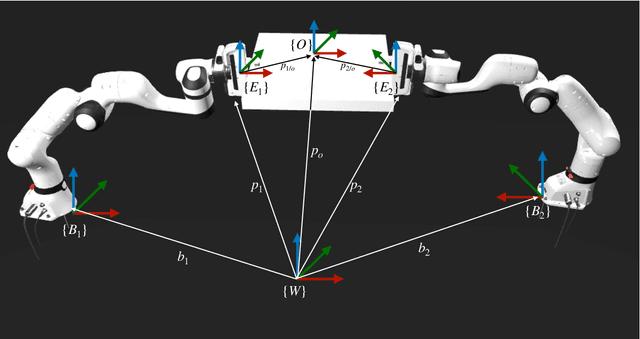
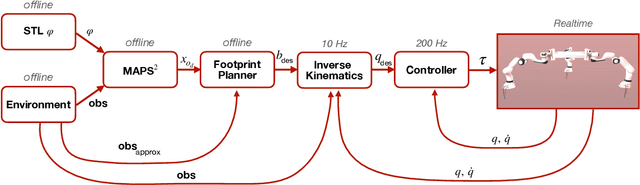
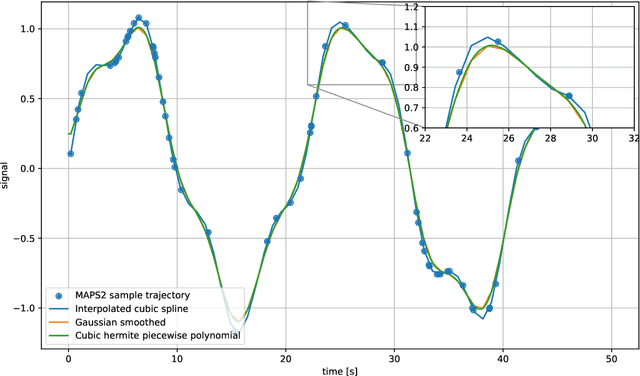
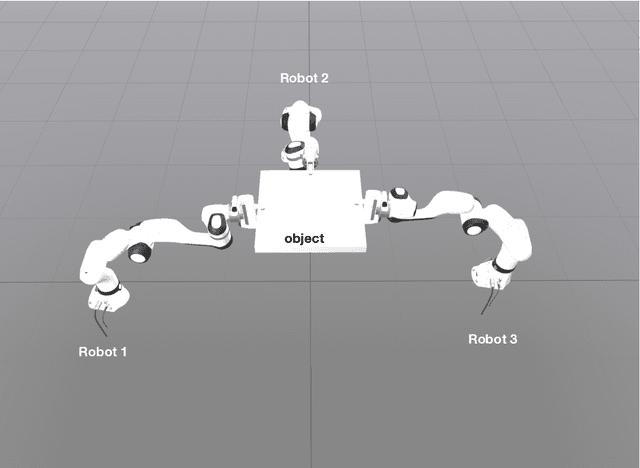
We consider the problem of cooperative manipulation by a mobile multi-manipulator system operating in obstacle-cluttered and highly constrained environments under spatio-temporal task specifications. The task requires transporting a grasped object while respecting both continuous robot dynamics and discrete geometric constraints arising from obstacles and narrow passages. To address this hybrid structure, we propose a multi-rate planning and control framework that combines offline generation of an STL-satisfying object trajectory and collision-free base footprints with online constrained inverse kinematics and continuous-time feedback control. The resulting closed-loop system enables coordinated reconfiguration of multiple manipulators while tracking the desired object motion. The approach is evaluated in high-fidelity physics simulations using three Franka Emika Panda mobile manipulators rigidly grasping an object.
Distribution-Free Stochastic MPC for Joint-in-Time Chance-Constrained Linear Systems
Dec 11, 2025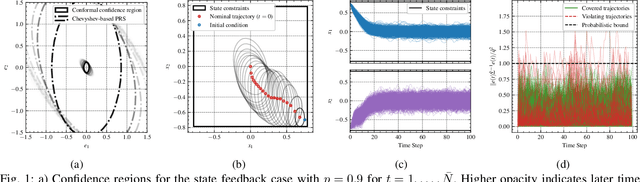
This work presents a stochastic model predictive control (MPC) framework for linear systems subject to joint-in-time chance constraints under unknown disturbance distributions. Unlike existing stochastic MPC formulations that rely on parametric or Gaussian assumptions or require expensive offline computations, the proposed method leverages conformal prediction (CP) as a streamlined tool to construct finite-sample confidence regions for the system's stochastic error trajectories with minimal computational effort. These regions enable the relaxation of probabilistic constraints while providing formal guarantees. By employing an indirect feedback mechanism and a probabilistic set-based formulation, we prove recursive feasibility of the relaxed optimization problem and establish chance constraint satisfaction in closed-loop. Furthermore, we extend the approach to the more general output feedback setting with unknown measurement noise distributions. Given available noise samples, we establish satisfaction of the joint chance constraints and recursive feasibility via output measurements alone. Numerical examples demonstrate the effectiveness and advantages of the proposed method compared to existing approaches.
Decoupled Design of Time-Varying Control Barrier Functions via Equivariances
Dec 09, 2025

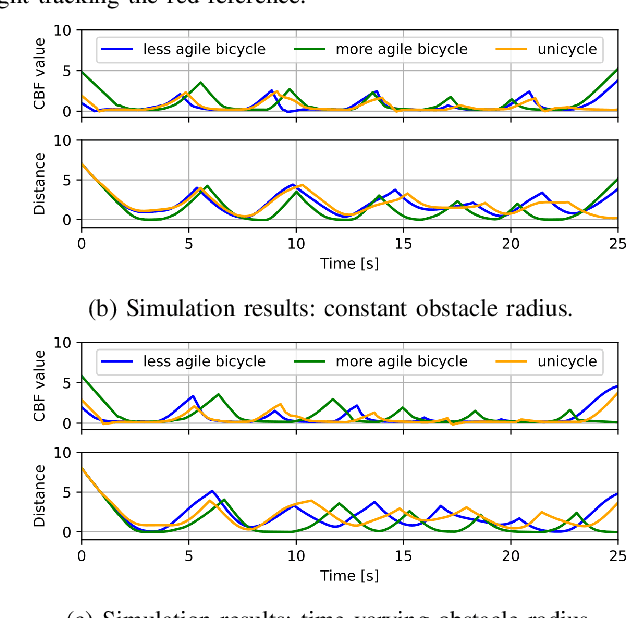
This article presents a systematic method for designing time-varying Control Barrier Functions (CBF) composed of a time-invariant component and multiple time-dependent components, leveraging structural properties of the system dynamics. The method involves the construction of a specific class of time-invariant CBFs that encode the system's dynamic capabilities with respect to a given constraint, and augments them subsequently with appropriately designed time-dependent transformations. While transformations uniformly varying the time-invariant CBF can be applied to arbitrary systems, transformations exploiting structural properties in the dynamics - equivariances in particular - enable the handling of a broader and more expressive class of time-varying constraints. The article shows how to leverage such properties in the design of time-varying CBFs. The proposed method decouples the design of time variations from the computationally expensive construction of the underlying CBFs, thereby providing a computationally attractive method to the design of time-varying CBFs. The method accounts for input constraints and under-actuation, and requires only qualitative knowledge on the time-variation of the constraints making it suitable to the application in uncertain environments.
Leveraging Equivariances and Symmetries in the Control Barrier Function Synthesis
Sep 04, 2025The synthesis of Control Barrier Functions (CBFs) often involves demanding computations or a meticulous construction. However, structural properties of the system dynamics and constraints have the potential to mitigate these challenges. In this paper, we explore how equivariances in the dynamics, loosely speaking a form of symmetry, can be leveraged in the CBF synthesis. Although CBFs are generally not inherently symmetric, we show how equivariances in the dynamics and symmetries in the constraints induce symmetries in CBFs derived through reachability analysis. This insight allows us to infer their CBF values across the entire domain from their values on a subset, leading to significant computational savings. Interestingly, equivariances can be even leveraged to the CBF synthesis for non-symmetric constraints. Specifically, we show how a partially known CBF can be leveraged together with equivariances to construct a CBF for various new constraints. Throughout the paper, we provide examples illustrating the theoretical findings. Furthermore, a numerical study investigates the computational gains from invoking equivariances into the CBF synthesis.