 Add to Chrome
 Add to Firefox
 Add to Edge
Validation of Space Robotics in Underwater Environments via Disturbance Robustness Equivalency
Feb 28, 2026
We present an experimental validation framework for space robotics that leverages underwater environments to approximate microgravity dynamics. While neutral buoyancy conditions make underwater robotics an excellent platform for space robotics validation, there are still dynamical and environmental differences that need to be overcome. Given a high-level space mission specification, expressed in terms of a Signal Temporal Logic specification, we overcome these differences via the notion of maximal disturbance robustness of the mission. We formulate the motion planning problem such that the original space mission and the validation mission achieve the same disturbance robustness degree. The validation platform then executes its mission plan using a near-identical control strategy to the space mission where the closed-loop controller considers the spacecraft dynamics. Evaluating our validation framework relies on estimating disturbances during execution and comparing them to the disturbance robustness degree, providing practical evidence of operation in the space environment. Our evaluation features a dual-experiment setup: an underwater robot operating under near-neutral buoyancy conditions to validate the planning and control strategy of either an experimental planar spacecraft platform or a CubeSat in a high-fidelity space dynamics simulator.

Bridging the Basilisk Astrodynamics Framework with ROS 2 for Modular Spacecraft Simulation and Hardware Integration
Dec 10, 2025Integrating high-fidelity spacecraft simulators with modular robotics frameworks remains a challenge for autonomy development. This paper presents a lightweight, open-source communication bridge between the Basilisk astrodynamics simulator and the Robot Operating System 2 (ROS 2), enabling real-time, bidirectional data exchange for spacecraft control. The bridge requires no changes to Basilisk's core and integrates seamlessly with ROS 2 nodes. We demonstrate its use in a leader-follower formation flying scenario using nonlinear model predictive control, deployed identically in both simulation and on the ATMOS planar microgravity testbed. This setup supports rapid development, hardware-in-the-loop testing, and seamless transition from simulation to hardware. The bridge offers a flexible and scalable platform for modular spacecraft autonomy and reproducible research workflows.
Towards Open-Source and Modular Space Systems with ATMOS
Jan 28, 2025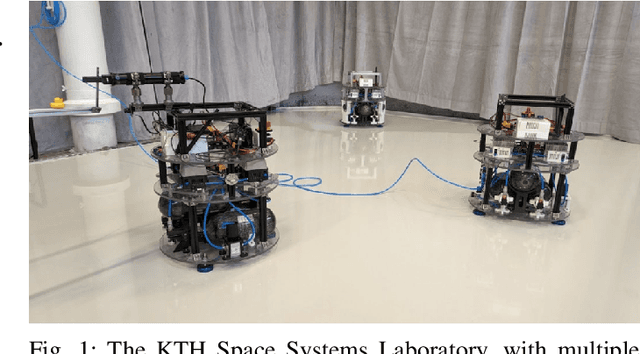
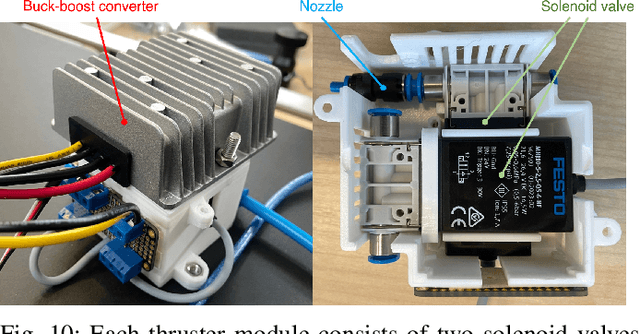
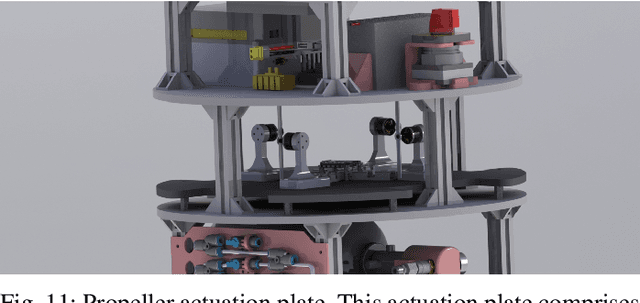

In the near future, autonomous space systems will compose a large number of the spacecraft being deployed. Their tasks will involve autonomous rendezvous and proximity operations with large structures, such as inspections or assembly of orbiting space stations and maintenance and human-assistance tasks over shared workspaces. To promote replicable and reliable scientific results for autonomous control of spacecraft, we present the design of a space systems laboratory based on open-source and modular software and hardware. The simulation software provides a software-in-the-loop (SITL) architecture that seamlessly transfers simulated results to the ATMOS platforms, developed for testing of multi-agent autonomy schemes for microgravity. The manuscript presents the KTH space systems laboratory facilities and the ATMOS platform as open-source hardware and software contributions. Preliminary results showcase SITL and real testing.