 Add to Chrome
 Add to Firefox
 Add to Edge
Distribution-Free Stochastic MPC for Joint-in-Time Chance-Constrained Linear Systems
Dec 11, 2025
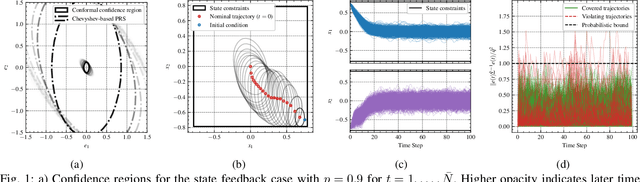
This work presents a stochastic model predictive control (MPC) framework for linear systems subject to joint-in-time chance constraints under unknown disturbance distributions. Unlike existing stochastic MPC formulations that rely on parametric or Gaussian assumptions or require expensive offline computations, the proposed method leverages conformal prediction (CP) as a streamlined tool to construct finite-sample confidence regions for the system's stochastic error trajectories with minimal computational effort. These regions enable the relaxation of probabilistic constraints while providing formal guarantees. By employing an indirect feedback mechanism and a probabilistic set-based formulation, we prove recursive feasibility of the relaxed optimization problem and establish chance constraint satisfaction in closed-loop. Furthermore, we extend the approach to the more general output feedback setting with unknown measurement noise distributions. Given available noise samples, we establish satisfaction of the joint chance constraints and recursive feasibility via output measurements alone. Numerical examples demonstrate the effectiveness and advantages of the proposed method compared to existing approaches.

Efficient Coordination and Synchronization of Multi-Robot Systems Under Recurring Linear Temporal Logic
Feb 23, 2025We consider multi-robot systems under recurring tasks formalized as linear temporal logic (LTL) specifications. To solve the planning problem efficiently, we propose a bottom-up approach combining offline plan synthesis with online coordination, dynamically adjusting plans via real-time communication. To address action delays, we introduce a synchronization mechanism ensuring coordinated task execution, leading to a multi-agent coordination and synchronization framework that is adaptable to a wide range of multi-robot applications. The software package is developed in Python and ROS2 for broad deployment. We validate our findings through lab experiments involving nine robots showing enhanced adaptability compared to previous methods. Additionally, we conduct simulations with up to ninety agents to demonstrate the reduced computational complexity and the scalability features of our work.