 Add to Chrome
 Add to Firefox
 Add to Edge
ZoomLDM: Latent Diffusion Model for multi-scale image generation
Nov 25, 2024
Diffusion models have revolutionized image generation, yet several challenges restrict their application to large-image domains, such as digital pathology and satellite imagery. Given that it is infeasible to directly train a model on 'whole' images from domains with potential gigapixel sizes, diffusion-based generative methods have focused on synthesizing small, fixed-size patches extracted from these images. However, generating small patches has limited applicability since patch-based models fail to capture the global structures and wider context of large images, which can be crucial for synthesizing (semantically) accurate samples. In this paper, to overcome this limitation, we present ZoomLDM, a diffusion model tailored for generating images across multiple scales. Central to our approach is a novel magnification-aware conditioning mechanism that utilizes self-supervised learning (SSL) embeddings and allows the diffusion model to synthesize images at different 'zoom' levels, i.e., fixed-size patches extracted from large images at varying scales. ZoomLDM achieves state-of-the-art image generation quality across all scales, excelling particularly in the data-scarce setting of generating thumbnails of entire large images. The multi-scale nature of ZoomLDM unlocks additional capabilities in large image generation, enabling computationally tractable and globally coherent image synthesis up to $4096 \times 4096$ pixels and $4\times$ super-resolution. Additionally, multi-scale features extracted from ZoomLDM are highly effective in multiple instance learning experiments. We provide high-resolution examples of the generated images on our website https://histodiffusion.github.io/docs/publications/zoomldm/.

Importance-based Token Merging for Diffusion Models
Nov 23, 2024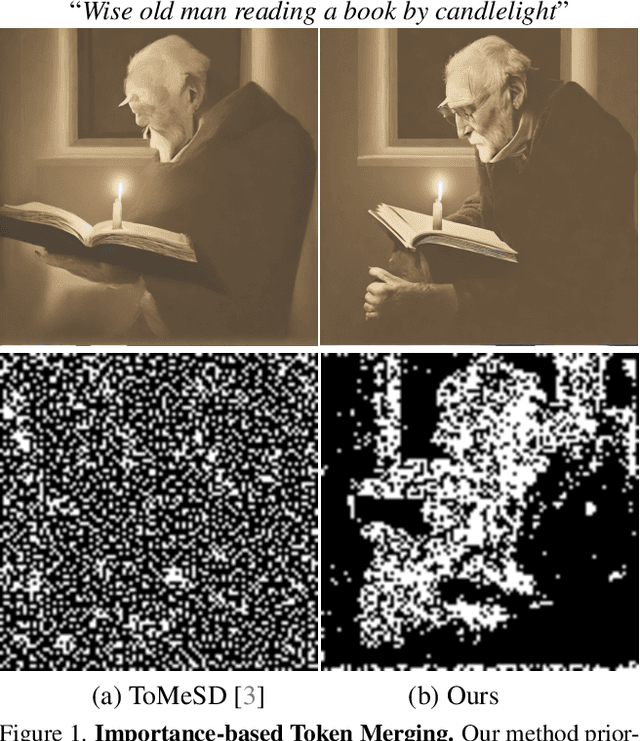


Diffusion models excel at high-quality image and video generation. However, a major drawback is their high latency. A simple yet powerful way to speed them up is by merging similar tokens for faster computation, though this can result in some quality loss. In this paper, we demonstrate that preserving important tokens during merging significantly improves sample quality. Notably, the importance of each token can be reliably determined using the classifier-free guidance magnitude, as this measure is strongly correlated with the conditioning input and corresponds to output fidelity. Since classifier-free guidance incurs no additional computational cost or requires extra modules, our method can be easily integrated into most diffusion-based frameworks. Experiments show that our approach significantly outperforms the baseline across various applications, including text-to-image synthesis, multi-view image generation, and video generation.
Instance-Aware Generalized Referring Expression Segmentation
Nov 22, 2024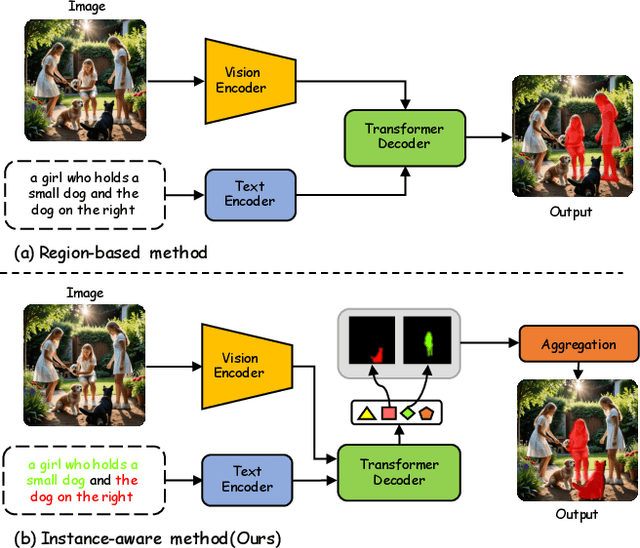
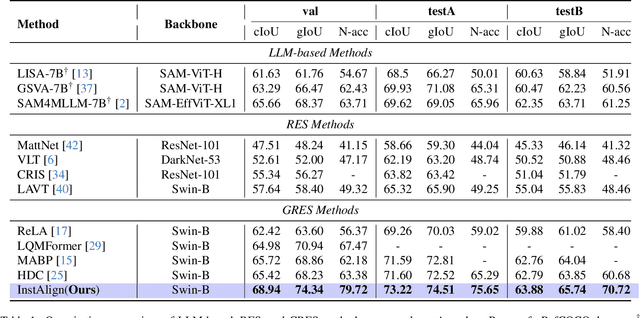
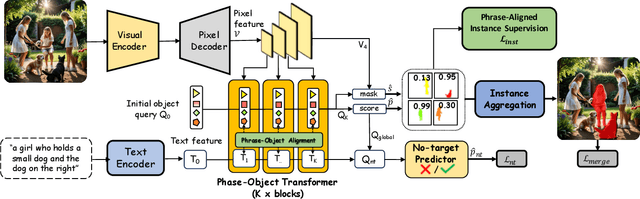
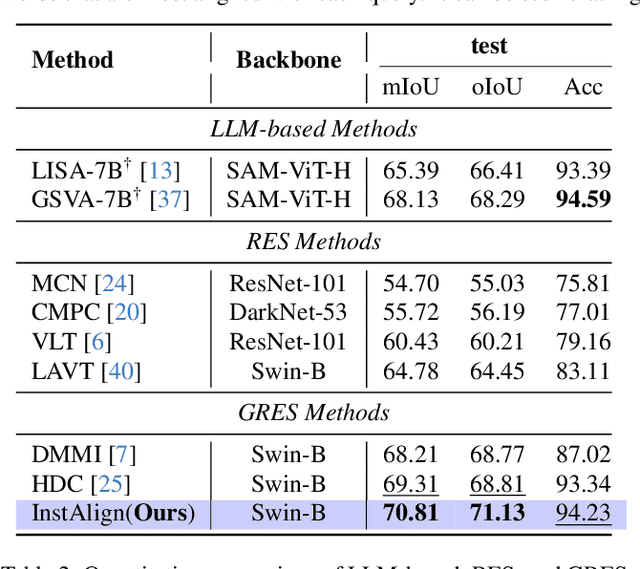
Recent works on Generalized Referring Expression Segmentation (GRES) struggle with handling complex expressions referring to multiple distinct objects. This is because these methods typically employ an end-to-end foreground-background segmentation and lack a mechanism to explicitly differentiate and associate different object instances to the text query. To this end, we propose InstAlign, a method that incorporates object-level reasoning into the segmentation process. Our model leverages both text and image inputs to extract a set of object-level tokens that capture both the semantic information in the input prompt and the objects within the image. By modeling the text-object alignment via instance-level supervision, each token uniquely represents an object segment in the image, while also aligning with relevant semantic information from the text. Extensive experiments on the gRefCOCO and Ref-ZOM benchmarks demonstrate that our method significantly advances state-of-the-art performance, setting a new standard for precise and flexible GRES.
Direct and Explicit 3D Generation from a Single Image
Nov 17, 2024


Current image-to-3D approaches suffer from high computational costs and lack scalability for high-resolution outputs. In contrast, we introduce a novel framework to directly generate explicit surface geometry and texture using multi-view 2D depth and RGB images along with 3D Gaussian features using a repurposed Stable Diffusion model. We introduce a depth branch into U-Net for efficient and high quality multi-view, cross-domain generation and incorporate epipolar attention into the latent-to-pixel decoder for pixel-level multi-view consistency. By back-projecting the generated depth pixels into 3D space, we create a structured 3D representation that can be either rendered via Gaussian splatting or extracted to high-quality meshes, thereby leveraging additional novel view synthesis loss to further improve our performance. Extensive experiments demonstrate that our method surpasses existing baselines in geometry and texture quality while achieving significantly faster generation time.
Fast constrained sampling in pre-trained diffusion models
Oct 24, 2024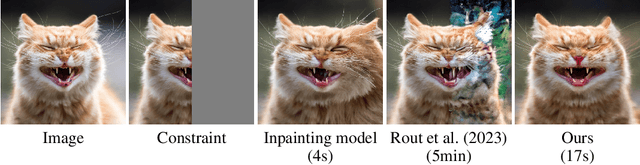
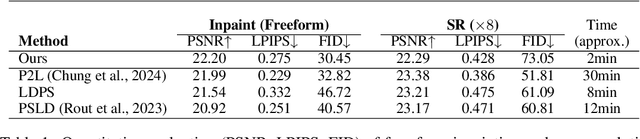
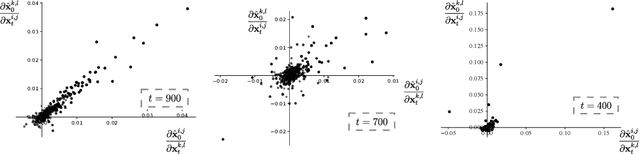
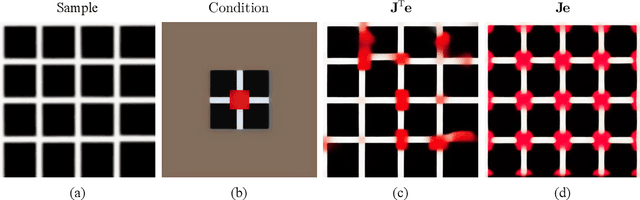
Diffusion models have dominated the field of large, generative image models, with the prime examples of Stable Diffusion and DALL-E 3 being widely adopted. These models have been trained to perform text-conditioned generation on vast numbers of image-caption pairs and as a byproduct, have acquired general knowledge about natural image statistics. However, when confronted with the task of constrained sampling, e.g. generating the right half of an image conditioned on the known left half, applying these models is a delicate and slow process, with previously proposed algorithms relying on expensive iterative operations that are usually orders of magnitude slower than text-based inference. This is counter-intuitive, as image-conditioned generation should rely less on the difficult-to-learn semantic knowledge that links captions and imagery, and should instead be achievable by lower-level correlations among image pixels. In practice, inverse models are trained or tuned separately for each inverse problem, e.g. by providing parts of images during training as an additional condition, to allow their application in realistic settings. However, we argue that this is not necessary and propose an algorithm for fast-constrained sampling in large pre-trained diffusion models (Stable Diffusion) that requires no expensive backpropagation operations through the model and produces results comparable even to the state-of-the-art \emph{tuned} models. Our method is based on a novel optimization perspective to sampling under constraints and employs a numerical approximation to the expensive gradients, previously computed using backpropagation, incurring significant speed-ups.
TopoDiffusionNet: A Topology-aware Diffusion Model
Oct 22, 2024Diffusion models excel at creating visually impressive images but often struggle to generate images with a specified topology. The Betti number, which represents the number of structures in an image, is a fundamental measure in topology. Yet, diffusion models fail to satisfy even this basic constraint. This limitation restricts their utility in applications requiring exact control, like robotics and environmental modeling. To address this, we propose TopoDiffusionNet (TDN), a novel approach that enforces diffusion models to maintain the desired topology. We leverage tools from topological data analysis, particularly persistent homology, to extract the topological structures within an image. We then design a topology-based objective function to guide the denoising process, preserving intended structures while suppressing noisy ones. Our experiments across four datasets demonstrate significant improvements in topological accuracy. TDN is the first to integrate topology with diffusion models, opening new avenues of research in this area.
Learning Frame-Wise Emotion Intensity for Audio-Driven Talking-Head Generation
Sep 29, 2024
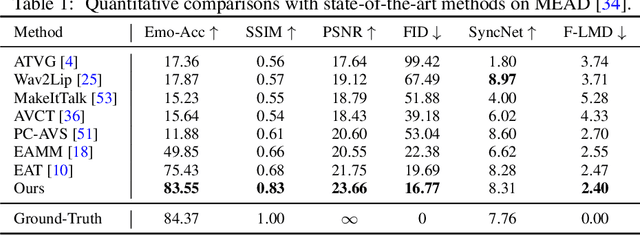
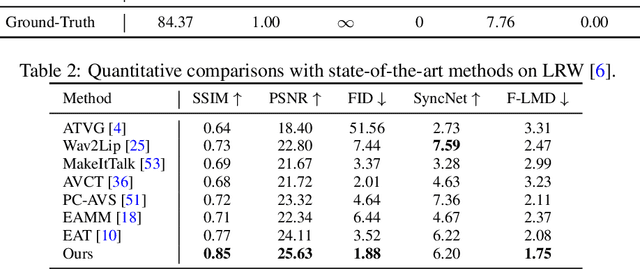
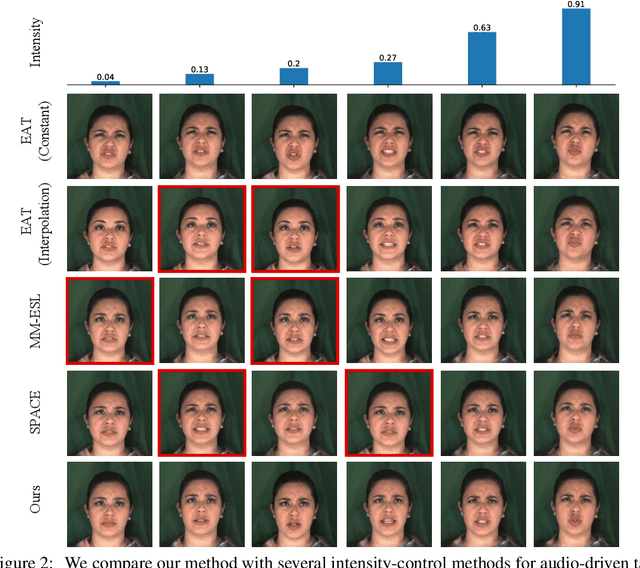
Human emotional expression is inherently dynamic, complex, and fluid, characterized by smooth transitions in intensity throughout verbal communication. However, the modeling of such intensity fluctuations has been largely overlooked by previous audio-driven talking-head generation methods, which often results in static emotional outputs. In this paper, we explore how emotion intensity fluctuates during speech, proposing a method for capturing and generating these subtle shifts for talking-head generation. Specifically, we develop a talking-head framework that is capable of generating a variety of emotions with precise control over intensity levels. This is achieved by learning a continuous emotion latent space, where emotion types are encoded within latent orientations and emotion intensity is reflected in latent norms. In addition, to capture the dynamic intensity fluctuations, we adopt an audio-to-intensity predictor by considering the speaking tone that reflects the intensity. The training signals for this predictor are obtained through our emotion-agnostic intensity pseudo-labeling method without the need of frame-wise intensity labeling. Extensive experiments and analyses validate the effectiveness of our proposed method in accurately capturing and reproducing emotion intensity fluctuations in talking-head generation, thereby significantly enhancing the expressiveness and realism of the generated outputs.
TalkinNeRF: Animatable Neural Fields for Full-Body Talking Humans
Sep 25, 2024

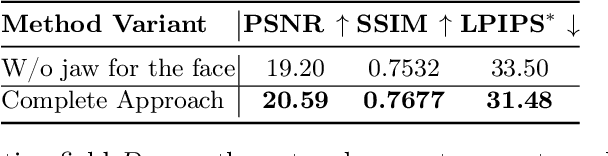
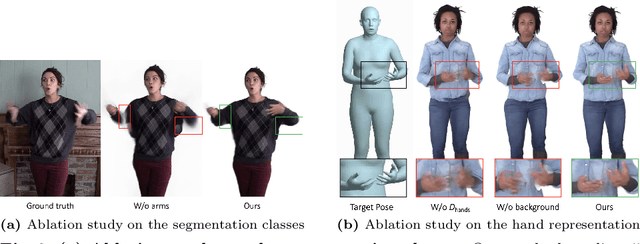
We introduce a novel framework that learns a dynamic neural radiance field (NeRF) for full-body talking humans from monocular videos. Prior work represents only the body pose or the face. However, humans communicate with their full body, combining body pose, hand gestures, as well as facial expressions. In this work, we propose TalkinNeRF, a unified NeRF-based network that represents the holistic 4D human motion. Given a monocular video of a subject, we learn corresponding modules for the body, face, and hands, that are combined together to generate the final result. To capture complex finger articulation, we learn an additional deformation field for the hands. Our multi-identity representation enables simultaneous training for multiple subjects, as well as robust animation under completely unseen poses. It can also generalize to novel identities, given only a short video as input. We demonstrate state-of-the-art performance for animating full-body talking humans, with fine-grained hand articulation and facial expressions.
JEAN: Joint Expression and Audio-guided NeRF-based Talking Face Generation
Sep 18, 2024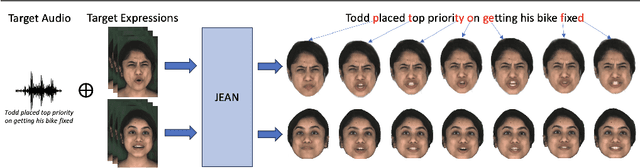
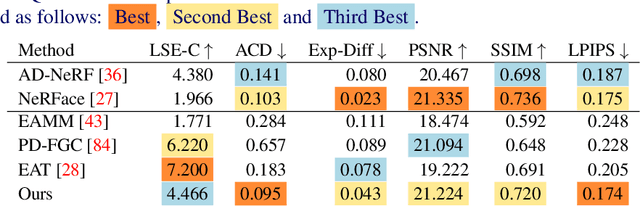
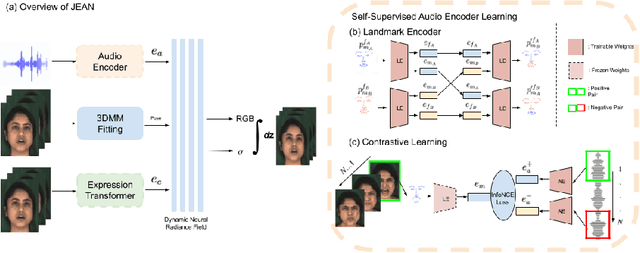

We introduce a novel method for joint expression and audio-guided talking face generation. Recent approaches either struggle to preserve the speaker identity or fail to produce faithful facial expressions. To address these challenges, we propose a NeRF-based network. Since we train our network on monocular videos without any ground truth, it is essential to learn disentangled representations for audio and expression. We first learn audio features in a self-supervised manner, given utterances from multiple subjects. By incorporating a contrastive learning technique, we ensure that the learned audio features are aligned to the lip motion and disentangled from the muscle motion of the rest of the face. We then devise a transformer-based architecture that learns expression features, capturing long-range facial expressions and disentangling them from the speech-specific mouth movements. Through quantitative and qualitative evaluation, we demonstrate that our method can synthesize high-fidelity talking face videos, achieving state-of-the-art facial expression transfer along with lip synchronization to unseen audio.
Shadow Removal Refinement via Material-Consistent Shadow Edges
Sep 10, 2024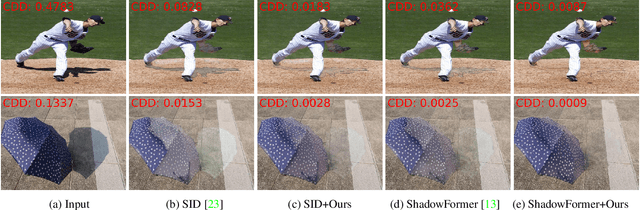

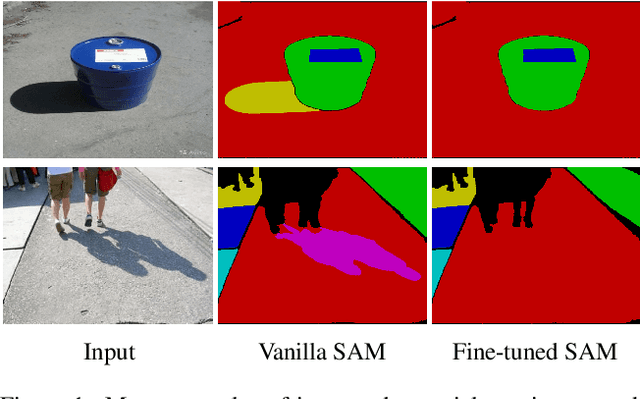

Shadow boundaries can be confused with material boundaries as both exhibit sharp changes in luminance or contrast within a scene. However, shadows do not modify the intrinsic color or texture of surfaces. Therefore, on both sides of shadow edges traversing regions with the same material, the original color and textures should be the same if the shadow is removed properly. These shadow/shadow-free pairs are very useful but hard-to-collect supervision signals. The crucial contribution of this paper is to learn how to identify those shadow edges that traverse material-consistent regions and how to use them as self-supervision for shadow removal refinement during test time. To achieve this, we fine-tune SAM, an image segmentation foundation model, to produce a shadow-invariant segmentation and then extract material-consistent shadow edges by comparing the SAM segmentation with the shadow mask. Utilizing these shadow edges, we introduce color and texture-consistency losses to enhance the shadow removal process. We demonstrate the effectiveness of our method in improving shadow removal results on more challenging, in-the-wild images, outperforming the state-of-the-art shadow removal methods. Additionally, we propose a new metric and an annotated dataset for evaluating the performance of shadow removal methods without the need for paired shadow/shadow-free data.