 Add to Chrome
 Add to Firefox
 Add to Edge
Poppy: Polarization-based Plug-and-Play Guidance for Enhancing Monocular Normal Estimation
Mar 29, 2026
Monocular surface normal estimators trained on large-scale RGB-normal data often perform poorly in the edge cases of reflective, textureless, and dark surfaces. Polarization encodes surface orientation independently of texture and albedo, offering a physics-based complement for these cases. Existing polarization methods, however, require multi-view capture or specialized training data, limiting generalization. We introduce Poppy, a training-free framework that refines normals from any frozen RGB backbone using single-shot polarization measurements at test time. Keeping backbone weights frozen, Poppy optimizes per-pixel offsets to the input RGB and output normal along with a learned reflectance decomposition. A differentiable rendering layer converts the refined normals into polarization predictions and penalizes mismatches with the observed signal. Across seven benchmarks and three backbone architectures (diffusion, flow, and feed-forward), Poppy reduces mean angular error by 23-26% on synthetic data and 6-16% on real data. These results show that guiding learned RGB-based normal estimators with polarization cues at test time refines normals on challenging surfaces without retraining.

JEAN: Joint Expression and Audio-guided NeRF-based Talking Face Generation
Sep 18, 2024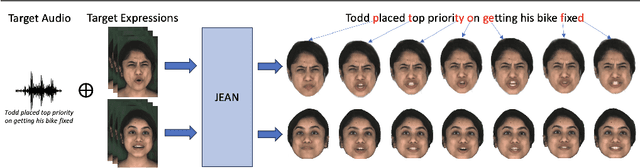
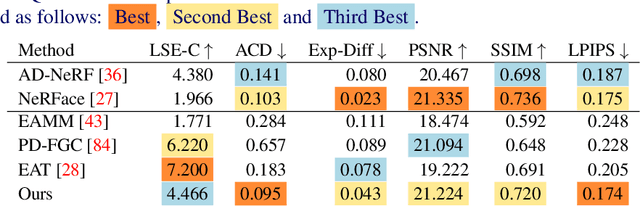
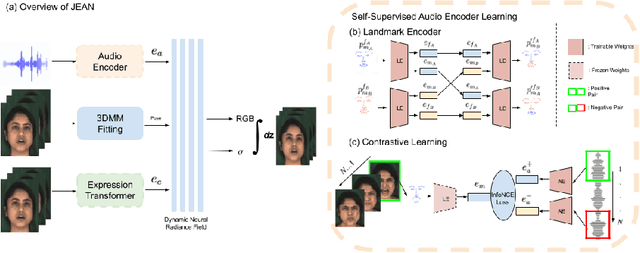

We introduce a novel method for joint expression and audio-guided talking face generation. Recent approaches either struggle to preserve the speaker identity or fail to produce faithful facial expressions. To address these challenges, we propose a NeRF-based network. Since we train our network on monocular videos without any ground truth, it is essential to learn disentangled representations for audio and expression. We first learn audio features in a self-supervised manner, given utterances from multiple subjects. By incorporating a contrastive learning technique, we ensure that the learned audio features are aligned to the lip motion and disentangled from the muscle motion of the rest of the face. We then devise a transformer-based architecture that learns expression features, capturing long-range facial expressions and disentangling them from the speech-specific mouth movements. Through quantitative and qualitative evaluation, we demonstrate that our method can synthesize high-fidelity talking face videos, achieving state-of-the-art facial expression transfer along with lip synchronization to unseen audio.