 Add to Chrome
 Add to Firefox
 Add to Edge
RECIPER: A Dual-View Retrieval Pipeline for Procedure-Oriented Materials Question Answering
Apr 13, 2026
Retrieving procedure-oriented evidence from materials science papers is difficult because key synthesis details are often scattered across long, context-heavy documents and are not well captured by paragraph-only dense retrieval. We present RECIPER, a dual-view retrieval pipeline that indexes both paragraph-level context and compact large language model-extracted procedural summaries, then combines the two candidate streams with lightweight lexical reranking. Across four dense retrieval backbones, RECIPER consistently improves early-rank retrieval over paragraph-only dense retrieval, achieving average gains of +3.73 in Recall@1, +2.85 in nDCG@10, and +3.13 in MRR. With BGE-large-en-v1.5, it reaches 86.82%, 97.07%, and 97.85% on Recall@1, Recall@5, and Recall@10, respectively. We further observe improved downstream question answering under automatic metrics, suggesting that procedural summaries can serve as a useful complementary retrieval signal for procedure-oriented materials question answering. Code and data are available at https://github.com/ReaganWu/RECIPER.

EndoCaver: Handling Fog, Blur and Glare in Endoscopic Images via Joint Deblurring-Segmentation
Jan 30, 2026Endoscopic image analysis is vital for colorectal cancer screening, yet real-world conditions often suffer from lens fogging, motion blur, and specular highlights, which severely compromise automated polyp detection. We propose EndoCaver, a lightweight transformer with a unidirectional-guided dual-decoder architecture, enabling joint multi-task capability for image deblurring and segmentation while significantly reducing computational complexity and model parameters. Specifically, it integrates a Global Attention Module (GAM) for cross-scale aggregation, a Deblurring-Segmentation Aligner (DSA) to transfer restoration cues, and a cosine-based scheduler (LoCoS) for stable multi-task optimisation. Experiments on the Kvasir-SEG dataset show that EndoCaver achieves 0.922 Dice on clean data and 0.889 under severe image degradation, surpassing state-of-the-art methods while reducing model parameters by 90%. These results demonstrate its efficiency and robustness, making it well-suited for on-device clinical deployment. Code is available at https://github.com/ReaganWu/EndoCaver.
RT-Focuser: A Real-Time Lightweight Model for Edge-side Image Deblurring
Dec 26, 2025Motion blur caused by camera or object movement severely degrades image quality and poses challenges for real-time applications such as autonomous driving, UAV perception, and medical imaging. In this paper, a lightweight U-shaped network tailored for real-time deblurring is presented and named RT-Focuser. To balance speed and accuracy, we design three key components: Lightweight Deblurring Block (LD) for edge-aware feature extraction, Multi-Level Integrated Aggregation module (MLIA) for encoder integration, and Cross-source Fusion Block (X-Fuse) for progressive decoder refinement. Trained on a single blurred input, RT-Focuser achieves 30.67 dB PSNR with only 5.85M parameters and 15.76 GMACs. It runs 6ms per frame on GPU and mobile, exceeds 140 FPS on both, showing strong potential for deployment on the edge. The official code and usage are available on: https://github.com/ReaganWu/RT-Focuser.
GUI Action Narrator: Where and When Did That Action Take Place?
Jun 19, 2024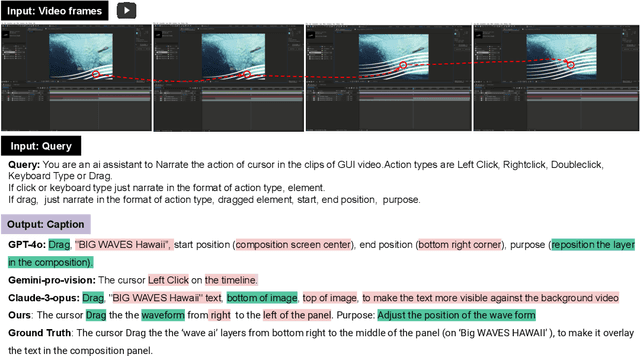
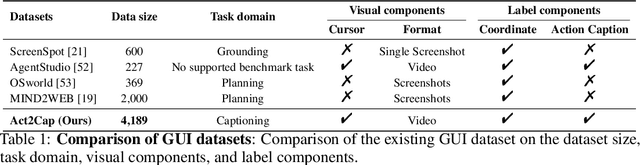
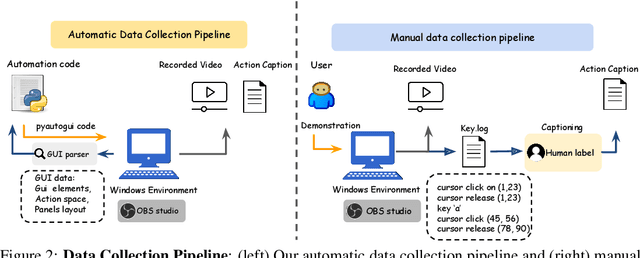

The advent of Multimodal LLMs has significantly enhanced image OCR recognition capabilities, making GUI automation a viable reality for increasing efficiency in digital tasks. One fundamental aspect of developing a GUI automation system is understanding primitive GUI actions. This comprehension is crucial as it enables agents to learn from user demonstrations, an essential element of automation. To rigorously evaluate such capabilities, we developed a video captioning benchmark for GUI actions, comprising 4,189 diverse video captioning samples. This task presents unique challenges compared to natural scene video captioning: 1) GUI screenshots typically contain denser information than natural scenes, and 2) events within GUIs are subtler and occur more rapidly, requiring precise attention to the appropriate time span and spatial region for accurate understanding. To address these challenges, we introduce our GUI action dataset \textbf{Act2Cap} as well as a simple yet effective framework, \textbf{GUI Narrator}, for GUI video captioning that utilizes the cursor as a visual prompt to enhance the interpretation of high-resolution screenshots. Specifically, a cursor detector is trained on our dataset, and a multimodal LLM model with mechanisms for selecting keyframes and key regions generates the captions. Experimental results indicate that even for today's most advanced multimodal models, such as GPT-4o, the task remains highly challenging. Additionally, our evaluations show that our strategy effectively enhances model performance, whether integrated into the fine-tuning of open-source models or employed as a prompting strategy in closed-source models.