 Add to Chrome
 Add to Firefox
 Add to Edge
Jagle: Building a Large-Scale Japanese Multimodal Post-Training Dataset for Vision-Language Models
Apr 02, 2026
Developing vision-language models (VLMs) that generalize across diverse tasks requires large-scale training datasets with diverse content. In English, such datasets are typically constructed by aggregating and curating numerous existing visual question answering (VQA) resources. However, this strategy does not readily extend to other languages, where VQA datasets remain limited in both scale and domain coverage, posing a major obstacle to building high-quality multilingual and non-English VLMs. In this work, we introduce Jagle, the largest Japanese multimodal post-training dataset to date, comprising approximately 9.2 million instances across diverse tasks. Rather than relying on existing VQA datasets, we collect heterogeneous source data, including images, image-text pairs, and PDF documents, and generate VQA pairs through multiple strategies such as VLM-based QA generation, translation, and text rendering. Experiments demonstrate that a 2.2B model trained with Jagle achieves strong performance on Japanese tasks, surpassing InternVL3.5-2B in average score across ten Japanese evaluation tasks and approaching within five points of Qwen3-VL-2B-Instruct. Furthermore, combining Jagle with FineVision does not degrade English performance; instead, it improves English performance compared to training with FineVision alone. To facilitate reproducibility and future research, we release the dataset, trained models, and code.

Constructing Multimodal Datasets from Scratch for Rapid Development of a Japanese Visual Language Model
Oct 30, 2024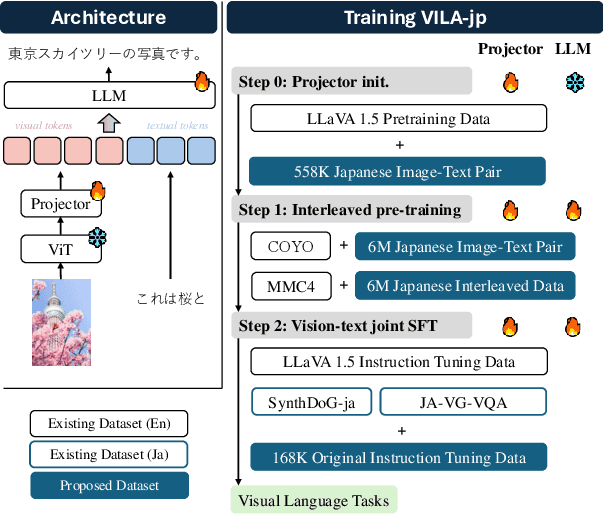
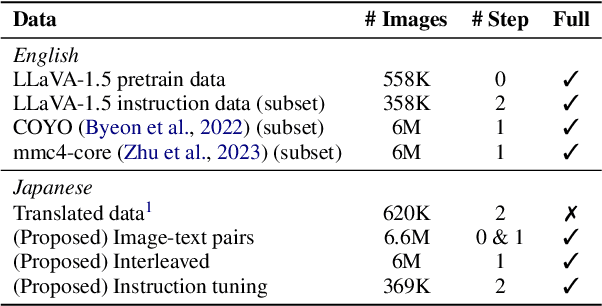
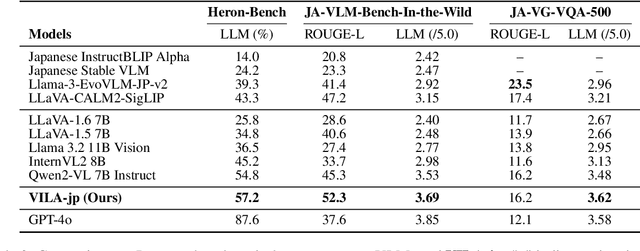

To develop high-performing Visual Language Models (VLMs), it is essential to prepare multimodal resources, such as image-text pairs, interleaved data, and instruction data. While multimodal resources for English are abundant, there is a significant lack of corresponding resources for non-English languages, such as Japanese. To address this problem, we take Japanese as a non-English language and propose a method for rapidly creating Japanese multimodal datasets from scratch. We collect Japanese image-text pairs and interleaved data from web archives and generate Japanese instruction data directly from images using an existing VLM. Our experimental results show that a VLM trained on these native datasets outperforms those relying on machine-translated content.