 Add to Chrome
 Add to Firefox
 Add to Edge
Mitigating Multimodal Hallucination via Phase-wise Self-reward
Apr 20, 2026
Large Vision-Language Models (LVLMs) still struggle with vision hallucination, where generated responses are inconsistent with the visual input. Existing methods either rely on large-scale annotated data for fine-tuning, which incurs massive computational overhead, or employ static post-hoc strategies that overlook the dynamic nature of hallucination emergence. To address these, we introduce a new self-rewarding framework, enabling dynamic hallucination mitigation at inference time without external supervision. On the empirical side, we reveal that visual hallucination exhibits phase-wise dynamic patterns, peaking at the onset of each semantic phase. Drawing on these insights, we propose \textbf{PSRD} (\textbf{Phase-wise \textbf{S}elf-\textbf{R}eward \textbf{D}ecoding) for online hallucination correction guided by phase-wise self-reward signals. To reduce the cost of repeated self-evaluation during decoding, we distill the hallucination guidance signal from LVLMs into a lightweight reward model. The reward model subsequently provides on-the-fly guidance for targeted intervention during the decoding process, enabling precise hallucination suppression. The proposed PSRD significantly reduces the hallucination rate of LLaVA-1.5-7B by 50.0% and consistently outperforms existing post-hoc methods across five hallucination evaluation benchmarks for four LVLMs. Further analysis confirms that PSRD effectively mitigates hallucination propagation and achieves a highly controllable trade-off between strong performance and inference efficiency.

MIPI 2024 Challenge on Few-shot RAW Image Denoising: Methods and Results
Jun 11, 2024

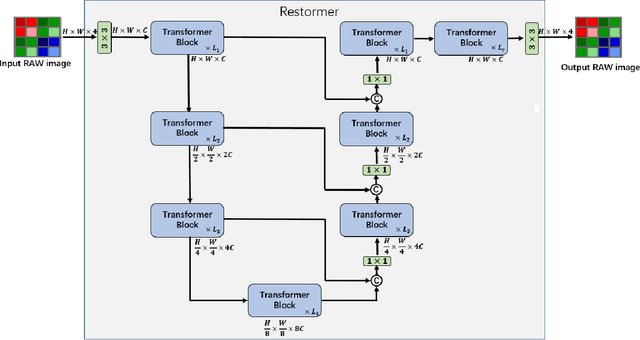

The increasing demand for computational photography and imaging on mobile platforms has led to the widespread development and integration of advanced image sensors with novel algorithms in camera systems. However, the scarcity of high-quality data for research and the rare opportunity for in-depth exchange of views from industry and academia constrain the development of mobile intelligent photography and imaging (MIPI). Building on the achievements of the previous MIPI Workshops held at ECCV 2022 and CVPR 2023, we introduce our third MIPI challenge including three tracks focusing on novel image sensors and imaging algorithms. In this paper, we summarize and review the Few-shot RAW Image Denoising track on MIPI 2024. In total, 165 participants were successfully registered, and 7 teams submitted results in the final testing phase. The developed solutions in this challenge achieved state-of-the-art erformance on Few-shot RAW Image Denoising. More details of this challenge and the link to the dataset can be found at https://mipichallenge.org/MIPI2024.