 Add to Chrome
 Add to Firefox
 Add to Edge
From Storage to Access: Verifiable Activation of Parametric Knowledge in LLMs via Explicit Priming and Implicit Reasoning
Aug 19, 2026
Although Large Language Models (LLMs) encode rich factual knowledge in their parameters, reliably recalling and verifying such knowledge remains a key bottleneck in factual question answering. Existing end-to-end methods entangle knowledge elicitation with reasoning, making it difficult to determine whether correct answers arise from parametric knowledge or the input context. To address this challenge, we propose VAKE (Verifiable Activation of Parametric KnowledgE), a two-stage reinforcement-learning framework that externalizes latent parametric knowledge through explicit Priming and transfers the acquired elicitation capability to implicit Reasoning. Given a query and an insufficient retrieved subgraph, the Priming policy explicitly inserts bridging triples as verifiable evidence, with supervision provided by rewards derived from answers generated by a separate frozen model over the augmented subgraph. Building on the policy learned during Priming, the Reasoning stage trains the model to answer from the original input, testing whether the capability acquired through explicit knowledge elicitation transfers to implicit reasoning. Experiments across seven benchmarks and models from 3B to 14B show that VAKE consistently outperforms standard baselines, including when transferring directly from HotpotQA to OOD datasets. LLM-based evaluation further shows that over 80% of the inserted triples provide factual bridging knowledge not derivable from the retrieved context, while more than half elicit knowledge inaccessible through direct prompting. These results suggest that VAKE activates latent parametric knowledge rather than copying the input context or memorizing dataset-specific associations.

DART-SD: Diamond-topology Aware Retrieval and Tuning for Self-Distillation of Multi-Turn Tool-Calling Agents
Aug 19, 2026Equipping Large Language Models (LLMs) with multi-turn tool-calling capabilities is essential for building autonomous agents. However, progress is fundamentally limited by the reliance on full-length trajectory imitation. For tasks involving multiple order-independent sub-goals, the optimal solution space forms a vast combinatorial diamond lattice. Forcing this rich topology into monolithic trajectories causes a severe topological collapse, indiscriminately penalizing valid alternative explorations and severely degrading policy diversity. To address this, we propose DART-SD (Diamond-topology Aware Retrieval and Tuning for Self-Distillation), a novel framework that shifts the paradigm from global forcing to topology-guided localized correction. DART-SD first models the execution process as a converging Interaction-State Transition Graph (ISTG), faithfully capturing the inherent diamond topology of successful and failed exploratory paths. During autonomous rollouts, the framework identifies the Critical Topological Breakpoint (CTB) and retrieves success-supported recovery references. Finally, we introduce a progressive self-distillation paradigm through CTB-guided localized supervision, ensuring that the training loss is calculated exclusively on the generated recovery steps while strictly protecting the valid reasoning prefix from destructive gradient updates. Experiments on complex multi-turn tool-calling benchmarks demonstrate that DART-SD significantly outperforms traditional full-trajectory baselines.
UniSAE: Unified Speech Attribute Editing on Speaker, Emotion and Low-Level Content via Discrete Phonetic Posteriorgram Modelling
Jun 30, 2026Speech editing aims to modify specific portions of an utterance while preserving the remaining speech. Existing approaches primarily focus on word-level content modification and typically treat content, speaker, and emotion editing as separate tasks, limiting both editing granularity and flexibility. We propose UniSAE, a unified speech attribute editing framework which supports composable speaker, emotion and content editing from sub-phoneme to word level within a single architecture. UniSAE introduces a Discrete Phonetic PosteriorGram (DPPG) representation that factorizes speech content into discrete tokens encoding phoneme identity, pronunciation variants, and duration, enabling direct phoneme- and sub-phoneme-level editing. For higher-level modifications, an autoregressive content transformer predicts edited DPPG sequences for word-level content editing. The edited sequences are rendered into speech by a diffusion-based acoustic decoder, conditioned on disentangled speaker and emotion representations. Experimental results demonstrate that the proposed unified framework supports precise speaker and emotion control, content editing at multiple granularities, and joint modification of all three attributes within a single framework.
Audio-FLAN: A Preliminary Release
Feb 23, 2025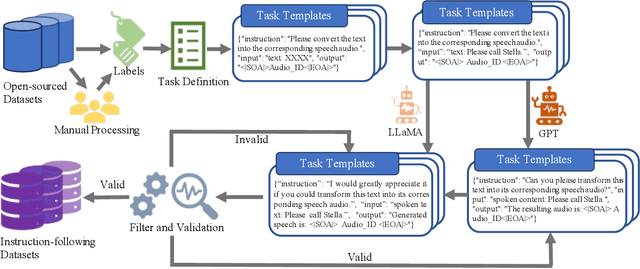
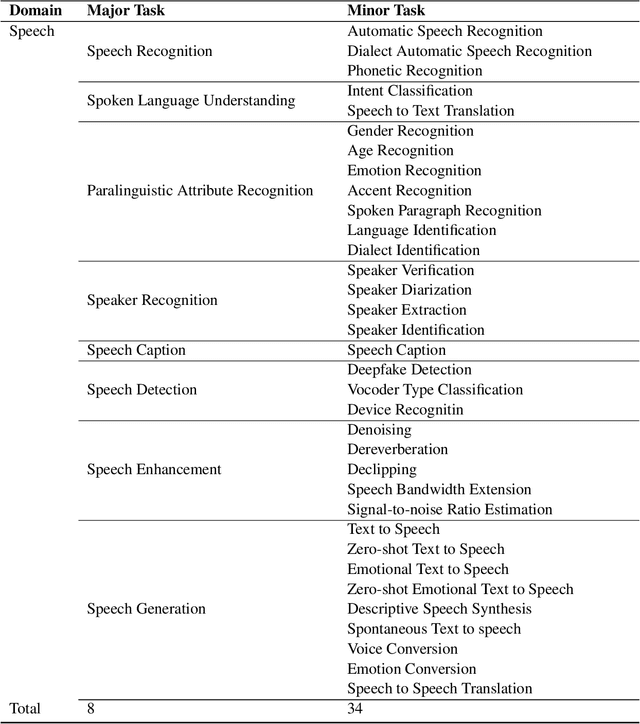
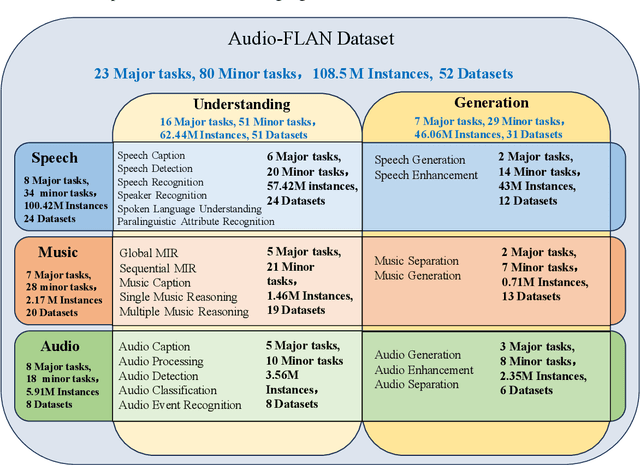
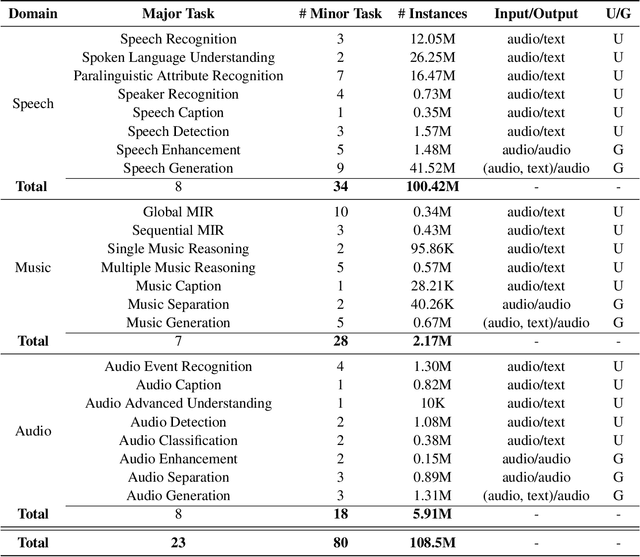
Recent advancements in audio tokenization have significantly enhanced the integration of audio capabilities into large language models (LLMs). However, audio understanding and generation are often treated as distinct tasks, hindering the development of truly unified audio-language models. While instruction tuning has demonstrated remarkable success in improving generalization and zero-shot learning across text and vision, its application to audio remains largely unexplored. A major obstacle is the lack of comprehensive datasets that unify audio understanding and generation. To address this, we introduce Audio-FLAN, a large-scale instruction-tuning dataset covering 80 diverse tasks across speech, music, and sound domains, with over 100 million instances. Audio-FLAN lays the foundation for unified audio-language models that can seamlessly handle both understanding (e.g., transcription, comprehension) and generation (e.g., speech, music, sound) tasks across a wide range of audio domains in a zero-shot manner. The Audio-FLAN dataset is available on HuggingFace and GitHub and will be continuously updated.