 Add to Chrome
 Add to Firefox
 Add to Edge
Self-Destructing Models: Increasing the Costs of Harmful Dual Uses in Foundation Models
Nov 27, 2022
A growing ecosystem of large, open-source foundation models has reduced the labeled data and technical expertise necessary to apply machine learning to many new problems. Yet foundation models pose a clear dual-use risk, indiscriminately reducing the costs of building both harmful and beneficial machine learning systems. To mitigate this risk, we propose the task blocking paradigm, in which foundation models are trained with an additional mechanism to impede adaptation to harmful tasks while retaining good performance on desired tasks. We call the resulting models self-destructing models, inspired by mechanisms that prevent adversaries from using tools for harmful purposes. We present an algorithm for training self-destructing models leveraging techniques from meta-learning and adversarial learning, showing that it can largely prevent a BERT-based model from learning to perform gender identification without harming the model's ability to perform profession classification. We conclude with a discussion of future directions.

Enhancing Self-Consistency and Performance of Pre-Trained Language Models through Natural Language Inference
Nov 21, 2022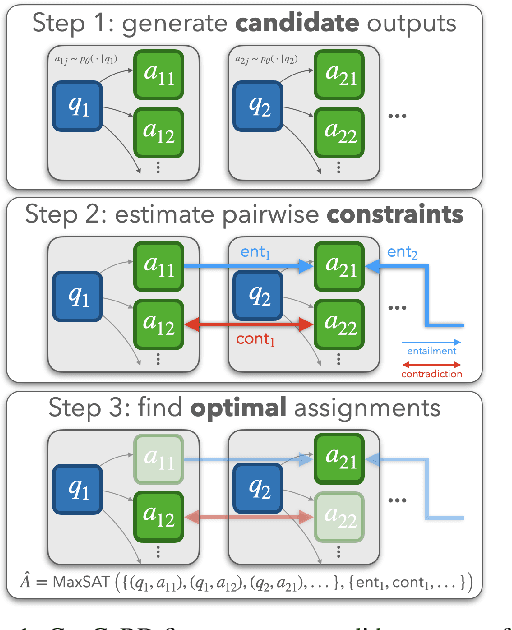
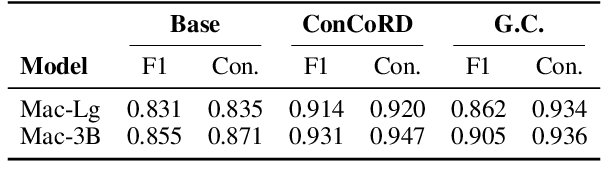
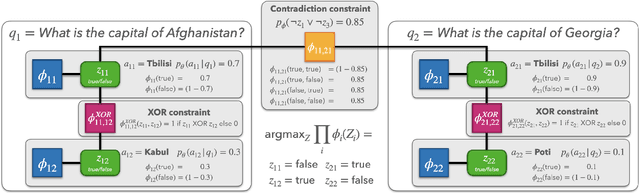
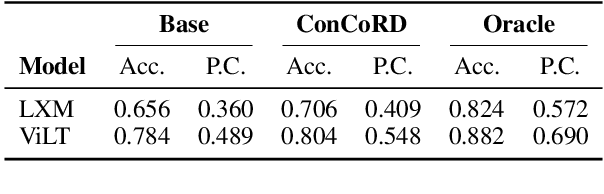
While large pre-trained language models are powerful, their predictions often lack logical consistency across test inputs. For example, a state-of-the-art Macaw question-answering (QA) model answers 'Yes' to 'Is a sparrow a bird?' and 'Does a bird have feet?' but answers 'No' to 'Does a sparrow have feet?'. To address this failure mode, we propose a framework, Consistency Correction through Relation Detection, or ConCoRD, for boosting the consistency and accuracy of pre-trained NLP models using pre-trained natural language inference (NLI) models without fine-tuning or re-training. Given a batch of test inputs, ConCoRD samples several candidate outputs for each input and instantiates a factor graph that accounts for both the model's belief about the likelihood of each answer choice in isolation and the NLI model's beliefs about pair-wise answer choice compatibility. We show that a weighted MaxSAT solver can efficiently compute high-quality answer choices under this factor graph, improving over the raw model's predictions. Our experiments demonstrate that ConCoRD consistently boosts accuracy and consistency of off-the-shelf closed-book QA and VQA models using off-the-shelf NLI models, notably increasing accuracy of LXMERT on ConVQA by 5% absolute. See https://ericmitchell.ai/emnlp-2022-concord/ for code and data.
Fixing Model Bugs with Natural Language Patches
Nov 20, 2022Current approaches for fixing systematic problems in NLP models (e.g. regex patches, finetuning on more data) are either brittle, or labor-intensive and liable to shortcuts. In contrast, humans often provide corrections to each other through natural language. Taking inspiration from this, we explore natural language patches -- declarative statements that allow developers to provide corrective feedback at the right level of abstraction, either overriding the model (``if a review gives 2 stars, the sentiment is negative'') or providing additional information the model may lack (``if something is described as the bomb, then it is good''). We model the task of determining if a patch applies separately from the task of integrating patch information, and show that with a small amount of synthetic data, we can teach models to effectively use real patches on real data -- 1 to 7 patches improve accuracy by ~1-4 accuracy points on different slices of a sentiment analysis dataset, and F1 by 7 points on a relation extraction dataset. Finally, we show that finetuning on as many as 100 labeled examples may be needed to match the performance of a small set of language patches.
Holistic Evaluation of Language Models
Nov 16, 2022


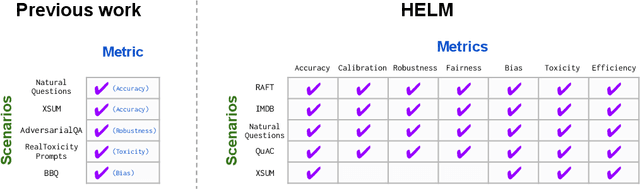
Language models (LMs) are becoming the foundation for almost all major language technologies, but their capabilities, limitations, and risks are not well understood. We present Holistic Evaluation of Language Models (HELM) to improve the transparency of language models. First, we taxonomize the vast space of potential scenarios (i.e. use cases) and metrics (i.e. desiderata) that are of interest for LMs. Then we select a broad subset based on coverage and feasibility, noting what's missing or underrepresented (e.g. question answering for neglected English dialects, metrics for trustworthiness). Second, we adopt a multi-metric approach: We measure 7 metrics (accuracy, calibration, robustness, fairness, bias, toxicity, and efficiency) for each of 16 core scenarios when possible (87.5% of the time). This ensures metrics beyond accuracy don't fall to the wayside, and that trade-offs are clearly exposed. We also perform 7 targeted evaluations, based on 26 targeted scenarios, to analyze specific aspects (e.g. reasoning, disinformation). Third, we conduct a large-scale evaluation of 30 prominent language models (spanning open, limited-access, and closed models) on all 42 scenarios, 21 of which were not previously used in mainstream LM evaluation. Prior to HELM, models on average were evaluated on just 17.9% of the core HELM scenarios, with some prominent models not sharing a single scenario in common. We improve this to 96.0%: now all 30 models have been densely benchmarked on the same core scenarios and metrics under standardized conditions. Our evaluation surfaces 25 top-level findings. For full transparency, we release all raw model prompts and completions publicly for further analysis, as well as a general modular toolkit. We intend for HELM to be a living benchmark for the community, continuously updated with new scenarios, metrics, and models.
On Measuring the Intrinsic Few-Shot Hardness of Datasets
Nov 16, 2022While advances in pre-training have led to dramatic improvements in few-shot learning of NLP tasks, there is limited understanding of what drives successful few-shot adaptation in datasets. In particular, given a new dataset and a pre-trained model, what properties of the dataset make it \emph{few-shot learnable} and are these properties independent of the specific adaptation techniques used? We consider an extensive set of recent few-shot learning methods, and show that their performance across a large number of datasets is highly correlated, showing that few-shot hardness may be intrinsic to datasets, for a given pre-trained model. To estimate intrinsic few-shot hardness, we then propose a simple and lightweight metric called "Spread" that captures the intuition that few-shot learning is made possible by exploiting feature-space invariances between training and test samples. Our metric better accounts for few-shot hardness compared to existing notions of hardness, and is ~8-100x faster to compute.
Characterizing Intrinsic Compositionality in Transformers with Tree Projections
Nov 03, 2022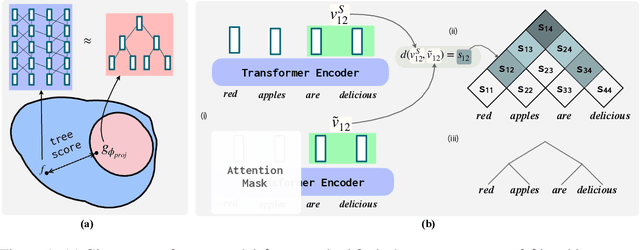
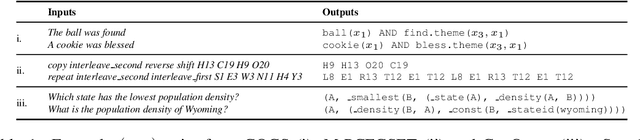
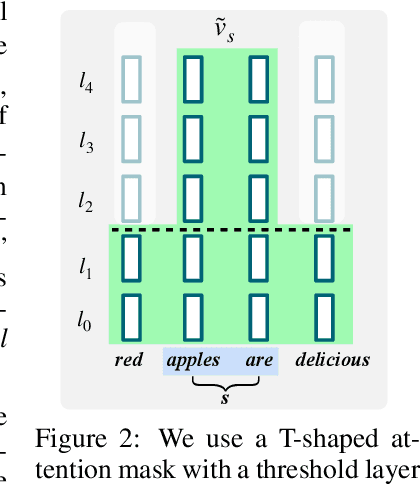

When trained on language data, do transformers learn some arbitrary computation that utilizes the full capacity of the architecture or do they learn a simpler, tree-like computation, hypothesized to underlie compositional meaning systems like human languages? There is an apparent tension between compositional accounts of human language understanding, which are based on a restricted bottom-up computational process, and the enormous success of neural models like transformers, which can route information arbitrarily between different parts of their input. One possibility is that these models, while extremely flexible in principle, in practice learn to interpret language hierarchically, ultimately building sentence representations close to those predictable by a bottom-up, tree-structured model. To evaluate this possibility, we describe an unsupervised and parameter-free method to \emph{functionally project} the behavior of any transformer into the space of tree-structured networks. Given an input sentence, we produce a binary tree that approximates the transformer's representation-building process and a score that captures how "tree-like" the transformer's behavior is on the input. While calculation of this score does not require training any additional models, it provably upper-bounds the fit between a transformer and any tree-structured approximation. Using this method, we show that transformers for three different tasks become more tree-like over the course of training, in some cases unsupervisedly recovering the same trees as supervised parsers. These trees, in turn, are predictive of model behavior, with more tree-like models generalizing better on tests of compositional generalization.
Truncation Sampling as Language Model Desmoothing
Oct 27, 2022Long samples of text from neural language models can be of poor quality. Truncation sampling algorithms--like top-$p$ or top-$k$ -- address this by setting some words' probabilities to zero at each step. This work provides framing for the aim of truncation, and an improved algorithm for that aim. We propose thinking of a neural language model as a mixture of a true distribution and a smoothing distribution that avoids infinite perplexity. In this light, truncation algorithms aim to perform desmoothing, estimating a subset of the support of the true distribution. Finding a good subset is crucial: we show that top-$p$ unnecessarily truncates high-probability words, for example causing it to truncate all words but Trump for a document that starts with Donald. We introduce $\eta$-sampling, which truncates words below an entropy-dependent probability threshold. Compared to previous algorithms, $\eta$-sampling generates more plausible long English documents according to humans, is better at breaking out of repetition, and behaves more reasonably on a battery of test distributions.
When can I Speak? Predicting initiation points for spoken dialogue agents
Aug 07, 2022


Current spoken dialogue systems initiate their turns after a long period of silence (700-1000ms), which leads to little real-time feedback, sluggish responses, and an overall stilted conversational flow. Humans typically respond within 200ms and successfully predicting initiation points in advance would allow spoken dialogue agents to do the same. In this work, we predict the lead-time to initiation using prosodic features from a pre-trained speech representation model (wav2vec 1.0) operating on user audio and word features from a pre-trained language model (GPT-2) operating on incremental transcriptions. To evaluate errors, we propose two metrics w.r.t. predicted and true lead times. We train and evaluate the models on the Switchboard Corpus and find that our method outperforms features from prior work on both metrics and vastly outperforms the common approach of waiting for 700ms of silence.
Neural Generation Meets Real People: Building a Social, Informative Open-Domain Dialogue Agent
Jul 25, 2022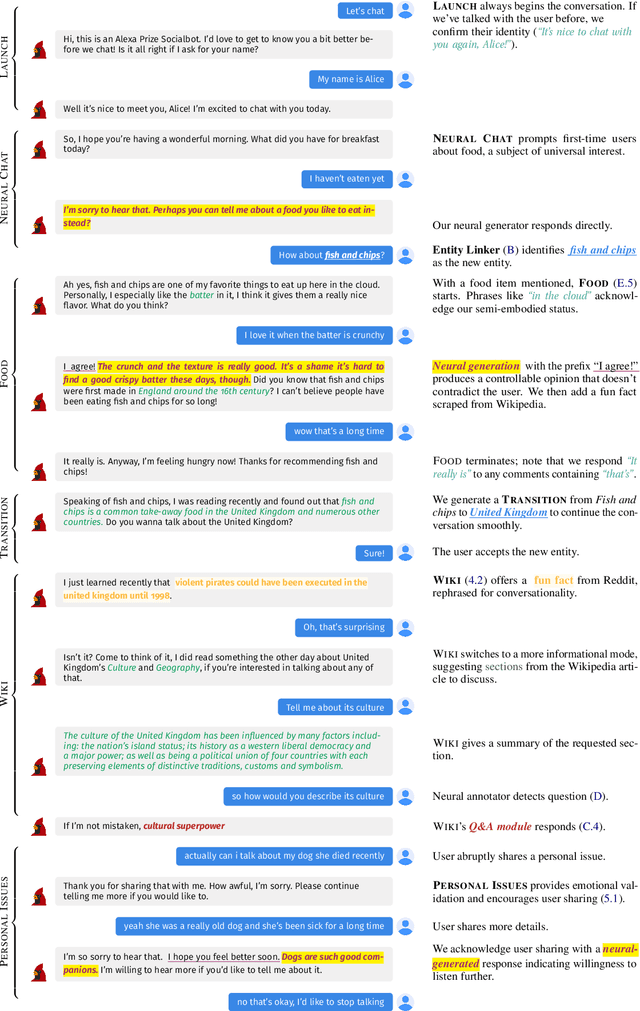
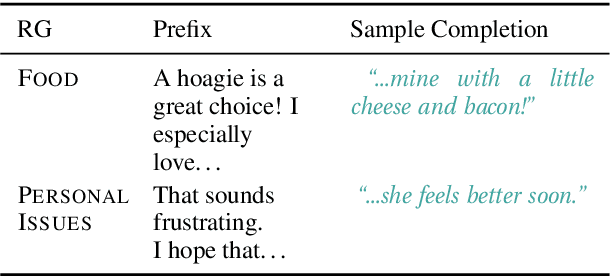
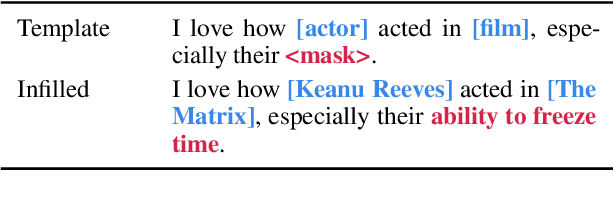
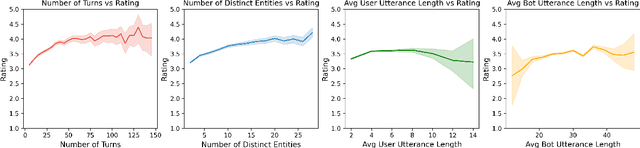
We present Chirpy Cardinal, an open-domain social chatbot. Aiming to be both informative and conversational, our bot chats with users in an authentic, emotionally intelligent way. By integrating controlled neural generation with scaffolded, hand-written dialogue, we let both the user and bot take turns driving the conversation, producing an engaging and socially fluent experience. Deployed in the fourth iteration of the Alexa Prize Socialbot Grand Challenge, Chirpy Cardinal handled thousands of conversations per day, placing second out of nine bots with an average user rating of 3.58/5.
Pile of Law: Learning Responsible Data Filtering from the Law and a 256GB Open-Source Legal Dataset
Jul 01, 2022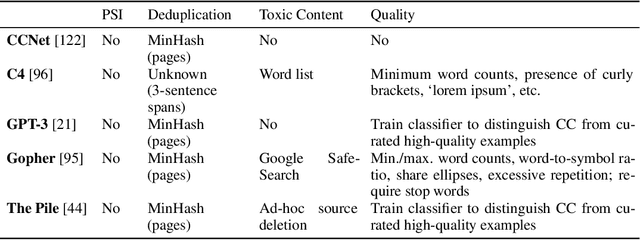
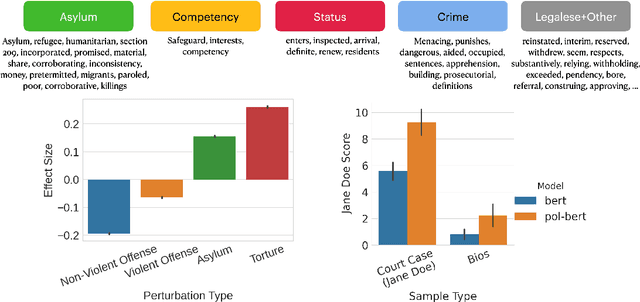
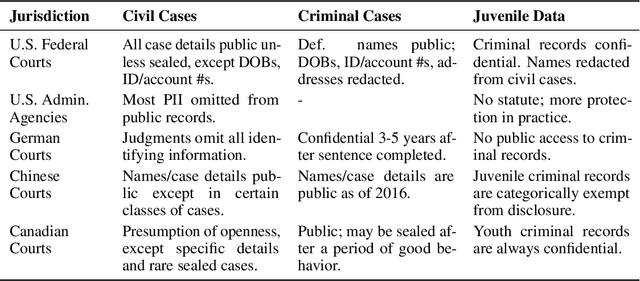
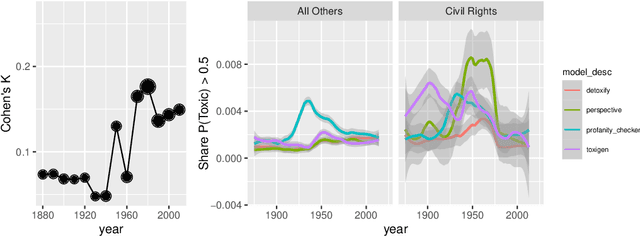
One concern with the rise of large language models lies with their potential for significant harm, particularly from pretraining on biased, obscene, copyrighted, and private information. Emerging ethical approaches have attempted to filter pretraining material, but such approaches have been ad hoc and failed to take into account context. We offer an approach to filtering grounded in law, which has directly addressed the tradeoffs in filtering material. First, we gather and make available the Pile of Law, a 256GB (and growing) dataset of open-source English-language legal and administrative data, covering court opinions, contracts, administrative rules, and legislative records. Pretraining on the Pile of Law may potentially help with legal tasks that have the promise to improve access to justice. Second, we distill the legal norms that governments have developed to constrain the inclusion of toxic or private content into actionable lessons for researchers and discuss how our dataset reflects these norms. Third, we show how the Pile of Law offers researchers the opportunity to learn such filtering rules directly from the data, providing an exciting new research direction in model-based processing.