 Add to Chrome
 Add to Firefox
 Add to Edge
DyNet: The Dynamic Neural Network Toolkit
Jan 15, 2017
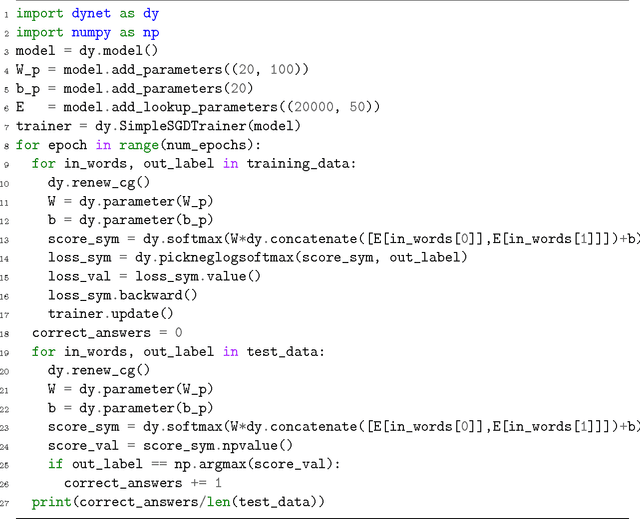
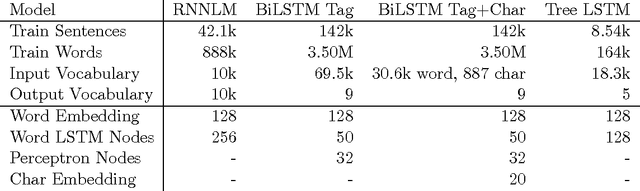
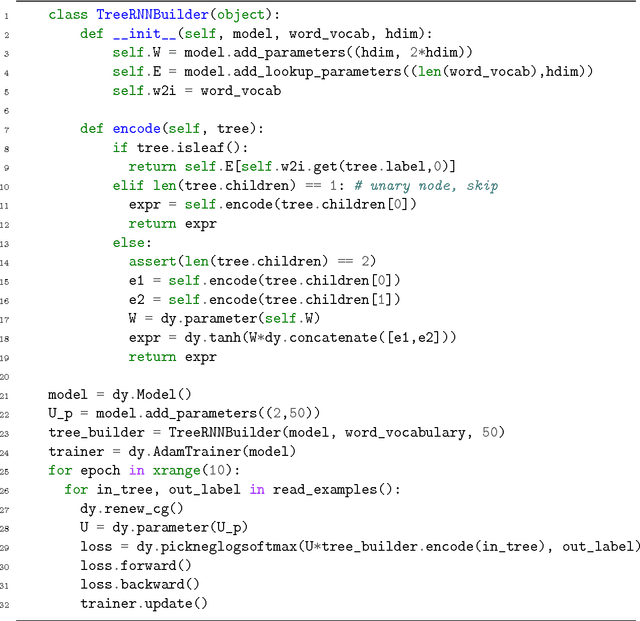
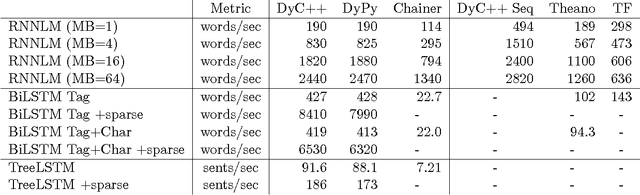
We describe DyNet, a toolkit for implementing neural network models based on dynamic declaration of network structure. In the static declaration strategy that is used in toolkits like Theano, CNTK, and TensorFlow, the user first defines a computation graph (a symbolic representation of the computation), and then examples are fed into an engine that executes this computation and computes its derivatives. In DyNet's dynamic declaration strategy, computation graph construction is mostly transparent, being implicitly constructed by executing procedural code that computes the network outputs, and the user is free to use different network structures for each input. Dynamic declaration thus facilitates the implementation of more complicated network architectures, and DyNet is specifically designed to allow users to implement their models in a way that is idiomatic in their preferred programming language (C++ or Python). One challenge with dynamic declaration is that because the symbolic computation graph is defined anew for every training example, its construction must have low overhead. To achieve this, DyNet has an optimized C++ backend and lightweight graph representation. Experiments show that DyNet's speeds are faster than or comparable with static declaration toolkits, and significantly faster than Chainer, another dynamic declaration toolkit. DyNet is released open-source under the Apache 2.0 license and available at http://github.com/clab/dynet.

What Do Recurrent Neural Network Grammars Learn About Syntax?
Jan 10, 2017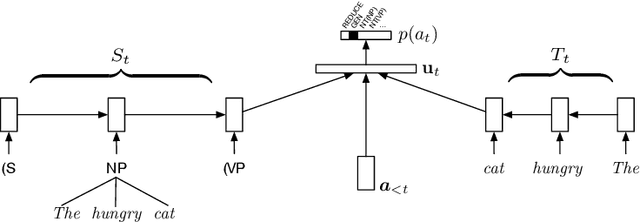
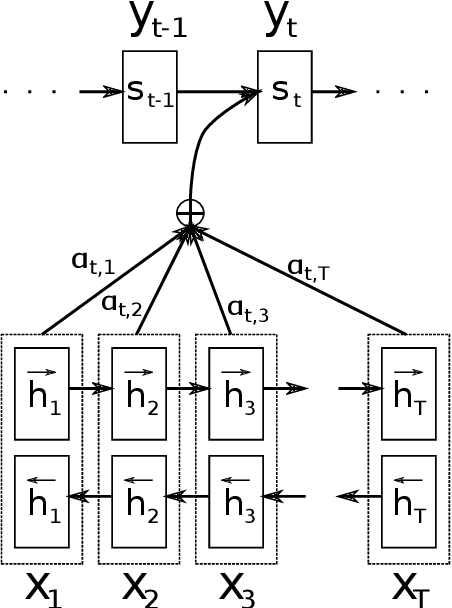
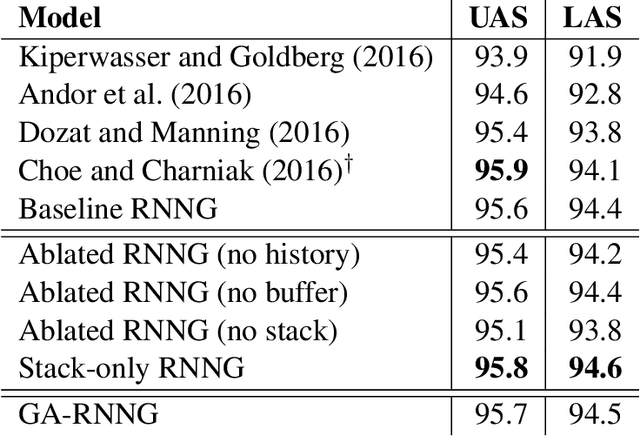

Recurrent neural network grammars (RNNG) are a recently proposed probabilistic generative modeling family for natural language. They show state-of-the-art language modeling and parsing performance. We investigate what information they learn, from a linguistic perspective, through various ablations to the model and the data, and by augmenting the model with an attention mechanism (GA-RNNG) to enable closer inspection. We find that explicit modeling of composition is crucial for achieving the best performance. Through the attention mechanism, we find that headedness plays a central role in phrasal representation (with the model's latent attention largely agreeing with predictions made by hand-crafted head rules, albeit with some important differences). By training grammars without nonterminal labels, we find that phrasal representations depend minimally on nonterminals, providing support for the endocentricity hypothesis.
Learning to Compose Words into Sentences with Reinforcement Learning
Nov 28, 2016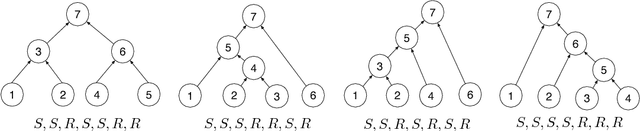
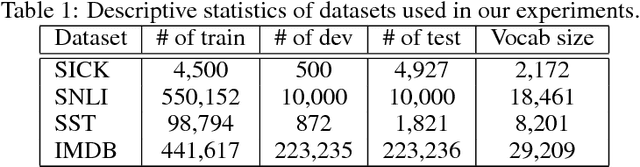
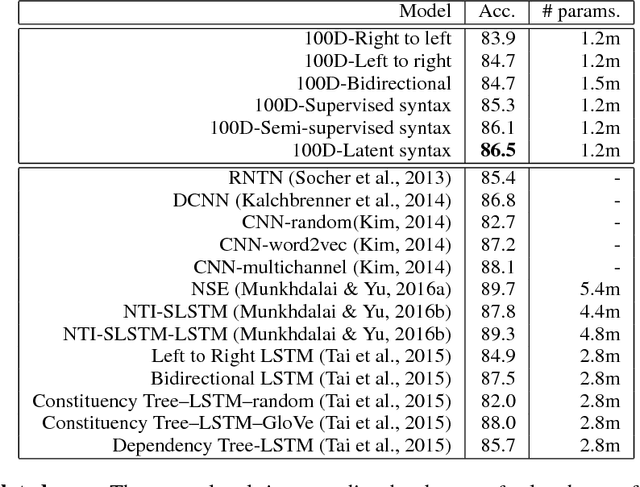
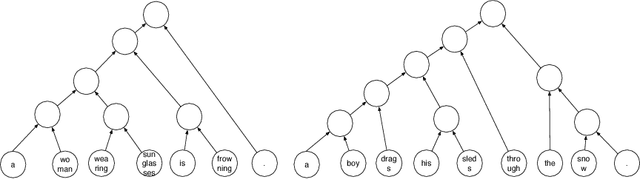
We use reinforcement learning to learn tree-structured neural networks for computing representations of natural language sentences. In contrast with prior work on tree-structured models in which the trees are either provided as input or predicted using supervision from explicit treebank annotations, the tree structures in this work are optimized to improve performance on a downstream task. Experiments demonstrate the benefit of learning task-specific composition orders, outperforming both sequential encoders and recursive encoders based on treebank annotations. We analyze the induced trees and show that while they discover some linguistically intuitive structures (e.g., noun phrases, simple verb phrases), they are different than conventional English syntactic structures.
Recurrent Neural Network Grammars
Oct 12, 2016
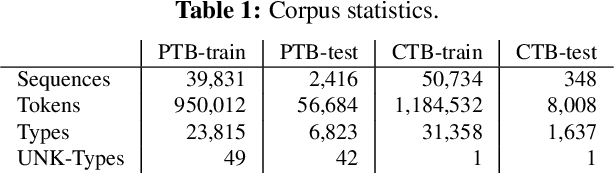
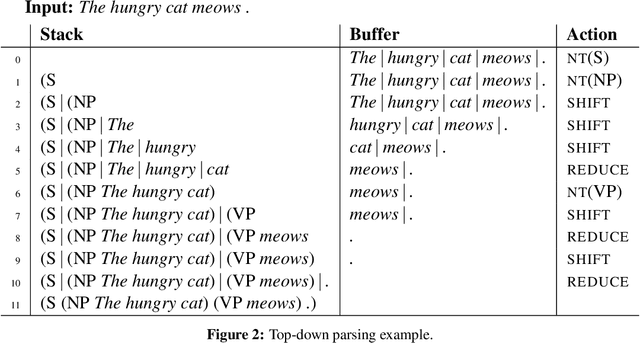
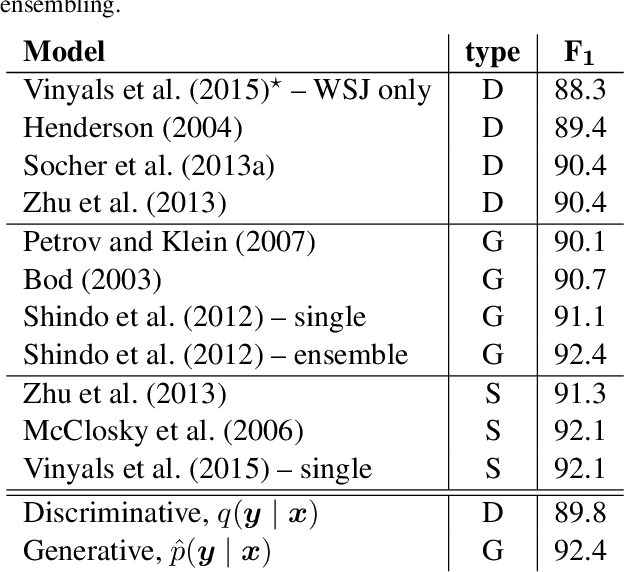
We introduce recurrent neural network grammars, probabilistic models of sentences with explicit phrase structure. We explain efficient inference procedures that allow application to both parsing and language modeling. Experiments show that they provide better parsing in English than any single previously published supervised generative model and better language modeling than state-of-the-art sequential RNNs in English and Chinese.
Semantic Parsing with Semi-Supervised Sequential Autoencoders
Sep 29, 2016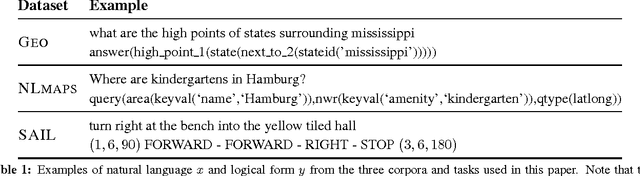

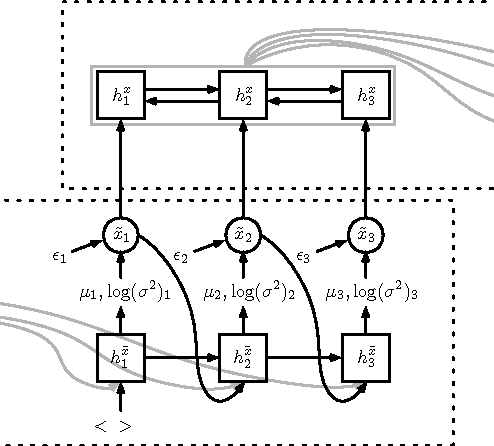
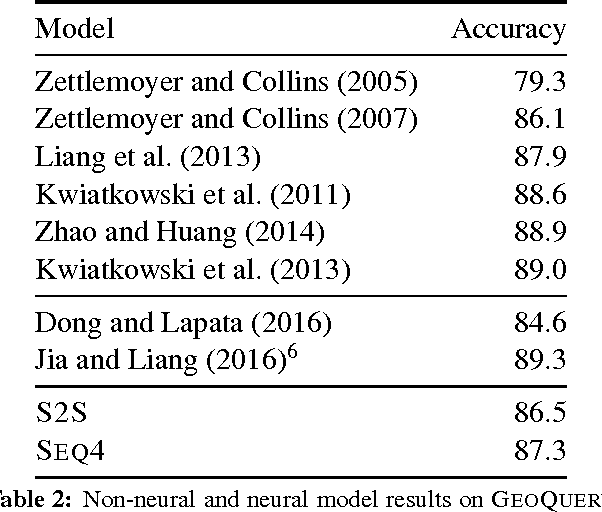
We present a novel semi-supervised approach for sequence transduction and apply it to semantic parsing. The unsupervised component is based on a generative model in which latent sentences generate the unpaired logical forms. We apply this method to a number of semantic parsing tasks focusing on domains with limited access to labelled training data and extend those datasets with synthetically generated logical forms.
Generalizing and Hybridizing Count-based and Neural Language Models
Sep 26, 2016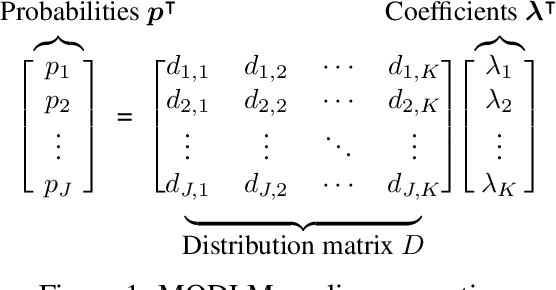
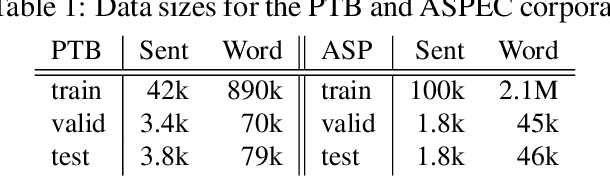
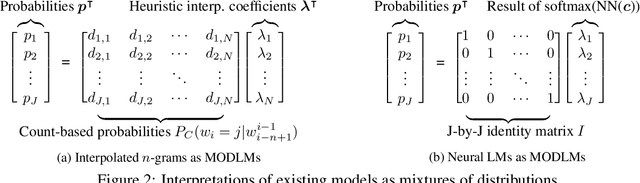
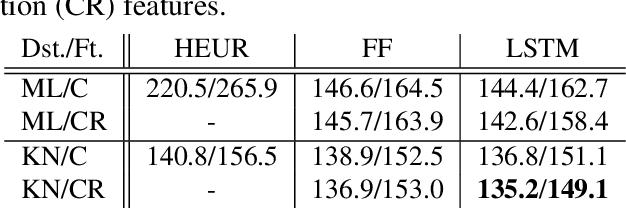
Language models (LMs) are statistical models that calculate probabilities over sequences of words or other discrete symbols. Currently two major paradigms for language modeling exist: count-based n-gram models, which have advantages of scalability and test-time speed, and neural LMs, which often achieve superior modeling performance. We demonstrate how both varieties of models can be unified in a single modeling framework that defines a set of probability distributions over the vocabulary of words, and then dynamically calculates mixture weights over these distributions. This formulation allows us to create novel hybrid models that combine the desirable features of count-based and neural LMs, and experiments demonstrate the advantages of these approaches.
Distilling an Ensemble of Greedy Dependency Parsers into One MST Parser
Sep 24, 2016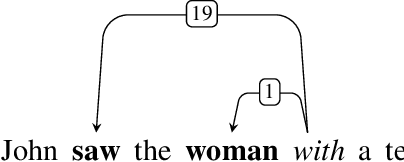
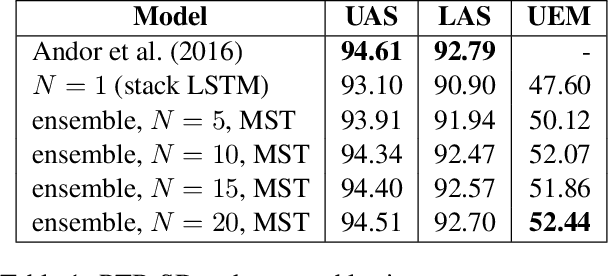


We introduce two first-order graph-based dependency parsers achieving a new state of the art. The first is a consensus parser built from an ensemble of independently trained greedy LSTM transition-based parsers with different random initializations. We cast this approach as minimum Bayes risk decoding (under the Hamming cost) and argue that weaker consensus within the ensemble is a useful signal of difficulty or ambiguity. The second parser is a "distillation" of the ensemble into a single model. We train the distillation parser using a structured hinge loss objective with a novel cost that incorporates ensemble uncertainty estimates for each possible attachment, thereby avoiding the intractable cross-entropy computations required by applying standard distillation objectives to problems with structured outputs. The first-order distillation parser matches or surpasses the state of the art on English, Chinese, and German.
Training with Exploration Improves a Greedy Stack-LSTM Parser
Sep 13, 2016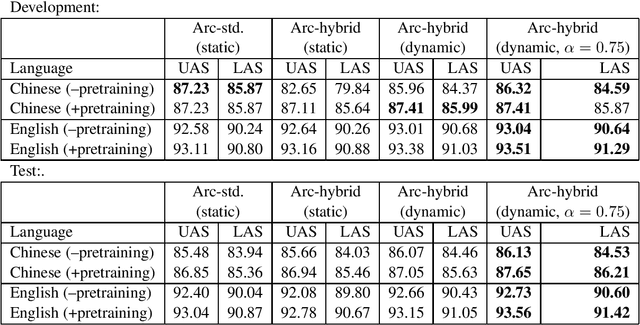
We adapt the greedy Stack-LSTM dependency parser of Dyer et al. (2015) to support a training-with-exploration procedure using dynamic oracles(Goldberg and Nivre, 2013) instead of cross-entropy minimization. This form of training, which accounts for model predictions at training time rather than assuming an error-free action history, improves parsing accuracies for both English and Chinese, obtaining very strong results for both languages. We discuss some modifications needed in order to get training with exploration to work well for a probabilistic neural-network.
Many Languages, One Parser
Jul 26, 2016We train one multilingual model for dependency parsing and use it to parse sentences in several languages. The parsing model uses (i) multilingual word clusters and embeddings; (ii) token-level language information; and (iii) language-specific features (fine-grained POS tags). This input representation enables the parser not only to parse effectively in multiple languages, but also to generalize across languages based on linguistic universals and typological similarities, making it more effective to learn from limited annotations. Our parser's performance compares favorably to strong baselines in a range of data scenarios, including when the target language has a large treebank, a small treebank, or no treebank for training.
Neural Machine Translation with Recurrent Attention Modeling
Jul 18, 2016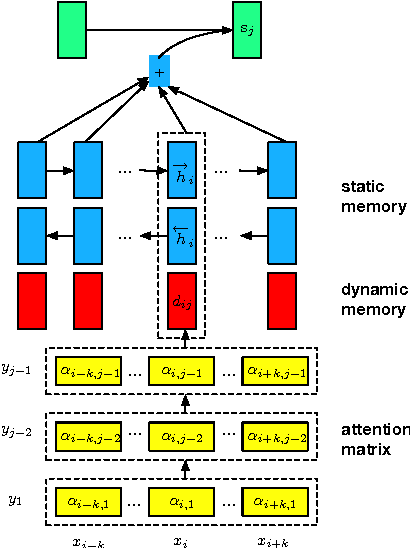
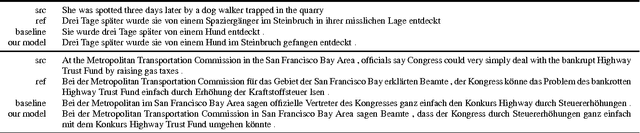
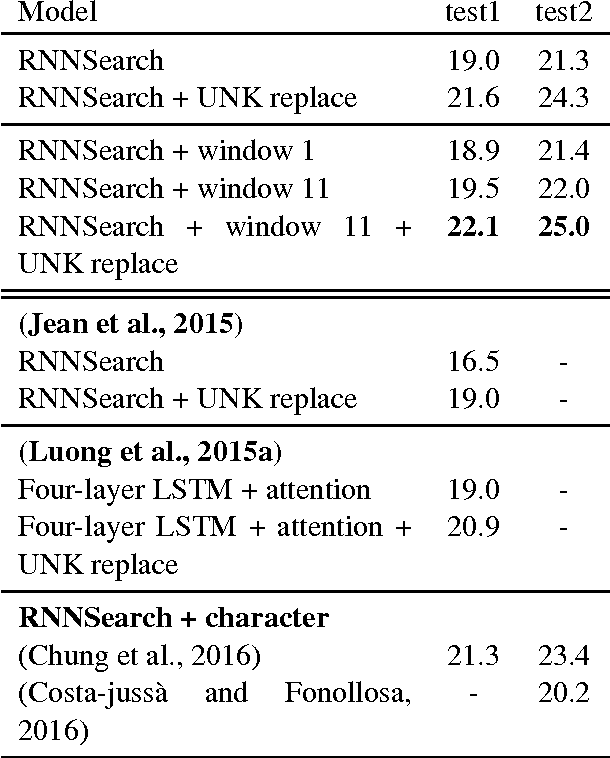
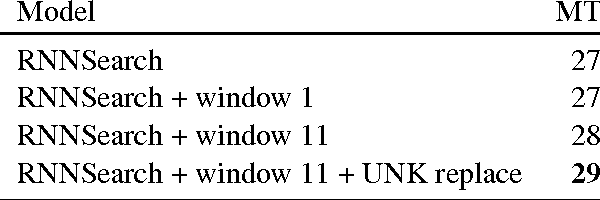
Knowing which words have been attended to in previous time steps while generating a translation is a rich source of information for predicting what words will be attended to in the future. We improve upon the attention model of Bahdanau et al. (2014) by explicitly modeling the relationship between previous and subsequent attention levels for each word using one recurrent network per input word. This architecture easily captures informative features, such as fertility and regularities in relative distortion. In experiments, we show our parameterization of attention improves translation quality.