 Add to Chrome
 Add to Firefox
 Add to Edge
Speech Meets ELF: Audio Conditional Continuous-Target Diffusion for Speech Recognition and Translation
Jun 09, 2026
Speech-to-text (S2T) systems for recognition (ASR) and translation (S2TT) typically generate discrete text tokens. In contrast, continuous-target language modelling performs generation in a continuous space, yet its potential for S2T remains unexplored. To bridge this gap, we propose ELF-S2T, an audio-conditioned continuous-target generative model for S2T. Built upon the pre-trained Embedded Language Flows (ELF) backbone, ELF-S2T processes speech via a frozen Whisper encoder and a single linear projector, prepending the resulting audio condition to the noisy text latent for in-context, flow-matching denoising. To prevent the model from over-relying on its pre-trained text context, we introduce audio forcing during training, and further amplify the audio condition via classifier-free guidance at inference. Experiments on LibriSpeech and CoVoST2 show that ELF-S2T achieves competitive ASR and S2TT performance. Crucially, our error analysis reveals that, although ASR and S2TT errors look very different on the surface, both stem from the same underlying cause, a close distance confusion in the continuous latent space. This finding naturally aligns with the continuous representation generation paradigm, indicating a common semantic mapping process beneath recognition and translation. Our code and pretrained models are publicly available at https://github.com/Sslnon/ELF-S2T.

Separate First, Fuse Later: Mitigating Cross-Modal Interference in Audio-Visual LLMs Reasoning with Modality-Specific Chain-of-Thought
May 11, 2026Audio and vision provide complementary evidence for audio-visual question answering, yet current audio-visual large language models may suffer from cross-modal interference: information from one modality misguides the interpretation of another, thereby inducing hallucinations. We attribute this issue to uncontrolled cross-modal interactions during intermediate reasoning. To mitigate this, we propose Separate First, Fuse Later (SFFL), an audio-visual reasoning framework designed to reduce cross-modal interference. SFFL enforces modality-specific chain-of-thought reasoning, producing separate audio and visual reasoning traces and integrating evidence for answering. We construct modality-preference labels via a data pipeline under different modality input settings. We use these labels as an auxiliary reward in reinforcement learning to encourage a instance-dependent preference for modality cues when answering. We further introduce a modality-specific reasoning mechanism that preserves modality isolation during the separated reasoning stage while enabling full access to cross-modal information at the evidence fusion stage. Experiments demonstrate consistent improvements in both accuracy and robustness, yielding an average relative gain of 5.16\% on general AVQA benchmarks and 11.17\% on a cross-modal hallucination benchmark.
Evaluating the Expressive Appropriateness of Speech in Rich Contexts
May 10, 2026Evaluating expressive speech remains challenging, as existing methods mainly assess emotional intensity and overlook whether a speech sample is expressively appropriate for its contextual setting. This limitation hinders reliable evaluation of speech systems used in narrative-driven and interactive applications, such as audiobooks and conversational agents. We introduce CEAEval, a Context-rich framework for Evaluating Expressive Appropriateness in speech, which assesses whether a speech sample expressively aligns with the underlying communicative intent implied by its discourse-level narrative context. To support this task, we construct CEAEval-D, the first context-rich speech dataset with real human performances in Mandarin conversational speech, providing narrative descriptions together with fifteen dimensions of human annotations covering expressive attributes and expressive appropriateness. We further develop CEAEval-M, a model that integrates knowledge distillation, planner-based multi-model collaboration, adaptive audio attention bias, and reinforcement learning to perform context-rich expressive appropriateness evaluation. Experiments on a human-annotated test set demonstrate that CEAEval-M substantially outperforms existing speech evaluation and analysis systems.
MSR-HuBERT: Self-supervised Pre-training for Adaptation to Multiple Sampling Rates
Mar 24, 2026Self-supervised learning (SSL) has advanced speech processing. However, existing speech SSL methods typically assume a single sampling rate and struggle with mixed-rate data due to temporal resolution mismatch. To address this limitation, we propose MSRHuBERT, a multi-sampling-rate adaptive pre-training method. Building on HuBERT, we replace its single-rate downsampling CNN with a multi-sampling-rate adaptive downsampling CNN that maps raw waveforms from different sampling rates to a shared temporal resolution without resampling. This design enables unified mixed-rate pre-training and fine-tuning. In experiments spanning 16 to 48 kHz, MSRHuBERT outperforms HuBERT on speech recognition and full-band speech reconstruction, preserving high-frequency detail while modeling low-frequency semantic structure. Moreover, MSRHuBERT retains HuBERT's mask-prediction objective and Transformer encoder, so existing analyses and improvements that were developed for HuBERT can apply directly.
Covo-Audio Technical Report
Feb 10, 2026In this work, we present Covo-Audio, a 7B-parameter end-to-end LALM that directly processes continuous audio inputs and generates audio outputs within a single unified architecture. Through large-scale curated pretraining and targeted post-training, Covo-Audio achieves state-of-the-art or competitive performance among models of comparable scale across a broad spectrum of tasks, including speech-text modeling, spoken dialogue, speech understanding, audio understanding, and full-duplex voice interaction. Extensive evaluations demonstrate that the pretrained foundation model exhibits strong speech-text comprehension and semantic reasoning capabilities on multiple benchmarks, outperforming representative open-source models of comparable scale. Furthermore, Covo-Audio-Chat, the dialogue-oriented variant, demonstrates strong spoken conversational abilities, including understanding, contextual reasoning, instruction following, and generating contextually appropriate and empathetic responses, validating its applicability to real-world conversational assistant scenarios. Covo-Audio-Chat-FD, the evolved full-duplex model, achieves substantially superior performance on both spoken dialogue capabilities and full-duplex interaction behaviors, demonstrating its competence in practical robustness. To mitigate the high cost of deploying end-to-end LALMs for natural conversational systems, we propose an intelligence-speaker decoupling strategy that separates dialogue intelligence from voice rendering, enabling flexible voice customization with minimal text-to-speech (TTS) data while preserving dialogue performance. Overall, our results highlight the strong potential of 7B-scale models to integrate sophisticated audio intelligence with high-level semantic reasoning, and suggest a scalable path toward more capable and versatile LALMs.
POTSA: A Cross-Lingual Speech Alignment Framework for Low Resource Speech-to-Text Translation
Nov 12, 2025Speech Large Language Models (SpeechLLMs) have achieved breakthroughs in multilingual speech-to-text translation (S2TT). However, existing approaches often overlook semantic commonalities across source languages, leading to biased translation performance. In this work, we propose \textbf{POTSA} (Parallel Optimal Transport for Speech Alignment), a new framework based on cross-lingual parallel speech pairs and Optimal Transport (OT), designed to bridge high- and low-resource translation gaps. First, we introduce a Bias Compensation module to coarsely align initial speech representations across languages. Second, we impose token-level OT constraints on a Q-Former using parallel speech pairs to establish fine-grained consistency of representations. Then, we apply a layer scheduling strategy to focus OT constraints on the most semantically beneficial layers. Experiments on the FLEURS dataset show that our method achieves SOTA performance, with +0.93 BLEU on average over five common languages and +5.05 BLEU on zero-shot languages, using only 10 hours of parallel speech per source language.
Characteristic-Specific Partial Fine-Tuning for Efficient Emotion and Speaker Adaptation in Codec Language Text-to-Speech Models
Jan 24, 2025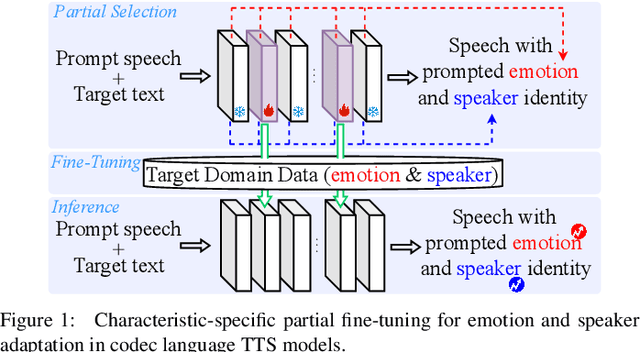
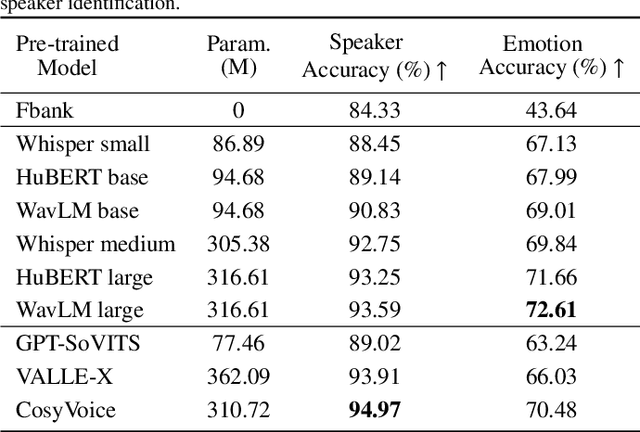
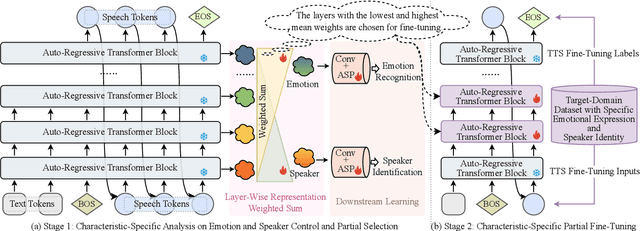
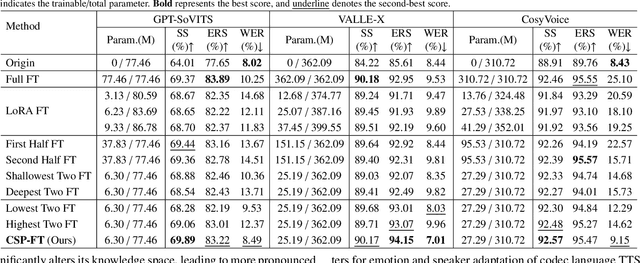
Recently, emotional speech generation and speaker cloning have garnered significant interest in text-to-speech (TTS). With the open-sourcing of codec language TTS models trained on massive datasets with large-scale parameters, adapting these general pre-trained TTS models to generate speech with specific emotional expressions and target speaker characteristics has become a topic of great attention. Common approaches, such as full and adapter-based fine-tuning, often overlook the specific contributions of model parameters to emotion and speaker control. Treating all parameters uniformly during fine-tuning, especially when the target data has limited content diversity compared to the pre-training corpus, results in slow training speed and an increased risk of catastrophic forgetting. To address these challenges, we propose a characteristic-specific partial fine-tuning strategy, short as CSP-FT. First, we use a weighted-sum approach to analyze the contributions of different Transformer layers in a pre-trained codec language TTS model for emotion and speaker control in the generated speech. We then selectively fine-tune the layers with the highest and lowest characteristic-specific contributions to generate speech with target emotional expression and speaker identity. Experimental results demonstrate that our method achieves performance comparable to, or even surpassing, full fine-tuning in generating speech with specific emotional expressions and speaker identities. Additionally, CSP-FT delivers approximately 2x faster training speeds, fine-tunes only around 8% of parameters, and significantly reduces catastrophic forgetting. Furthermore, we show that codec language TTS models perform competitively with self-supervised models in speaker identification and emotion classification tasks, offering valuable insights for developing universal speech processing models.